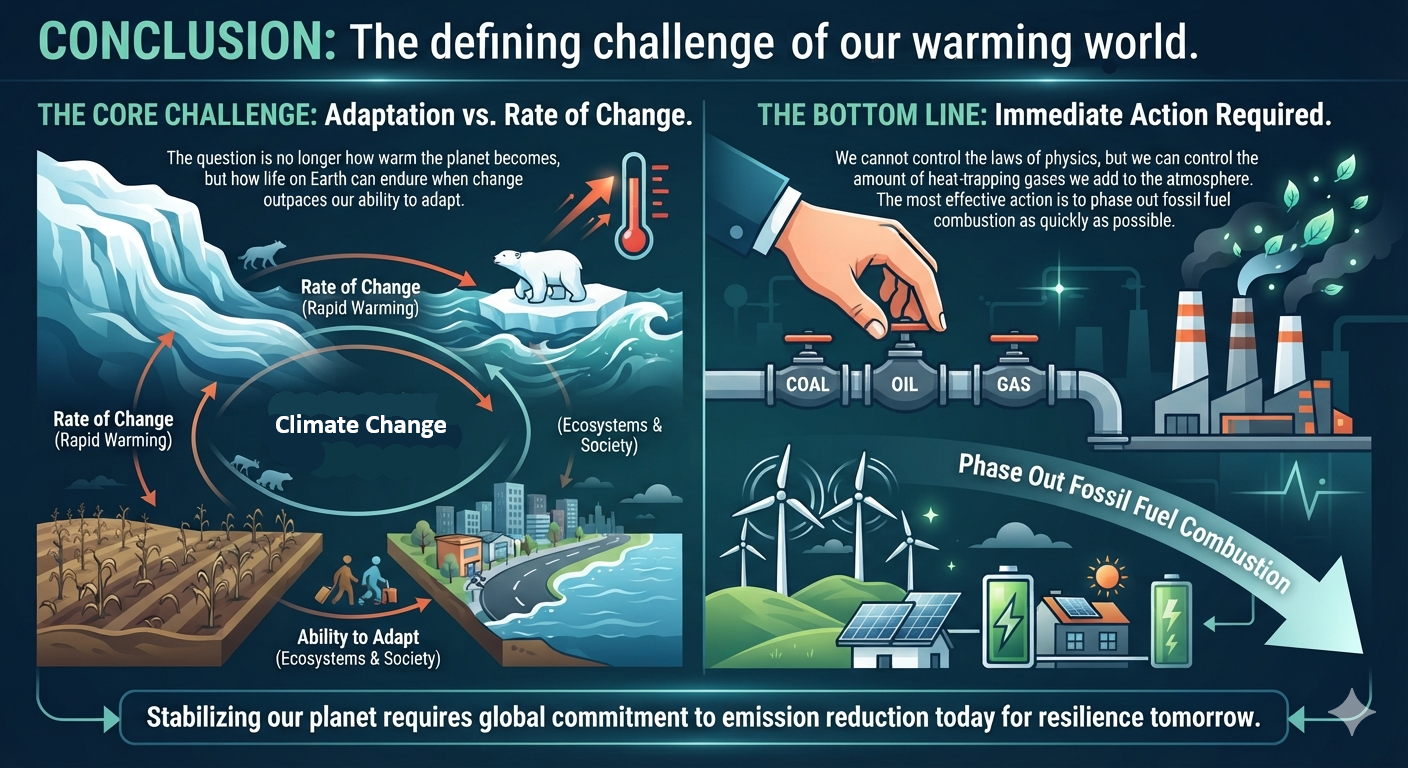
We cannot control the laws of physics, but we can control our pollution. The most effective action is to stop burning fossil fuels.
Introduction
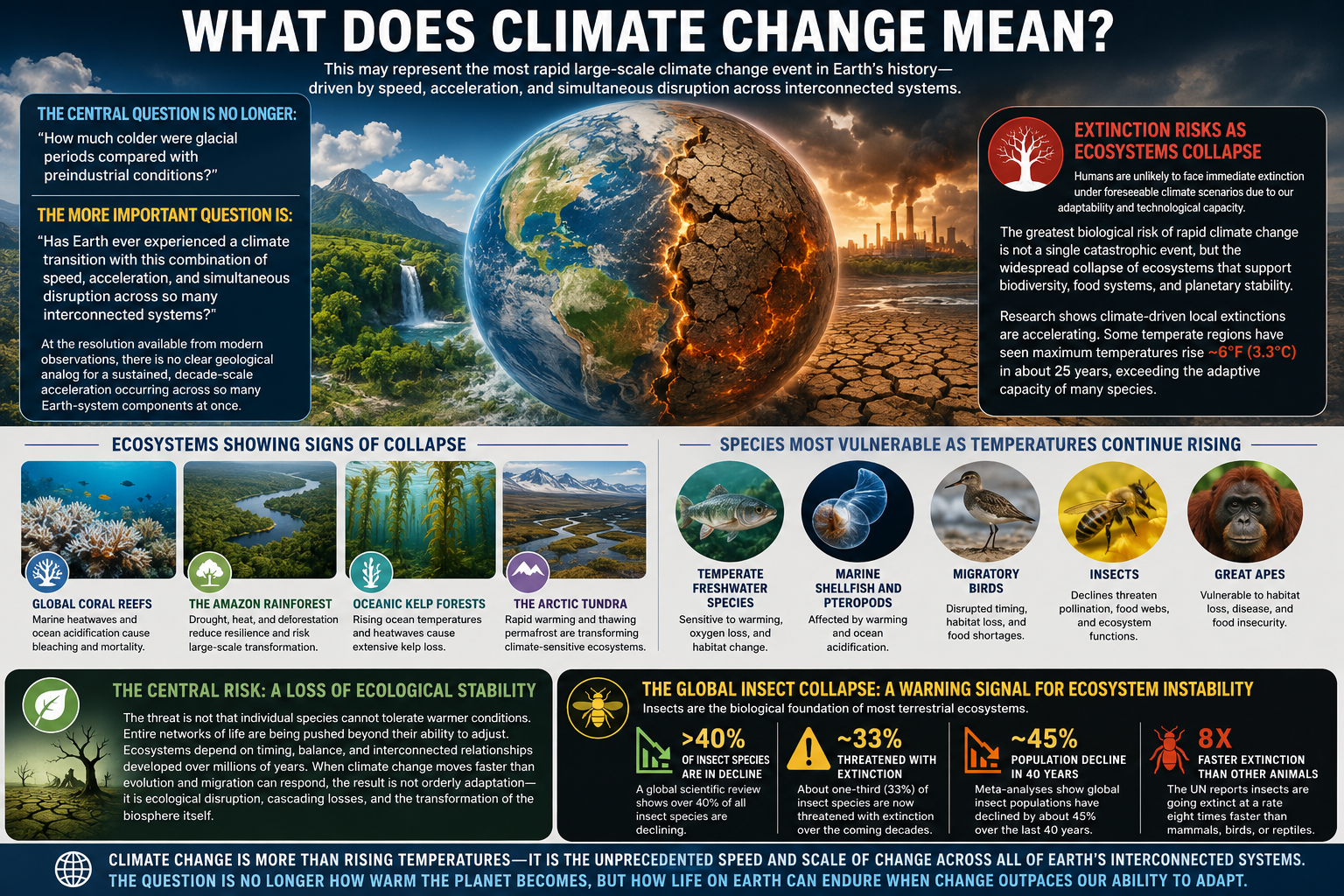
The central question is no longer:
Q: “How Fast Is the Earth Warming?”
The more important question is:
Q: “Has Earth ever experienced a climate change with this combination of speed, acceleration, and simultaneous disruption across Earth?”
A: No.
There is no comparison in the geological record. The present is revealing a system changing at a rate that may be outside the range experienced throughout human civilization and perhaps for millions of years.
Q: “What Are the Immediate Impacts?”
A: More extreme weather.
Severe weather is becoming more frequent, more intense, and more persistent, with extreme events lasting longer and affecting larger areas.
Bottom line: We cannot control the laws of physics, but we can control the amount of heat-trapping gases we add to the atmosphere. The most effective action is to phase out fossil fuel combustion as quickly as possible.
Q: What Causes Climate Change?
A: Human activities.
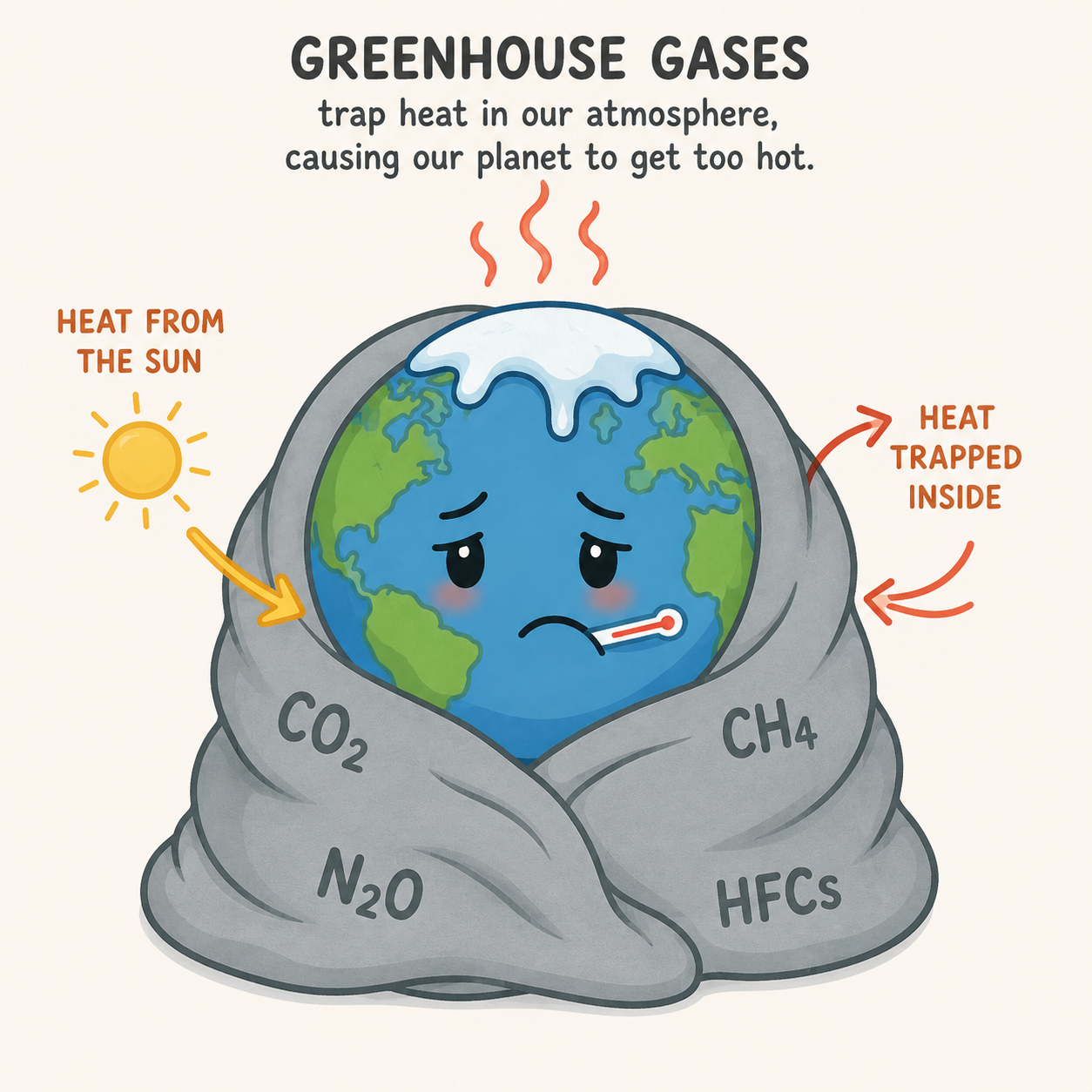
The primary driver of modern global warming is the increase in greenhouse gases released through human activities, especially the burning of fossil fuels. Carbon dioxide (CO2) and other greenhouse gases act like an insulating layer in the atmosphere, absorbing and re-emitting infrared radiation. This slows the loss of heat from Earth to space, creating an energy imbalance that causes the planet to warm.
Q: What Is Climate Change?
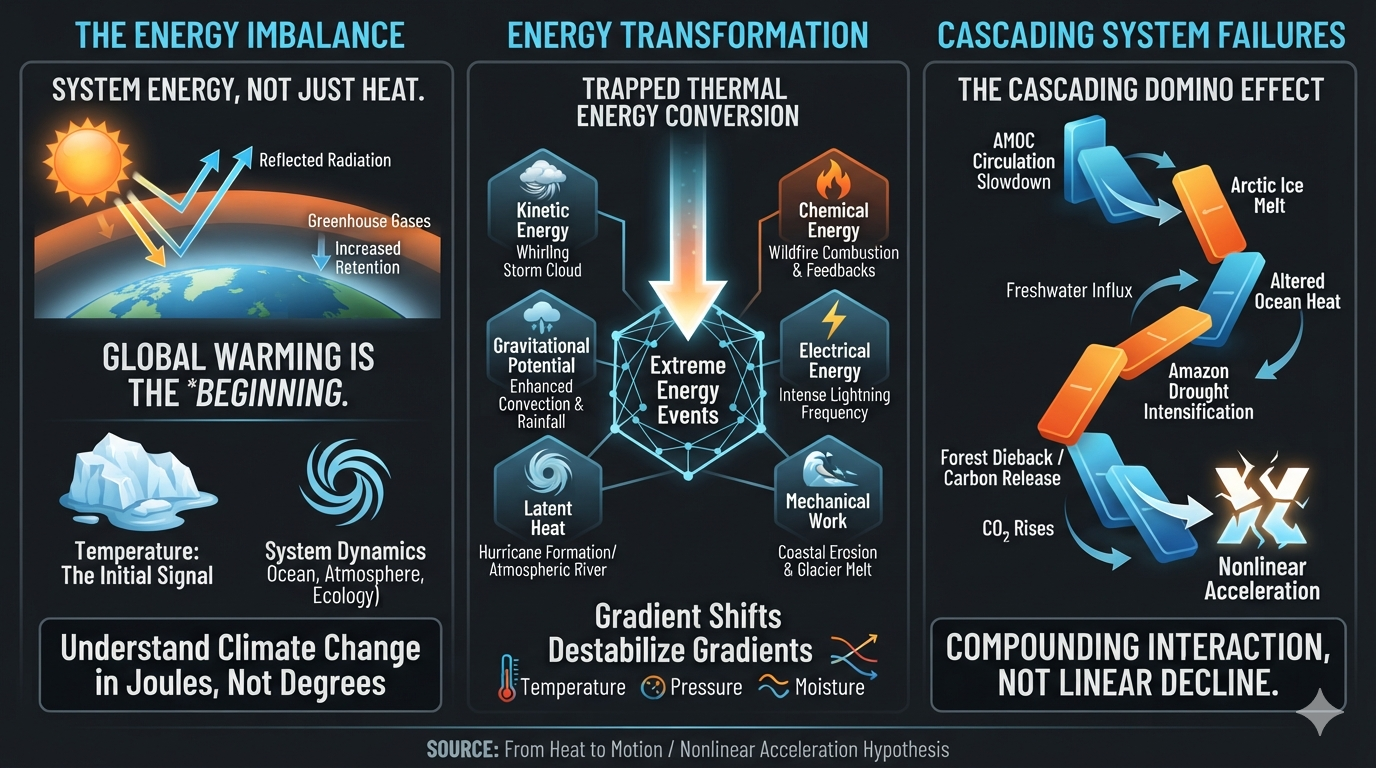
A: Climate change is energy transfer.
The phrase “global warming” is often misunderstood. While it correctly describes rising average temperatures, it does not tell the whole story. The real issue is the rapid buildup and movement of extra heat energy throughout Earth’s climate system.
Global warming is the beginning of climate change—not the end of it.
When greenhouse gases trap additional heat, that energy does not simply make the air warmer. It is continually transformed into other forms of energy, including:
More than 90% of this excess heat is absorbed by the oceans, not the atmosphere. The oceans act like a giant heat reservoir, storing energy and releasing it slowly over time. Because of this thermal inertia, the climate can continue changing even if emissions begin to decline.
By 2025, global temperatures had exceeded the long-recognized 1.5°C (2.7°F) warming threshold. To many people, an increase of 1.5°C may sound small. In Earth’s climate system, it is not.
Small increases in average temperature can produce much larger changes in temperature differences, air pressure, and atmospheric moisture. These changes alter weather patterns, intensify storms, increase heavy rainfall, and make many extreme events more severe.
What we are witnessing are not simply isolated weather events. They are increasingly extreme energy events occurring within an interconnected Earth system.
To understand climate change, it helps to think not only in terms of degrees of warming, but also in terms of joules of energy and how that energy moves through the atmosphere, oceans, ice, and living ecosystems.
Q: How Fast Is the Climate Changing?
A: The climate appears to be changing at an exceptionally rapid pace—faster than at any time in human history and possibly faster than at any time in the past several million years.
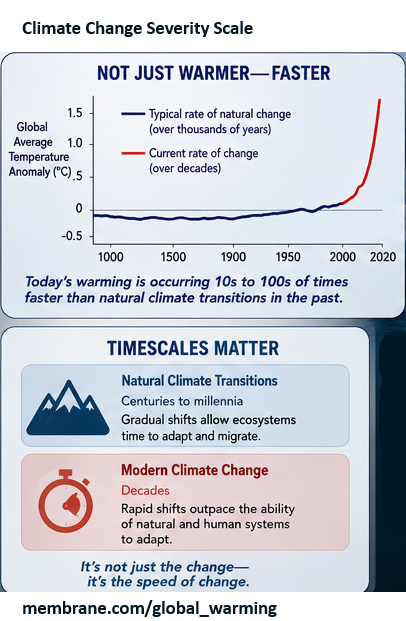
Many past climate transitions unfolded over centuries, thousands of years, or longer. The modern climate system is experiencing simultaneous changes across the atmosphere, oceans, cryosphere, and biosphere over time scales measured in decades.
Climate change is often measured in degrees, but degrees alone cannot describe the full magnitude of the transformation now underway. The defining feature of the modern climate system is not simply that Earth is warmer than it was in the past, but that multiple components of the Earth system are changing simultaneously at rates that challenge the ability of natural systems, ecosystems, and human societies to adapt.
Historical climate records remain essential for understanding how the planet responds to changes in energy balance. However, the current climate trajectory represents a fundamentally different challenge: a rapidly accelerating transition occurring across the atmosphere, oceans, cryosphere, and biosphere within decades rather than centuries or millennia. The question is no longer only how much the climate has changed, but how quickly the rate of change itself is increasing and how those changes interact through a highly connected planetary system.
The past reveals what climate systems can do.
The present is revealing a system changing at a rate that may be outside the range experienced throughout human civilization and perhaps for millions of years.

Climate change is often framed around a simple comparison:
How much colder were ice ages than the climate before the Industrial Revolution?
While historical temperature comparisons remain scientifically important, they no longer capture the most significant feature of modern climate change.
The more important question today is:
Has Earth ever experienced a climate transition with this combination of speed, acceleration, and simultaneous disruption across so many interconnected systems?
Based on modern observations, there is no clear geological example of a sustained, decade-scale acceleration occurring simultaneously across numerous components of the Earth system. Rising temperatures are occurring alongside accelerating changes in oceans, ice sheets, ecosystems, atmospheric moisture, and extreme weather patterns. It is this convergence of rapid changes—not temperature alone—that defines the modern climate era. This may represent the most rapid large-scale climate change event in Earth’s history, based on the rate and simultaneous disruption now being observed across multiple interconnected Earth systems.
Humans are unlikely to face immediate extinction under foreseeable climate scenarios. Our species possesses technological capabilities, global communication networks, and a remarkable ability to adapt to changing conditions.
Many other species, however, do not have those advantages.
The greatest biological danger posed by rapid climate change is not a single catastrophic event. It is the gradual breakdown of ecosystems that support biodiversity, food production, and the stability of the biosphere itself.
Research increasingly shows that climate-driven local extinctions are accelerating. Some temperate regions have experienced unexpectedly high biodiversity losses associated with rapidly increasing temperature extremes. In certain areas, maximum temperatures have risen by approximately 6°F (3.3°C) in only about 25 years, creating environmental conditions that exceed the ability of many species to adapt or migrate.
Several major ecosystems are exhibiting characteristics consistent with ecological disruption and increasing instability:
Some groups of organisms appear particularly vulnerable because they occupy narrow ecological niches or depend on highly synchronized environmental conditions.
Among the most at-risk are:
The loss of these organisms can have consequences far beyond individual extinctions because each species is connected to larger ecological networks.
The defining danger of rapid climate change is not simply that individual species cannot survive warmer temperatures.
The larger threat is that entire networks of life are being pushed beyond their capacity to adjust.
Ecosystems depend on timing, balance, and intricate relationships that evolved over millions of years. Plants flower at specific times to coincide with pollinators. Predators and prey maintain dynamic balances. Migratory species depend on seasonal cues that have remained relatively stable throughout human history.
When climate change occurs faster than evolution, migration, and adaptation can respond, ecosystems do not smoothly transition to new conditions. Instead, they experience disruption, cascading losses, and fundamental reorganization.
The result is not merely a warmer planet. It is the transformation of the biosphere itself.
One of the clearest indicators of accelerating ecological disruption is the worldwide decline of insect populations.
Insects form the biological foundation of most terrestrial ecosystems. They pollinate crops and wild plants, decompose organic material, recycle nutrients, and provide food for countless birds, fish, amphibians, reptiles, and mammals.
Scientific studies paint a concerning picture:
Because insects support so many ecological processes, their decline serves as an early warning signal of broader ecosystem instability. Reduced pollination, disrupted food webs, and diminished nutrient cycling can trigger cascading effects that extend throughout the biosphere.
Climate change is often discussed in terms of global average temperature—1°C, 2°C, or 3°C of warming. But the defining characteristic of the modern climate system is not simply how warm the planet becomes.
It is the unprecedented pace of change and the simultaneous disruption occurring across interconnected physical and biological systems.
The central question of climate change is therefore no longer:
“How different is today’s temperature from the past?”
The more consequential question is:
“How do ecosystems and societies respond when multiple Earth systems begin changing faster than they can adapt?”
The answer to that question may determine not only the future of individual species, but the stability of the biosphere upon which human civilization ultimately depends.
Conclusion
The question is no longer how warm the planet becomes, but how life on Earth can endure when change outpaces our ability to adapt.
Bottom line: We cannot control the laws of physics, but we can control the amount of heat-trapping gases we add to the atmosphere. The most effective action is to phase out fossil fuel combustion as quickly as possible.
* Our probabilistic, ensemble-based climate model — which incorporates complex socio-economic and ecological feedback loops within a dynamic, nonlinear system — projects that global temperatures are becoming unsustainable this century. This far exceeds earlier estimates of a 4°C rise over the next thousand years, highlighting a dramatic acceleration in global warming. We are now entering a phase of compound, cascading collapse, where climate, ecological, and societal systems destabilize through interlinked, self-reinforcing feedback loops.
We examine how human activities — such as deforestation, fossil fuel combustion, mass consumption, industrial agriculture, and land development — interact with ecological processes like thermal energy redistribution, carbon cycling, hydrological flow, biodiversity loss, and the spread of disease vectors. These interactions do not follow linear cause-and-effect patterns. Instead, they form complex, self-reinforcing feedback loops that can trigger rapid, system-wide transformations — often abruptly and without warning. Grasping these dynamics is crucial for accurately assessing global risks and developing effective strategies for long-term survival.