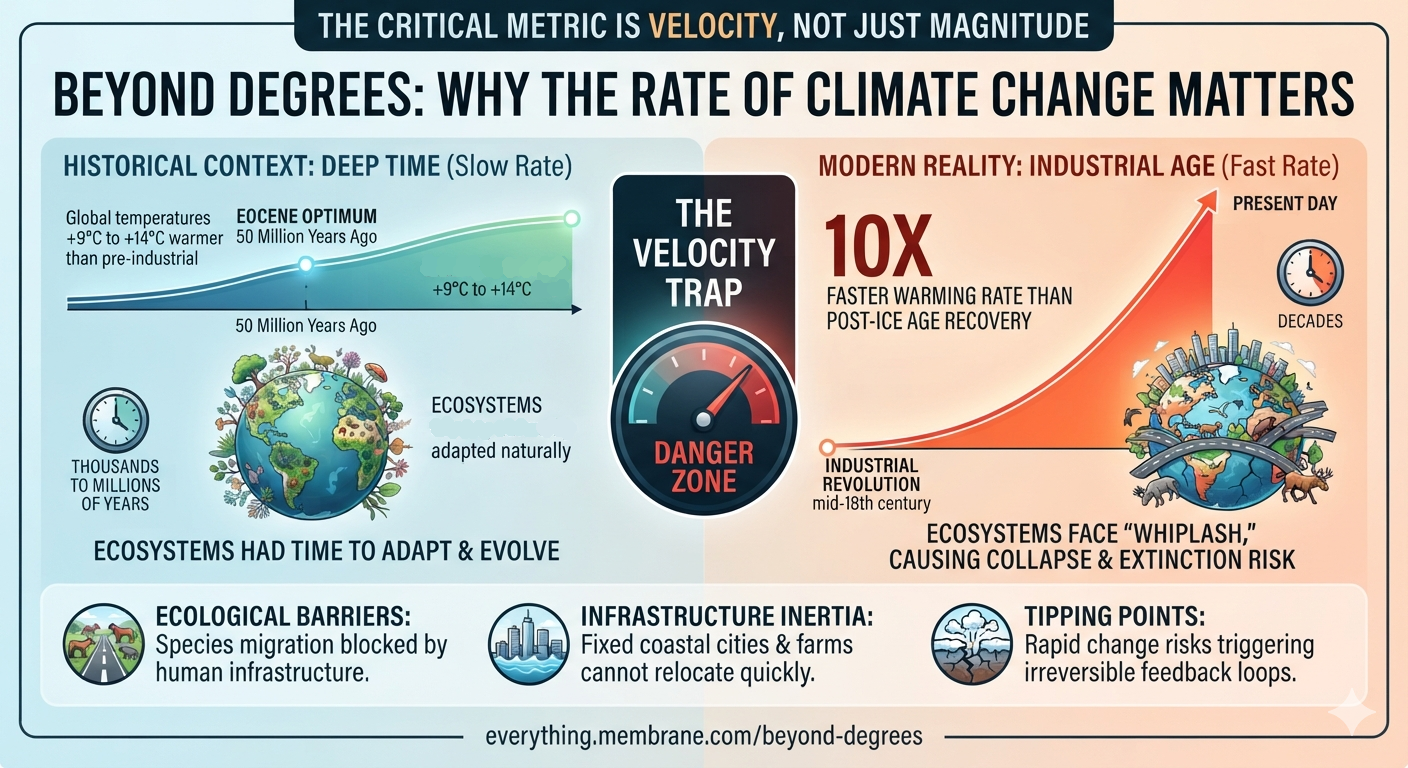
Climate change is often framed around a simple question: How much warmer is the planet compared with the past? While global temperature remains an important indicator, it does not fully capture the defining characteristic of the modern climate system.
The more fundamental shift is not only the magnitude of warming, but the rate, acceleration, and changing dynamics of the Earth system. If the Earth has not experienced a comparable rate of climate-system acceleration over millions of years, then historical records provide increasingly limited predictive value for the future. They tell us how the climate system responded under previous conditions, but they may not accurately describe how a rapidly accelerating, highly coupled system will behave under unprecedented rates of change.
At the same time, many of the climate indicators traditionally used for forecasting are exhibiting increasingly nonlinear and volatile behavior. Temperature anomalies, ocean heat content, sea-level rise, atmospheric moisture, ice loss, and extreme weather patterns are showing changes that are becoming more difficult to model using assumptions based primarily on historical variability.
The challenge is not that these indicators have lost their value—they remain essential observations of the Earth system. The challenge is that a climate regime undergoing rapid acceleration and increasing feedback coupling may behave differently from the relatively stable climate conditions on which many traditional predictive approaches were developed.
Historical climate records, including glacial cycles, provide essential context for understanding how the planet has responded to major changes in energy balance. However, their predictive power becomes increasingly limited when the current climate regime begins to operate outside the conditions and time scales represented in those records.
The defining feature of today’s climate change is not merely that the planet is warming. It is that the system is changing rapidly, with multiple interconnected components accelerating simultaneously.
The geological record tells us that Earth’s climate has changed dramatically many times before. During glacial periods, global average temperatures were several degrees colder than preindustrial conditions, and transitions between climate states reshaped ice sheets, oceans, ecosystems, and atmospheric circulation.
Those records remain valuable for understanding climate sensitivity, feedback mechanisms, and long-term Earth-system behavior.
However, the question facing modern civilization is not simply whether Earth has been warmer or colder in the past. The more important question is whether previous transitions occurred at a comparable rate of change.
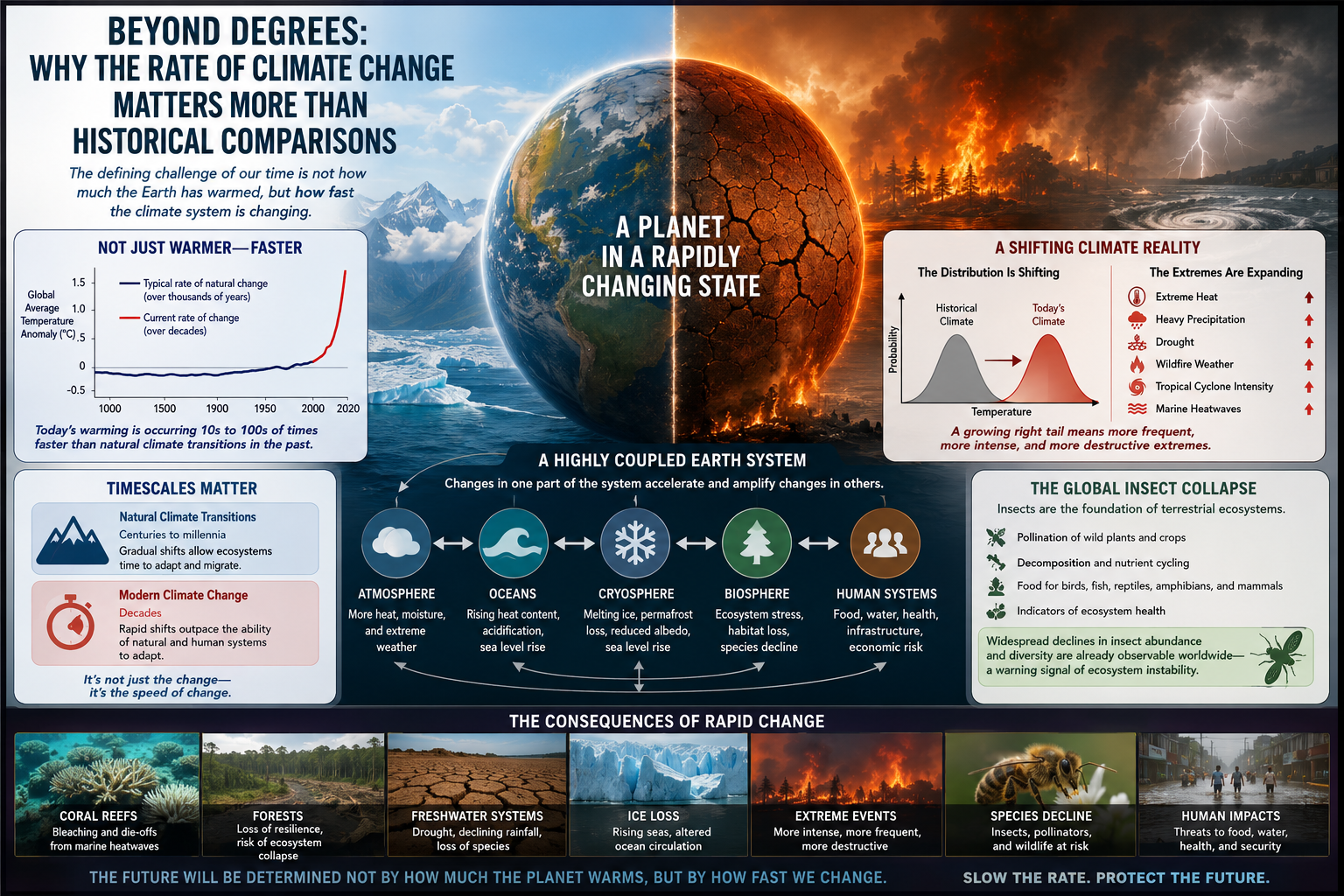
Many past climate transitions unfolded over centuries, thousands of years, or longer. The modern climate system is experiencing simultaneous changes across the atmosphere, oceans, cryosphere, and biosphere over time scales measured in decades.
This difference in timescale fundamentally changes the problem.
Climate change is commonly described as an increase in average global temperature. While accurate, this description captures only one dimension of a much larger transformation.
The climate system is better understood as a complex, dynamic system whose behavior depends not only on its current state, but also on how quickly that state is changing.
The key question is no longer only:
How much has temperature increased?
It is also:
How quickly is the rate of change itself changing?
This introduces the importance of higher-order dynamics, including acceleration and the changing acceleration of climate variables. In physics, the third derivative of position is known as “jerk.” Applied conceptually to climate dynamics, it represents a system in which the acceleration of change is itself becoming nonlinear.
A system exhibiting increasing jerk is not simply moving toward a new state—it is moving toward that state at an increasingly rapid pace.
The most visible consequence of this changing climate regime is not just a warmer average. It is a transformation of the entire probability distribution of climate events.
The temperature distribution is shifting toward warmer conditions while becoming increasingly right-skewed.
This means two things are happening simultaneously:
A simple shift of the entire distribution would produce a warmer climate. A growing right tail produces something more disruptive: a climate system increasingly capable of generating events beyond the historical range of experience.
The same principle applies beyond temperature.
As the distribution of climate states changes, the probability of extreme events shifts as well:
These are not simply warmer versions of historical weather events. They are manifestations of a changing statistical regime.
Early climate analysis often focused on individual indicators:
These measurements remain essential, but they are increasingly insufficient as standalone descriptions of system behavior.
The Earth system is not a collection of independent variables. It is a network of interacting components connected through feedback loops.
For example:
Polar amplification weakens equator-to-pole temperature gradients, affecting atmospheric circulation. Changes in circulation influence jet stream behavior and storm tracks. Altered weather patterns affect drought, flooding, agriculture, ecosystems, and human infrastructure. Ice loss changes freshwater distribution, ocean circulation, and planetary energy balance.
Each component influences the others.
As these connections strengthen, the behavior of the entire system becomes more important than any single measurement.
The initial approach to understanding accelerating climate impacts focused on individual indicators and their changing growth rates, including the concept of shrinking effective doubling times.
The next step is moving beyond retrospective curve fitting toward a state-space view of Earth-system evolution.
This perspective asks:
The objective is not merely to measure a warmer planet, but to characterize the evolving dynamics of a coupled Earth system.
The historical record tells us that Earth’s climate can change dramatically. It provides a foundation for understanding climate sensitivity and feedback processes.
But the modern challenge is different.
The central question is no longer:
“How much colder were glacial periods compared with preindustrial conditions?”
The more important question is:
“Has Earth ever experienced a climate transition with this combination of speed, acceleration, and simultaneous disruption across multiple interconnected systems?”
At the resolution available from modern observations, there is no clear geological analog for a sustained, decade-scale acceleration occurring across so many Earth-system components at once.
The past reveals what climate systems can do.
The present is revealing a system changing at a rate that may be outside the range experienced throughout human civilization and perhaps for millions of years.
Although humans are unlikely to face immediate extinction under foreseeable climate scenarios due to our adaptability and technological capacity, the same cannot be said for many other species. The greatest biological risk of rapid climate change is not a single catastrophic event, but the widespread collapse of ecosystems that support biodiversity, food systems, and planetary stability.
The concept of “ecological whiplash” captures one of the defining dangers of climate change: the speed of environmental transformation. When climate conditions shift over decades rather than thousands of years, species are forced into a mismatch between the environments that shaped their evolution and the rapidly changing physical world around them. Instead of a gradual transition toward a new equilibrium, ecosystems can experience abrupt destabilization as food webs fracture, habitats disappear, and critical relationships between species break down.
Recent research indicates that climate-driven local extinctions are accelerating, with some temperate regions experiencing unexpectedly high biodiversity losses. These changes are strongly associated with rapid increases in temperature extremes, including a reported 6°F rise in maximum temperatures over roughly 25 years in some affected regions, creating conditions that exceed the adaptive capacity of many species.
Global Coral Reefs
Marine heatwaves are triggering widespread coral bleaching events across the planet. When ocean temperatures become too high, corals expel the symbiotic algae that provide most of their energy, leaving them weakened and vulnerable to mass mortality. Repeated bleaching events reduce recovery time and threaten the long-term survival of reef ecosystems.
The Amazon Rainforest
Rising temperatures, changing precipitation patterns, and increasing drought stress are pushing portions of the Amazon toward ecological fragmentation. As forests lose moisture and resilience, some regions risk transitioning from rainforest ecosystems into degraded savannah-like landscapes, reducing biodiversity and weakening one of Earth’s largest carbon sinks.
Oceanic Kelp Forests
Rapid ocean warming, combined with ecological disruptions such as predator loss, has caused widespread kelp forest declines. In some regions, once-thriving underwater forests have been replaced by barren “urchin barrens,” fundamentally altering marine ecosystems and eliminating habitat for countless species.
The Arctic Tundra
The Arctic is warming several times faster than the global average. Melting permafrost, landscape subsidence, vegetation shifts, and widespread “browning” events are transforming tundra ecosystems that evolved under stable frozen conditions.
The Bramble Cay Melomys
The Bramble Cay melomys is widely recognized as the first mammal considered to have gone extinct primarily because of human-caused climate change. Rising seas, storm surges, and habitat loss overwhelmed the species’ tiny coral island habitat.
The Arctic Bumblebee (Bombus polaris)
This highly specialized polar pollinator evolved thick insulating hair and behaviors adapted to extreme cold. Rapid Arctic warming threatens to push this species beyond its environmental limits as temperatures rise and seasonal patterns shift.
Alpine Butterflies
Many high-elevation butterfly species depend on narrow ecological conditions and specialized alpine plants. As mountain climates warm, these species face habitat loss because they cannot migrate upward indefinitely as suitable conditions disappear.
The Golden Toad
The golden toad, once found in Costa Rica’s cloud forests, disappeared after climate-driven changes disrupted the persistent mist and moisture conditions required for reproduction. Its loss became an early warning example of how climate shifts can destabilize specialized ecosystems.
Temperate Freshwater Species
Freshwater ecosystems are among the most threatened environments on Earth. Changes in rainfall, rising temperatures, and wetland loss are increasing extinction risks for fish, amphibians, and aquatic invertebrates that depend on narrow environmental conditions.
Marine Shellfish and Pteropods
The ocean has absorbed a substantial portion of human carbon emissions, causing approximately a 30% increase in ocean acidity since the preindustrial era. Acidification makes it more difficult for organisms such as shellfish and pteropods to build and maintain calcium carbonate shells.
Migratory Birds
Climate disruption is altering migration timing and seasonal cycles. Earlier springs can create a dangerous mismatch between bird breeding periods and the availability of insect prey, reducing reproductive success and population stability.
Cold-Blooded (Ectothermic) Insects
Many insects rely on external temperatures to regulate their metabolism and survival. Rapid, unpredictable temperature swings can exceed their physiological limits, disrupting reproduction, migration, and population cycles.
Great Apes
Species such as orangutans and gorillas face compounding pressures from habitat destruction, drought, and climate-driven ecosystem changes. As forests become increasingly fragmented and stressed, remaining populations face shrinking ranges and declining resources.
The defining threat of rapid climate change is not simply that individual species cannot tolerate warmer conditions. It is that entire networks of life are being pushed beyond their ability to adjust. Ecosystems depend on timing, balance, and interconnected relationships developed over millions of years. When climate change moves faster than evolution and migration can respond, the result is not orderly adaptation—it is ecological disruption, cascading losses, and the transformation of the biosphere itself.
Among the clearest indicators of accelerating ecological disruption is the widespread decline of insect populations worldwide. Insects represent the biological foundation of most terrestrial ecosystems, serving as pollinators, decomposers, nutrient recyclers, and a primary food source for countless birds, fish, reptiles, amphibians, and mammals.
Multiple long-term studies have documented substantial insect declines across regions, with losses observed in both abundance and diversity. A landmark analysis published in 2019 warned of a potential “insect apocalypse,” citing widespread declines driven by a combination of climate change, habitat destruction, pesticide exposure, invasive species, and pollution. While the magnitude of decline varies by location and species, the overall pattern is clear: many insect populations are experiencing unprecedented pressure.
Climate change is becoming an increasingly dominant driver because insects are highly sensitive to temperature changes. Unlike mammals and birds, most insects are ectothermic, meaning their body temperature and metabolic function depend on external environmental conditions. Rapid warming can push species beyond their thermal limits, disrupt reproductive cycles, alter migration patterns, and create mismatches between insects and the plants or animals that depend on them.
Butterflies and Moths
Long-term monitoring programs in Europe and North America have documented major declines in many butterfly and moth species. These insects are especially vulnerable because many have highly specialized relationships with particular plants, meaning climate-driven shifts in vegetation can eliminate their habitat faster than populations can adapt.
Pollinating Insects
Bees, butterflies, moths, and other pollinators are experiencing widespread stress from rising temperatures, changing flowering schedules, habitat loss, and chemical exposure. The disruption of pollinator populations threatens not only wild ecosystems but also agricultural systems that depend on insect pollination.
Aquatic Insects
Freshwater insects such as mayflies, stoneflies, and caddisflies are declining in many regions due to warming rivers, drought, pollution, and habitat degradation. These insects are critical indicators of freshwater ecosystem health and form the foundation of many aquatic food webs.
Tropical Insects
Tropical insects are particularly vulnerable because many already live near their upper thermal limits. Unlike temperate species, they often have little physiological capacity to tolerate additional warming. Even small increases in temperature can reduce survival, reproduction, and population stability.
The decline of insects represents more than the loss of individual species—it threatens entire ecological networks. A reduction in insect abundance can trigger cascading effects:
The disappearance of insects is therefore a measurable sign of ecosystem stress. Because insects reproduce quickly and occupy nearly every terrestrial environment, their decline acts as an early warning indicator of broader biological instability.
The global insect decline illustrates the central danger of rapid climate change: ecosystems do not respond only to the amount of warming, but to the speed at which environmental conditions change. Species that evolved within relatively stable climate ranges can be overwhelmed when temperature, precipitation, and seasonal patterns shift faster than adaptation can occur.
The loss of insects may ultimately prove to be one of the most consequential ecological changes of the modern era—not because insects are individually dominant, but because they quietly support the biological systems upon which nearly all complex life depends.
Climate change is often measured in degrees, but degrees alone cannot describe the full magnitude of the transformation now underway. The defining feature of the modern climate system is not simply that Earth is warmer than it was in the past, but that multiple components of the Earth system are changing simultaneously at rates that challenge the ability of natural systems, ecosystems, and human societies to adapt.
Historical climate records remain essential for understanding how the planet responds to changes in energy balance. However, the current climate trajectory represents a fundamentally different challenge: a rapidly accelerating transition occurring across the atmosphere, oceans, cryosphere, and biosphere within decades rather than centuries or millennia. The question is no longer only how much the climate has changed, but how quickly the rate of change itself is increasing and how those changes interact through a highly connected planetary system.
The consequences of this accelerating transition are already visible. Rising ocean heat content, intensifying marine heatwaves, accelerating ice loss, changing precipitation patterns, increasing atmospheric moisture, and the expansion of extreme climate events are not isolated trends. They are interconnected signals of a climate system moving into a new and less predictable operating regime.
The biological consequences reveal the deeper significance of this transformation. Ecosystems evolved within relatively stable climatic boundaries, allowing species relationships to develop over thousands to millions of years. When environmental conditions shift faster than migration, adaptation, and evolution can respond, ecosystems do not simply relocate—they destabilize. Coral reefs decline, forests lose resilience, freshwater systems deteriorate, and species disappear as ecological relationships unravel.
The global decline of insects provides one of the clearest warnings of this instability. Because insects occupy nearly every terrestrial ecosystem and support pollination, decomposition, nutrient cycling, and food webs, their decline represents more than the loss of individual species. It signals disruption at the foundation of biological systems. When the smallest organisms that support complex ecosystems begin to disappear, the consequences propagate upward through the entire web of life.
The greatest risk posed by rapid climate change is therefore not a single catastrophic threshold, but a cascade of interacting disruptions. A warmer planet is not merely a hotter version of the world we know. It is a different climate regime with altered probabilities, intensified extremes, weakened ecological stability, and increasing uncertainty.
The central challenge of the twenty-first century is recognizing that climate change is not only a temperature problem—it is a systems problem. The future will be determined not just by the amount of additional warming that occurs, but by whether humanity can slow the rate of change before critical Earth-system processes move beyond the capacity of natural and human systems to respond.
The past demonstrates that Earth’s climate can change dramatically. The present demonstrates that it can change rapidly. The defining question before civilization is whether we can recognize the difference in time to influence the trajectory of the planet’s future.
* Our probabilistic, ensemble-based climate model — which incorporates complex socio-economic and ecological feedback loops within a dynamic, nonlinear system — projects that global temperatures are becoming unsustainable this century. This far exceeds earlier estimates of a 4°C rise over the next thousand years, highlighting a dramatic acceleration in global warming. We are now entering a phase of compound, cascading collapse, where climate, ecological, and societal systems destabilize through interlinked, self-reinforcing feedback loops.
We examine how human activities — such as deforestation, fossil fuel combustion, mass consumption, industrial agriculture, and land development — interact with ecological processes like thermal energy redistribution, carbon cycling, hydrological flow, biodiversity loss, and the spread of disease vectors. These interactions do not follow linear cause-and-effect patterns. Instead, they form complex, self-reinforcing feedback loops that can trigger rapid, system-wide transformations — often abruptly and without warning. Grasping these dynamics is crucial for accurately assessing global risks and developing effective strategies for long-term survival.