
Heat waves are starting earlier, becoming more intense, and lasting longer as climate change reshapes weather patterns around the world. In the United States, extreme heat events have become significantly more likely due to human-caused warming. The same trend is affecting the UK and Europe, where aging infrastructure, rising energy demand, and political debates over air conditioning are colliding with the growing reality of a hotter climate.
Preparing for extreme heat does not always require expensive upgrades or major renovations. Simple, low-cost DIY climate control solutions can help keep homes cooler, improve indoor air quality, reduce energy consumption, and increase resilience during heat waves and power disruptions.
Extreme heat is more than an inconvenience—it is a serious health risk. Elevated temperatures place stress on the cardiovascular and immune systems and can affect cellular processes when exposure becomes severe or prolonged. Emerging research suggests that the temperature thresholds for some heat-related biological impacts may be lower than previously understood. A Corsi–Rosenthal Box can improve indoor conditions by increasing air circulation, reducing airborne particulate pollution, and helping maintain more stable indoor environments.
As climate change drives increased reliance on air conditioning, indoor air quality can decline due to reduced ventilation and the accumulation of indoor pollutants. Energy efficiency is therefore a critical component of climate adaptation. A Corsi–Rosenthal Box used alongside air conditioning can allow cooling systems to operate more efficiently by improving air mixing and filtration, reducing energy demand while maintaining comfort and healthier indoor air.
Additional passive cooling strategies, such as passive solar-driven heat rejection using phase-change energy transfer, offer affordable ways to reduce indoor temperatures without increasing electricity consumption. These approaches can provide meaningful savings—potentially hundreds to thousands of dollars per year—while improving household resilience in an era of increasingly extreme heat.
Causes
The world is now experiencing unprecedented heatwaves and persistent heat domes across much of the Northern Hemisphere. What were once considered rare “extreme weather events” are rapidly becoming prolonged seasonal patterns.
Currently, severe and dangerous heat is impacting the United Kingdom, large portions of Europe, India, China, the Middle East, and the Southwestern United States. These events are increasing not only in intensity, but also in frequency, duration, and geographic scale.
The underlying physics are becoming increasingly clear.
Polar amplification — the rapid warming of the Arctic relative to lower latitudes — is weakening the temperature gradient that historically drove a faster, more stable jet stream. As the jet stream slows, larger Rossby waves and blocking patterns become more common, allowing heat domes to remain “stuck” over regions for days or even weeks.
At the same time, weakening ocean circulation systems — particularly the Atlantic Meridional Overturning Circulation (AMOC) and Pacific Meridional Overturning Circulation (PMOC) — are altering global heat distribution and atmospheric dynamics. These circulation slowdowns further destabilize weather patterns and contribute to amplified climate extremes across similar Northern Hemisphere latitudes.
The result is a growing pattern of persistent atmospheric stagnation:
In many parts of the world, climate control is no longer simply a matter of comfort — it is increasingly becoming a matter of survival.
Heat-related fatalities are rising rapidly, particularly during early-season heat events when populations are less physiologically adapted and infrastructure is unprepared. Current hotspots include:

Extreme heat places enormous stress on:
The danger becomes even greater when heat combines with elevated particulate pollution, wildfire smoke, humidity, and ozone formation.
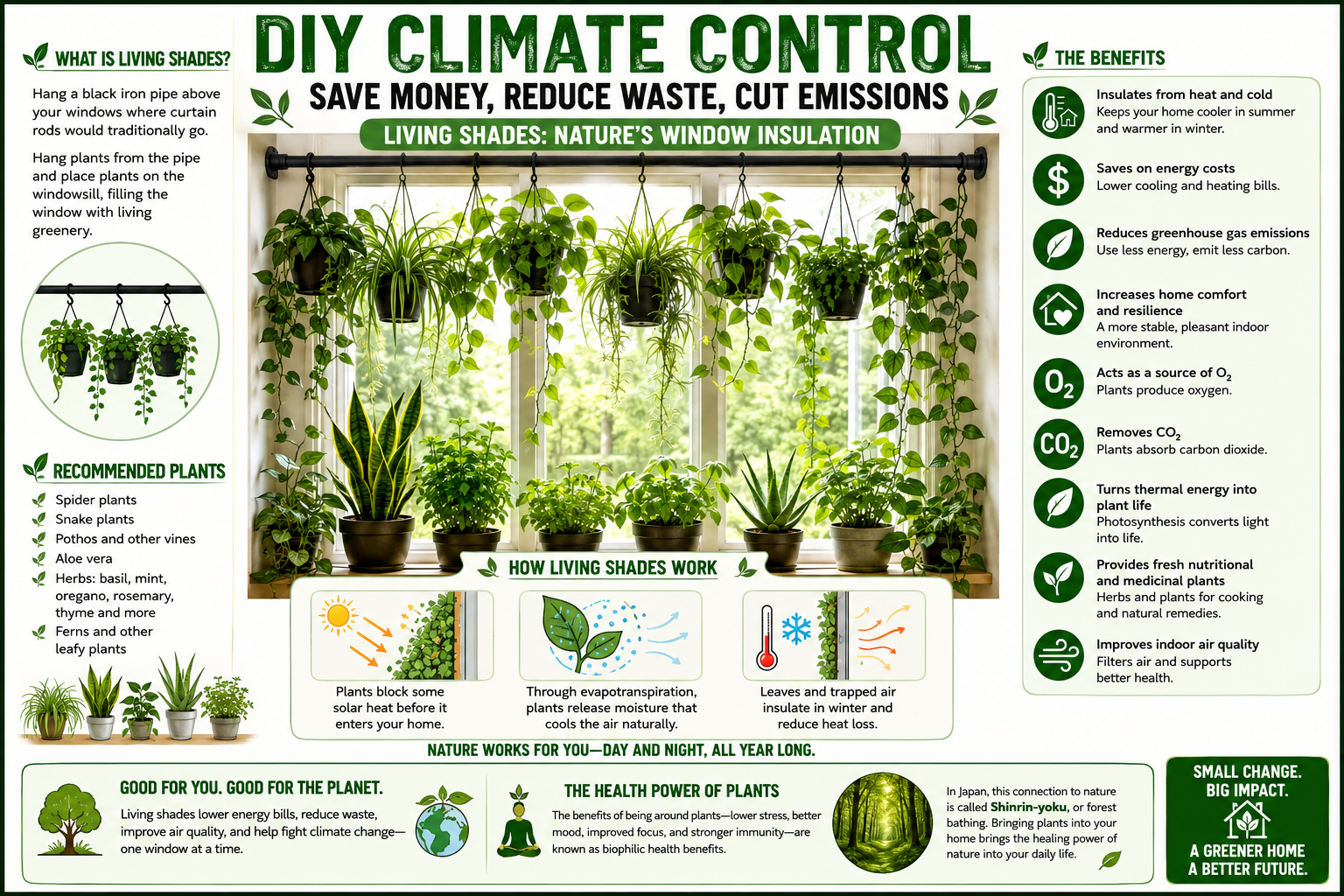
One of the simplest and most affordable ways to improve your home’s energy efficiency is to create living shades. Instead of installing traditional curtains or blinds, mount a sturdy black iron pipe above each window and suspend a collection of houseplants from it. Complement the hanging plants with additional plants on the windowsill, creating a dense layer of living vegetation between the window and the room.
A diverse mix of plants works best. Excellent choices include:
As the plants mature, they naturally form a living curtain that performs several useful functions simultaneously.
DIY Climate Controal Living Shades: House Plants as Nature’s Window Insulation

In Shakespeare’s Macbeth, Birnam Wood appears to come alive as Malcolm’s army cuts branches from the forest and carries them toward Dunsinane Castle, concealing its advance. What seemed like magic was actually an ingenious use of nature to solve a practical problem.
The Birnam Wood Experiment applies that same concept to climate resilience by using moveable trees and vegetation to improve home energy efficiency, reduce urban heat, harvest rainwater, provide food, and create healthier outdoor living spaces.
Rather than planting every tree permanently in the ground, many are grown in large mobile planters that can be repositioned throughout the year wherever they provide the greatest environmental and economic benefit.
DIY Climate the Birnam Wood Experiment: Moving Forests for a Cooler, More Efficient Home
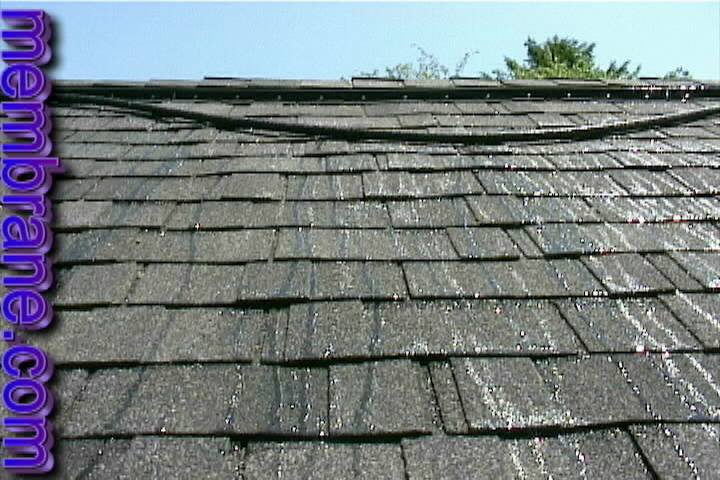
Evaporative roof cooling is thermodynamically efficient because it exploits one of the largest energy sinks available in everyday physics: the latent heat of vaporization of water. Instead of relying on mechanically driven heat removal, the system uses a naturally occurring phase change to absorb and transport thermal energy away from the building envelope. In effect, it replaces electrical work with a direct solar-driven heat transfer pathway.
Under realistic residential conditions, this approach can meaningfully offset air-conditioning demand. Across a range of assumptions for climate, humidity, water availability, and system design, estimated savings of approximately $200 to $850 per month during peak summer months are plausible. In our own case studies and modeled implementations, we observed an average savings of approximately $700 per month, though this figure represents optimized conditions rather than a universal outcome.
It is important to emphasize that performance is highly variable. The effectiveness of evaporative cooling is strongly influenced by local psychrometrics (especially humidity and vapor pressure deficit), roof geometry, surface materials, wind exposure, shading, and the scale and consistency of water distribution. Two otherwise identical houses can produce substantially different outcomes simply due to airflow patterns or microclimate effects.
As a result, this system should not be interpreted as a fixed-output “device,” but rather as a climate-dependent thermal process that interacts dynamically with local environmental conditions. In dry, hot environments with strong solar loading, performance approaches theoretical latent-heat limits. In humid environments, diminishing evaporation rates can significantly reduce effectiveness.
Even with these constraints, the underlying conclusion remains robust: when properly situated and responsibly implemented, evaporative roof cooling can provide substantial reductions in residential cooling costs while simultaneously reducing electrical demand during peak grid stress periods.
“The Waterfall House”: Passive Solar-Driven Heat Rejection Using Phase-Change Energy Transfer
One of the cheapest and most energy-efficient methods for improving indoor air quality and household climate resilience is the Corsi–Rosenthal Box.
The Corsi–Rosenthal Box is a simple DIY air filtration system that can outperform many expensive commercial HEPA purifiers at a fraction of the cost.
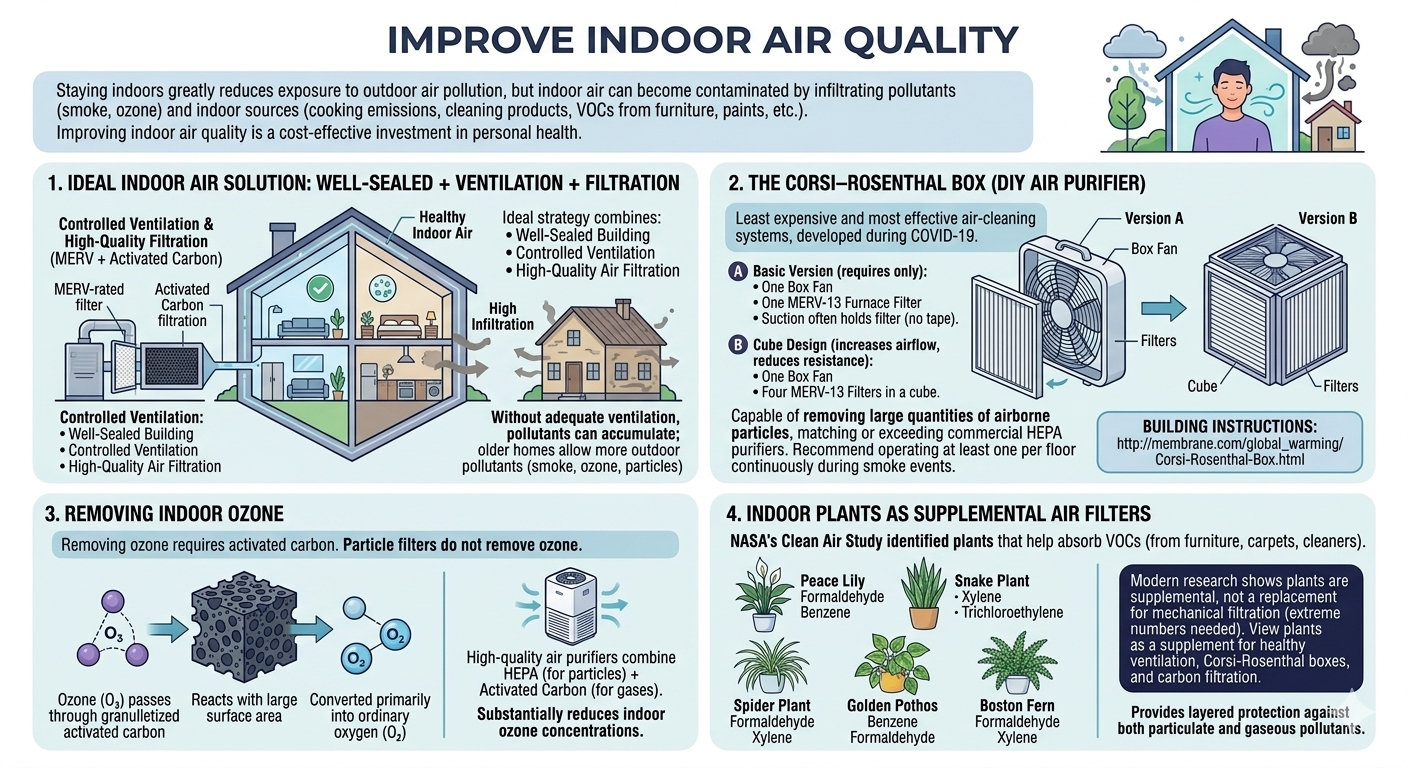
It is built using:
The design improves air circulation while removing:
To further reduce ozone, activated carbon filters can be added.
I first began using Corsi–Rosenthal Boxes several years ago when Canadian wildfire smoke heavily impacted Pennsylvania. The improvement in indoor air quality was immediate and dramatic — both for myself and for my dog. Since then, I have continued using multiple units throughout much of the year.
As climate change accelerates, these challenges are expected to worsen:
Indoor air circulation and filtration are increasingly becoming essential public-health tools.
While large-scale emissions reductions remain critical, individuals can still take practical steps to improve resilience and reduce exposure to worsening environmental conditions.
The Corsi–Rosenthal Box represents one of the simplest, lowest-cost, and most effective climate adaptation tools available today. Its energy efficiency is especially important because rising air-conditioning demand is helping drive a feedback loop: more heat leads to more air conditioning, which increases energy use and emissions, which in turn contributes to additional warming.
Do yourself, your pets, and your plants a favor:
build a DIY Corsi–Rosenthal Box.
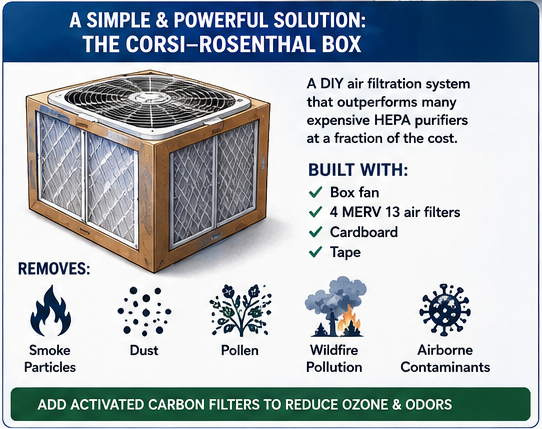
All you need is a box fan and some furnace filters. You can start with just one filter placed behind the fan; you don’t even need tape because the fan’s suction holds the filter securely in place.
Corsi–Rosenthal Box Instructions
One of the most underappreciated climate-health threats is tropospheric (ground-level) ozone.
Unlike protective stratospheric ozone, ground-level ozone is a toxic air pollutant formed when heat, ultraviolet radiation, nitrogen oxides, and volatile organic compounds react in sunlight.
The primary source of these precursor pollutants is carbon combustion:
On hot sunny days — especially near roads, cities, or industrial areas — exposure to ozone can become dangerous for humans, pets, and plants.
Ozone damages:
It worsens:
Plants and forests are also affected, with reduced photosynthesis, leaf damage, and weakened drought resistance contributing to ecosystem decline.
In effect, humans and vegetation are increasingly exposed to the same degraded atmosphere.
Indoor ozone levels are often lower than outdoor levels unless windows are open, outdoor air is directly entering, or ozone-generating devices are used indoors.
Many “air purifiers” that use ionization actually generate ozone and should generally be avoided.
The most effective low-cost ways to reduce ozone exposure are:
Nature: Heat and Human Health Research https://www.nature.com/articles/d41586-024-02422-5
* Our probabilistic, ensemble-based climate model — which incorporates complex socio-economic and ecological feedback loops within a dynamic, nonlinear system — projects that global temperatures are becoming unsustainable this century. This far exceeds earlier estimates of a 4°C rise over the next thousand years, highlighting a dramatic acceleration in global warming. We are now entering a phase of compound, cascading collapse, where climate, ecological, and societal systems destabilize through interlinked, self-reinforcing feedback loops.
We examine how human activities — such as deforestation, fossil fuel combustion, mass consumption, industrial agriculture, and land development — interact with ecological processes like thermal energy redistribution, carbon cycling, hydrological flow, biodiversity loss, and the spread of disease vectors. These interactions do not follow linear cause-and-effect patterns. Instead, they form complex, self-reinforcing feedback loops that can trigger rapid, system-wide transformations — often abruptly and without warning. Grasping these dynamics is crucial for accurately assessing global risks and developing effective strategies for long-term survival.
Feedback Loops →
Tipping Points →
Acceleration →
Domino Effect
Feedback loops amplify climate change and can push interconnected Earth systems past critical tipping points. As tipping points are crossed, they can trigger additional feedback loops and destabilize other climate systems. This cascading "Domino Effect" compresses timescales, accelerates change, and increases the risk of rapid, nonlinear climate transformations.