For decades, many researchers assumed humans could generally survive “wet-bulb” temperatures near 35°C (95°F at 100% humidity) for limited periods. This threshold was widely treated as the upper survivability boundary for healthy individuals under shaded and ventilated conditions.
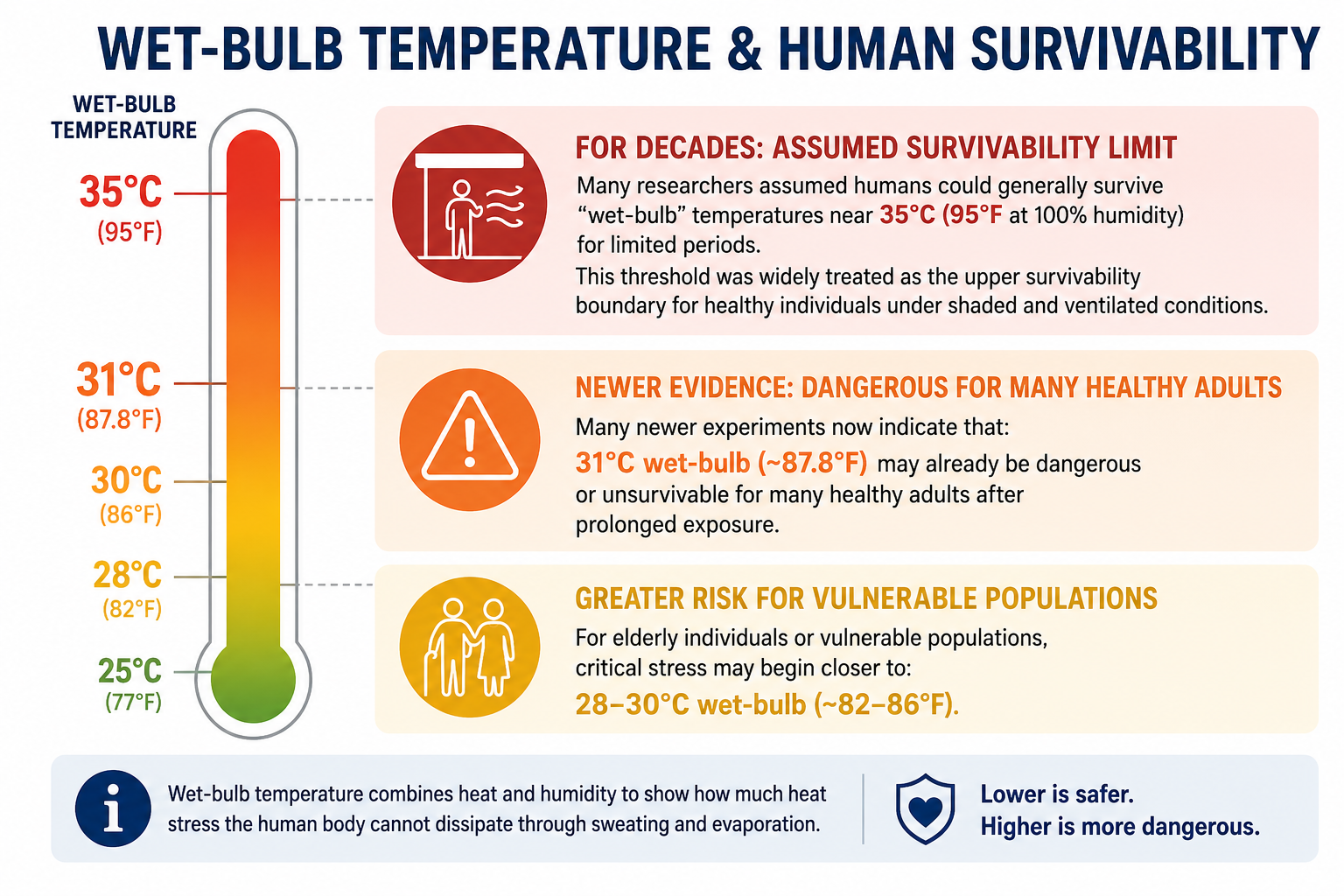
Many newer experiments now indicate that:
These newer laboratory experiments using controlled climate chambers now suggest that the true physiological danger threshold may be substantially lower for large portions of the population — particularly:
These findings significantly alter our understanding of human vulnerability in a warming world.
The emerging research demonstrates that heat stress is not merely a matter of discomfort or dehydration. Elevated temperatures directly impair critical biological systems, including:
This is critically important because public discussions often continue framing heatwaves as isolated “weather events” rather than systemic physiological stressors capable of destabilizing multiple organ systems simultaneously.
The newer findings instead suggest that prolonged heat exposure functions as a whole-body biological destabilizer.
One of the most significant emerging findings is that elevated temperatures can impair immune-cell stability while simultaneously increasing inflammatory stress and cellular damage.
Related NIH-supported research has shown that fever-range temperatures can increase mitochondrial dysfunction and DNA damage in critical immune cells. These processes may contribute to:
Additional studies suggest that prolonged heat exposure may even accelerate epigenetic aging markers — effectively speeding aspects of the body’s biological aging clock.
The implications extend well beyond temporary heat exhaustion.
These findings become even more significant when viewed in the context of accelerating climate instability.
Extreme heat events are increasing:
This is occurring alongside broader atmospheric and oceanic destabilization, including:
In practical terms, temperatures once considered rare anomalies are increasingly becoming sustained seasonal conditions across large regions of the world.
A major focus of current research is wet-bulb temperature — a combined measure of heat and humidity.
Humans cool themselves primarily through evaporative cooling via sweating. High humidity dramatically reduces the body’s ability to dissipate heat into the surrounding environment.
As humidity rises:
This means a moderately lower humid temperature can be more physiologically dangerous than a much hotter dry environment.
The danger becomes especially severe when:
Under these conditions, the body may no longer recover adequately from cumulative daytime heat stress.
Perhaps the most important implication is this:
Many regions may approach dangerous human survivability thresholds far earlier than current infrastructure, public-health planning, and policy assumptions anticipate.
Heat is already among the deadliest weather-related hazards globally. Unlike hurricanes or tornadoes, heat-related deaths are often undercounted because they frequently manifest indirectly through:
Climate change is therefore no longer solely an environmental issue. It is increasingly a direct human physiological and public-health crisis.
As temperatures continue rising, societies become increasingly dependent upon:
This creates a dangerous reinforcing feedback loop.
Extreme heat increases demand for cooling precisely when heat also strains:
The result is a compounding systems dynamic:
more heat → greater cooling demand → higher energy consumption → greater emissions → more heat
Without major improvements in energy efficiency, emissions reductions, and climate adaptation infrastructure, this cycle risks becoming increasingly self-reinforcing.
The growing body of heat-survivability research suggests that human physiological limits may become one of the defining constraints shaping civilization’s climate future during the twenty-first century.
Additional Sources
Heat Stress, Environmental Stressors, and the Limits of Human Adaptability
Elevated Nighttime Minimum Temperatures: Climate Change, Feedback Processes, and Heat-Health Impacts
Heat Stress and the Emerging Physiological Limits of Climate Change
Climate Change and Deadly Humid Heat
Climate-Driven Health Collapse Overview
Nature: Heat and Human Health Research https://www.nature.com/articles/d41586-024-02422-5
* Our probabilistic, ensemble-based climate model — which incorporates complex socio-economic and ecological feedback loops within a dynamic, nonlinear system — projects that global temperatures are becoming unsustainable this century. This far exceeds earlier estimates of a 4°C rise over the next thousand years, highlighting a dramatic acceleration in global warming. We are now entering a phase of compound, cascading collapse, where climate, ecological, and societal systems destabilize through interlinked, self-reinforcing feedback loops.
We examine how human activities — such as deforestation, fossil fuel combustion, mass consumption, industrial agriculture, and land development — interact with ecological processes like thermal energy redistribution, carbon cycling, hydrological flow, biodiversity loss, and the spread of disease vectors. These interactions do not follow linear cause-and-effect patterns. Instead, they form complex, self-reinforcing feedback loops that can trigger rapid, system-wide transformations — often abruptly and without warning. Grasping these dynamics is crucial for accurately assessing global risks and developing effective strategies for long-term survival.