
Among the clearest indicators of accelerating ecological disruption is the widespread decline of insect populations worldwide. Insects represent the biological foundation of most terrestrial ecosystems, serving as pollinators, decomposers, nutrient recyclers, and a primary food source for countless birds, fish, reptiles, amphibians, and mammals.
Key Takeaway: Many insect species already live near their thermal limits. As climate change increases the frequency, intensity, and duration of heatwaves, even modest additional warming can push populations beyond their capacity to survive and reproduce, accelerating the ongoing global decline of insect life.
The loss of insects is not simply the loss of small creatures—it is the weakening of the foundation upon which ecosystems, agriculture, and human civilization depend.
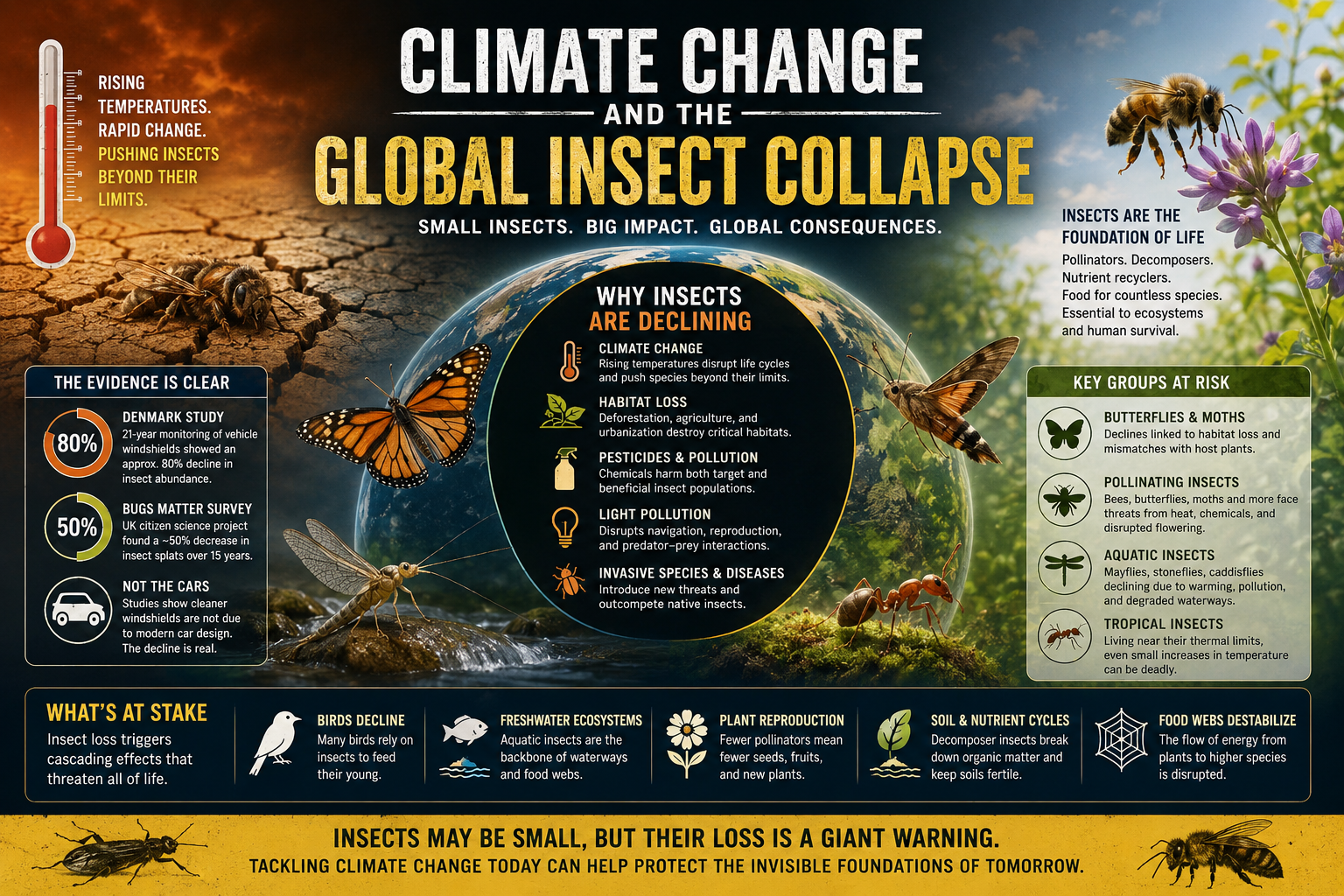
Among the clearest indicators of accelerating ecological disruption is the widespread decline of insect populations worldwide. Insects represent the biological foundation of most terrestrial ecosystems, serving as pollinators, decomposers, nutrient recyclers, and a primary food source for countless birds, fish, reptiles, amphibians, and mammals.
Multiple long-term studies have documented substantial insect declines across regions, with losses observed in both abundance and diversity. A landmark analysis published in 2019 warned of a potential “insect apocalypse,” citing widespread declines driven by a combination of climate change, habitat destruction, pesticide exposure, invasive species, and pollution. While the magnitude of decline varies by location and species, the overall pattern is clear: many insect populations are experiencing unprecedented pressure.
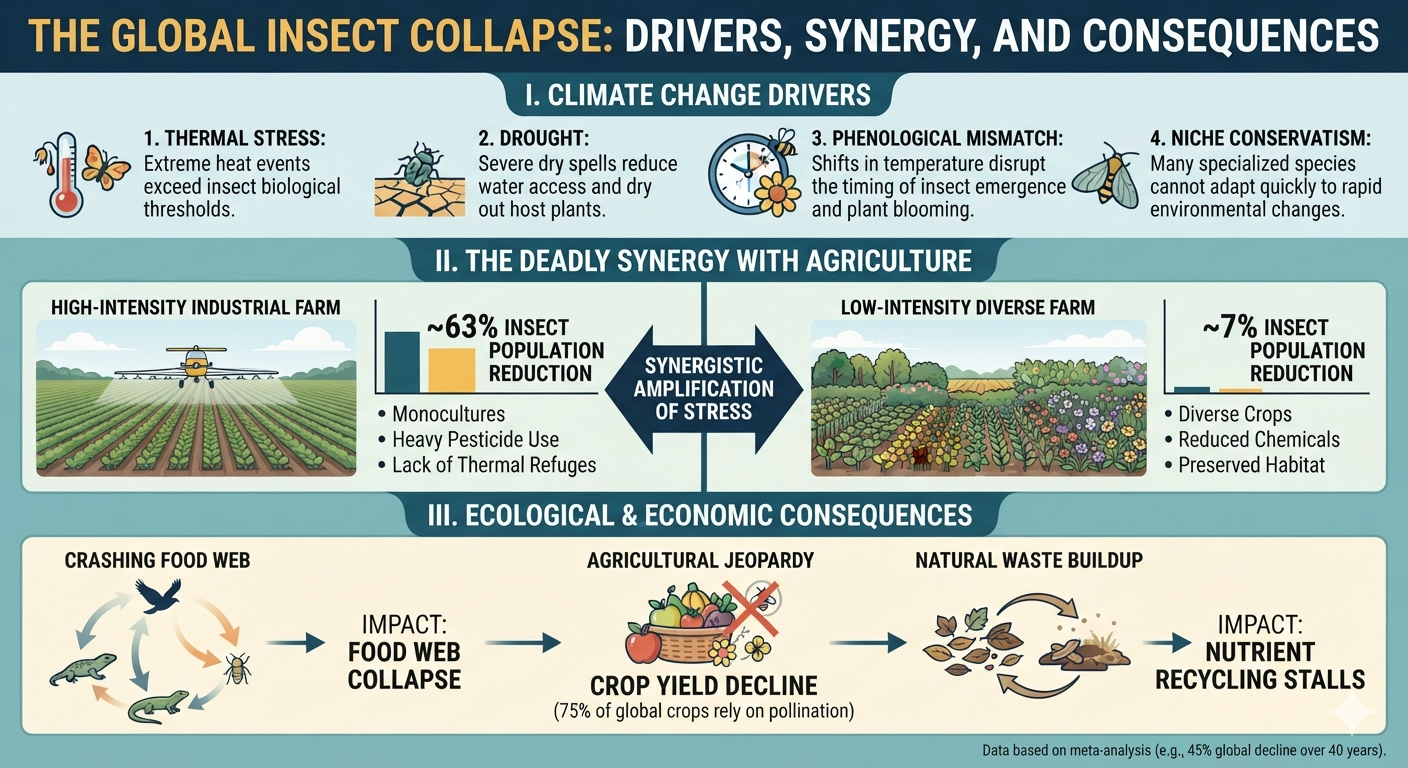
Climate change is becoming an increasingly dominant driver because insects are highly sensitive to temperature changes. Unlike mammals and birds, most insects are ectothermic, meaning their body temperature and metabolic function depend on external environmental conditions. Rapid warming can push species beyond their thermal limits, disrupt reproductive cycles, alter migration patterns, and create mismatches between insects and the plants or animals that depend on them.
Butterflies and Moths
Long-term monitoring programs in Europe and North America have documented major declines in many butterfly and moth species. These insects are especially vulnerable because many have highly specialized relationships with particular plants, meaning climate-driven shifts in vegetation can eliminate their habitat faster than populations can adapt.
Pollinating Insects
Bees, butterflies, moths, and other pollinators are experiencing widespread stress from rising temperatures, changing flowering schedules, habitat loss, and chemical exposure. The disruption of pollinator populations threatens not only wild ecosystems but also agricultural systems that depend on insect pollination.
Aquatic Insects
Freshwater insects such as mayflies, stoneflies, and caddisflies are declining in many regions due to warming rivers, drought, pollution, and habitat degradation. These insects are critical indicators of freshwater ecosystem health and form the foundation of many aquatic food webs.
Tropical Insects
Tropical insects are particularly vulnerable because many already live near their upper thermal limits. Unlike temperate species, they often have little physiological capacity to tolerate additional warming. Even small increases in temperature can reduce survival, reproduction, and population stability.
The decline of insects represents more than the loss of individual species—it threatens entire ecological networks. A reduction in insect abundance can trigger cascading effects:
The disappearance of insects is therefore a measurable sign of ecosystem stress. Because insects reproduce quickly and occupy nearly every terrestrial environment, their decline acts as an early warning indicator of broader biological instability.
The global insect decline illustrates the central danger of rapid climate change: ecosystems do not respond only to the amount of warming, but to the speed at which environmental conditions change. Species that evolved within relatively stable climate ranges can be overwhelmed when temperature, precipitation, and seasonal patterns shift faster than adaptation can occur.
The loss of insects may ultimately prove to be one of the most consequential ecological changes of the modern era—not because insects are individually dominant, but because they quietly support the biological systems upon which nearly all complex life depends.
The term “insect apocalypse” refers to the rapid and widespread decline of insect populations around the world. Because insects form the foundation of many terrestrial ecosystems, their disappearance threatens ecosystem stability, food security, and the survival of countless species—including humans.
For decades, people have noticed a simple but striking change: far fewer insects accumulate on car windshields during road trips than in previous generations. This observation, sometimes called the “windshield phenomenon,” was initially dismissed as anecdotal. However, long-term monitoring and scientific surveys have confirmed that it reflects a real ecological decline.
Evidence includes:
The windshield phenomenon is not merely a change in driving conditions—it is a visible indicator of a much broader ecological transformation.
The decline is not limited to individual species; entire insect communities are shrinking.
Many well-known insect species are experiencing severe population declines:
These losses represent more than disappearing species—they indicate weakening ecological networks that support entire ecosystems.
A rapidly warming climate acts as a powerful barrier to insect survival by fundamentally altering insect physiology, behavior, and reproductive success. Because insects are ectotherms (cold-blooded organisms), they cannot regulate their internal body temperature. Instead, their body temperature closely tracks the surrounding environment.
As temperatures rise, insects initially become more active because their metabolic processes accelerate. However, once temperatures approach or exceed their critical thermal maximum (CTmax), biological systems begin to fail rapidly. Importantly, severe population declines often occur well before temperatures become immediately lethal.
Thermal Sterility:
Temperatures significantly below lethal thresholds can permanently damage reproductive systems. Heat stress can destroy sperm, reduce egg viability, and impair mating success, causing populations to decline through reproductive failure before adult insects die.
Metabolic Exhaustion:
Higher temperatures dramatically increase metabolic rates. Insects burn through their limited energy reserves more rapidly and may effectively starve despite the presence of food because their energy demands exceed what they can consume and process.
Phenological Mismatch:
Warmer springs can trigger insects to emerge earlier than normal. However, their host plants, prey species, or symbiotic partners may not shift at the same pace. This creates ecological mismatches that leave insects without food, shelter, or breeding resources during critical life stages.
Evaporative Desiccation:
Extreme heat and drought reduce environmental moisture. Because insects have a high surface-area-to-volume ratio, they lose water rapidly and can die from dehydration, especially during prolonged heatwaves.
Honeybees maintain brood temperatures within a remarkably narrow range of approximately 34.5°C to 35.5°C (94°F–96°F). When hive temperatures rise above 40°C (104°F), worker bees largely cease foraging and devote their energy to cooling the colony through collective wing-fanning and water transport.
At sustained temperatures approaching 45°C (113°F), beeswax combs can soften or collapse, threatening developing larvae and potentially causing colony failure.
Bumblebees face an even greater challenge. Adapted primarily to cooler climates, many species have struggled to keep pace with rapid warming and have retreated from the warmer southern portions of their historical ranges.
Moderate warming can accelerate mosquito development and reproduction, increasing disease transmission risks in some regions. However, mosquitoes also have upper thermal limits.
Temperatures exceeding approximately 36°C to 40°C (97°F–104°F) substantially reduce adult survival, while prolonged exposure above 42°C (108°F) can cause rapid mortality. Additionally, mosquito larvae struggle to mature when water temperatures remain above approximately 34°C (93°F).
The result is a geographic shift rather than universal expansion. Extreme heat may suppress mosquito populations in some tropical and subtropical regions while warmer winters allow them to establish populations in areas that were previously too cold.
Many tropical insects—including ants, beetles, butterflies, and numerous other arthropods—evolved in environments with relatively stable temperatures throughout the year. Consequently, they possess much smaller thermal safety margins than many temperate species.
Research indicates that warming of only 1°C to 2°C above historical norms can impose substantial physiological stress. Exposure to projected future heat extremes for as little as several hours may push a significant proportion of tropical insects into heat coma, characterized by loss of motor function, protein damage, and eventual death.
Because tropical insects form the foundation of some of the world’s most biodiverse ecosystems, their decline has the potential to trigger widespread ecological disruptions throughout tropical food webs.
      Temperature Zone
      Temperature Range
      Biological Effects


      Cold Stress
      Below 10°C (50°F)
      Insects become lethargic, inactive, and exhibit reduced feeding and movement.


      Optimal Zone
      20°C–30°C (68°F–86°F)
      Peak feeding, growth, reproduction, pollination, and overall activity occur.


      Heat Stress
      35°C–38°C (95°F–100°F)
      Reproductive impairment, dehydration, metabolic exhaustion, and cooling behaviors begin.


      Lethal Limit
      Above 42°C (108°F)
      Heat coma, protein damage, organ failure, and rapid mortality occur.


Key Mechanisms of Climate-Driven Decline


      Mechanism
      Description
      Primary Consequence


      Thermal Sterility
      Heat damages sperm, eggs, and reproductive processes before lethal temperatures are reached.
      Population decline through reproductive failure.


      Metabolic Exhaustion
      Higher temperatures dramatically increase metabolic rates and energy demands.
      Starvation and reduced survival despite food availability.


      Phenological Mismatch
      Insects emerge before host plants, prey, or symbiotic partners become available.
      Loss of food resources and breeding opportunities.


      Evaporative Desiccation
      Heat and drought rapidly increase water loss from insect bodies.
      Dehydration and mortality during prolonged heat events.


Species-Specific Temperature Thresholds


      Species Group
      Critical Temperature Thresholds
      Potential Impacts


      Honeybees
      Brood is maintained at 34.5°C–35.5°C (94°F–96°F). Foraging largely stops above 40°C (104°F), and comb collapse is possible near 45°C (113°F).
      Colony cooling behavior, reduced pollination, brood loss, and potential colony failure.


      Mosquitoes
      Adult survival declines above 36°C–40°C (97°F–104°F), with rapid mortality above 42°C (108°F). Larval development is impaired above 34°C (93°F).
      Population declines in extremely hot regions but expansion into newly warmed areas.


      Tropical Insects
      Physiological stress often begins with only 1°C–2°C above historical norms.
      Heat coma, reduced reproduction, and ecosystem-wide disruption of tropical food webs.
Key Takeaway: Many insect species already live near their thermal limits. As climate change increases the frequency, intensity, and duration of heatwaves, even modest additional warming can push populations beyond their capacity to survive and reproduce, accelerating the ongoing global decline of insect life.
Agricultural expansion, deforestation, and urban development eliminate the plants, nesting areas, and breeding habitats insects depend upon. As landscapes become increasingly simplified, insects lose the diversity of resources required for survival.
The widespread use of synthetic pesticides—particularly neonicotinoids—has contributed to insect declines by affecting not only targeted agricultural pests but also beneficial insects such as bees, butterflies, and other pollinators.
Artificial nighttime lighting disrupts the natural behaviors of many nocturnal insects, interfering with navigation, reproduction, feeding, and predator-prey relationships. The loss of darkness has become an additional pressure on already stressed populations.
Insects occupy a critical position at the foundation of terrestrial food chains. They provide essential food sources for insect-eating birds, reptiles, amphibians, fish, and small mammals. A sustained decline in insects can trigger cascading ecosystem failures.
More than 75% of global food crop types rely to some degree on animal pollination. While some staple crops depend primarily on wind pollination, many fruits, vegetables, nuts, and specialty crops require insects. A major decline in pollinators threatens agricultural productivity and food diversity.
Insects serve as essential recyclers. They break down dead plants, animal remains, and waste materials, returning nutrients to soils and maintaining ecosystem productivity. Without insects, organic matter would accumulate, nutrient cycles would slow, and soil health would deteriorate.
The insect decline represents one of the most significant ecological warnings of the modern era. Unlike dramatic events such as melting glaciers or rising seas, insect losses often occur quietly and out of sight. Yet their disappearance signals a deeper destabilization of the biological systems that support life on Earth.
The loss of insects is not simply the loss of small creatures—it is the weakening of the foundation upon which ecosystems, agriculture, and human civilization depend.
* Our probabilistic, ensemble-based climate model — which incorporates complex socio-economic and ecological feedback loops within a dynamic, nonlinear system — projects that global temperatures are becoming unsustainable this century. This far exceeds earlier estimates of a 4°C rise over the next thousand years, highlighting a dramatic acceleration in global warming. We are now entering a phase of compound, cascading collapse, where climate, ecological, and societal systems destabilize through interlinked, self-reinforcing feedback loops.
We examine how human activities — such as deforestation, fossil fuel combustion, mass consumption, industrial agriculture, and land development — interact with ecological processes like thermal energy redistribution, carbon cycling, hydrological flow, biodiversity loss, and the spread of disease vectors. These interactions do not follow linear cause-and-effect patterns. Instead, they form complex, self-reinforcing feedback loops that can trigger rapid, system-wide transformations — often abruptly and without warning. Grasping these dynamics is crucial for accurately assessing global risks and developing effective strategies for long-term survival.