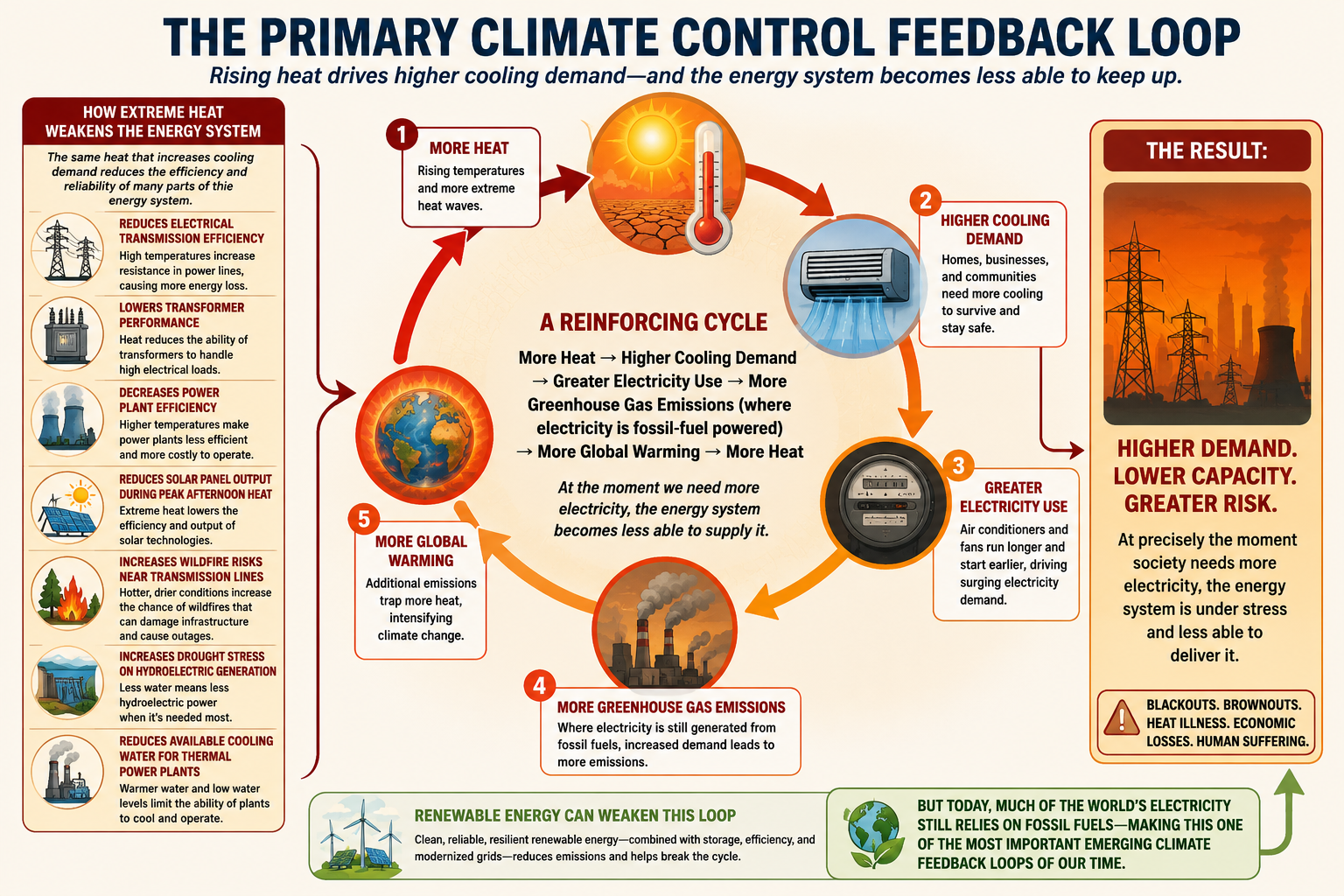
More Heat → Higher Cooling Demand → Greater Electricity Use → More Greenhouse Gas Emissions → More Global Warming → More Heat
by Daniel Brouse
July 2026
How the growing need for air conditioning is creating new reinforcing climate feedbacks
For most of the twentieth century, air conditioning was considered a luxury in many parts of the world. Today, in an increasing number of regions, it is becoming essential for human health and survival. As climate change drives longer, hotter, and more humid heat waves, indoor climate control is rapidly shifting from a convenience to a critical component of public safety.
This transition carries an important consequence that is often overlooked: climate control itself is becoming part of the climate system. Cooling technologies are increasingly intertwined with energy production, infrastructure resilience, water availability, urban design, and greenhouse gas emissions. As societies become more dependent on mechanical cooling, air conditioning becomes linked to a growing number of reinforcing climate feedback loops.
Many of these feedbacks are indirect, but together they form an interconnected system capable of amplifying both climate risks and societal vulnerability. Understanding these emerging “climate control feedback loops” is becoming increasingly important as the world enters an era of persistent extreme heat.
Heat waves are starting earlier, becoming more intense, and lasting longer as climate change reshapes weather patterns around the world. In the United States, extreme heat events have become dramatically more likely because of human-caused global warming. Similar trends are occurring across Europe, the United Kingdom, Asia, Australia, and many developing nations where populations and infrastructure were never designed for prolonged extreme heat.
Extreme heat is far more than an inconvenience—it is a major public health hazard.
High temperatures place increasing stress on the cardiovascular system, kidneys, lungs, and immune system while reducing the body’s ability to regulate its core temperature. Heat exhaustion, heat stroke, dehydration, and cardiovascular failure become more common during prolonged heat events. Emerging research also suggests that some heat-related cellular and metabolic impacts may occur at lower temperatures than previously believed, particularly when high humidity limits the body’s ability to cool itself through perspiration.
As these conditions become more common, reliable indoor cooling increasingly becomes a life-saving necessity rather than simply a comfort.
Modern societies are becoming increasingly dependent upon:
Each of these systems depends upon the others.
Hospitals require electricity to operate cooling systems.
Power plants often require large amounts of water for cooling.
Water systems require electricity to pump and distribute water.
Telecommunications rely upon climate-controlled data centers.
The result is an increasingly interconnected infrastructure network that becomes progressively more vulnerable during extreme heat.
As temperatures rise, cooling demand rises simultaneously.
Unfortunately, the same heat that increases cooling demand also reduces the efficiency of many parts of the energy system.
Extreme heat can:
At precisely the moment society needs more electricity, the energy system often becomes less capable of supplying it.
The reinforcing cycle becomes:
More Heat → Higher Cooling Demand → Greater Electricity Use → More Greenhouse Gas Emissions (where electricity is fossil-fuel powered) → More Global Warming → More Heat
Although renewable energy can weaken this loop, much of the world’s electricity still relies upon fossil fuels, making this one of the most important emerging climate feedbacks.
Cities absorb enormous amounts of solar energy through asphalt, concrete, brick, and roofing materials.
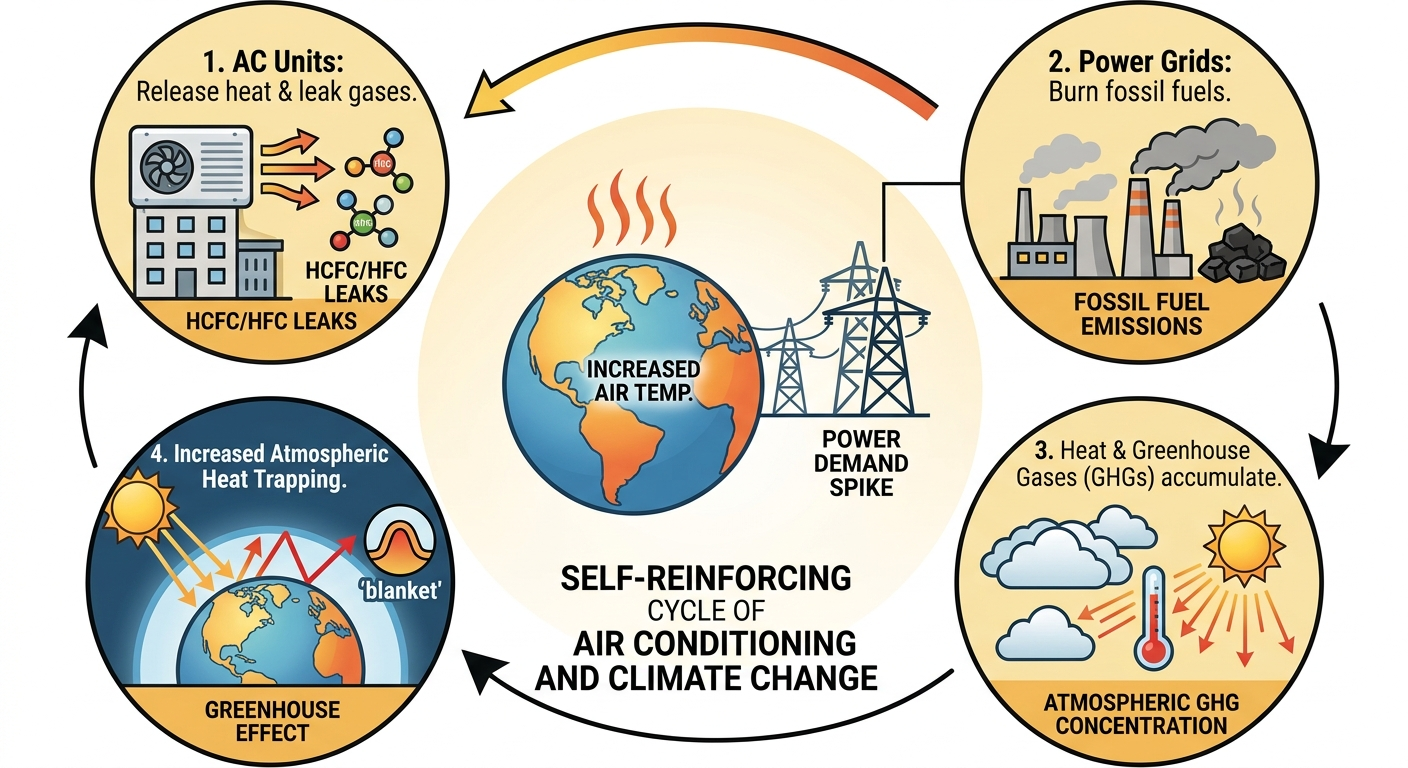
Air conditioners remove heat from inside buildings but release that heat outdoors through their condensers.
As more buildings use air conditioning:
Indoor Heat → Outdoor Heat Release → Higher Urban Temperatures → Greater Air Conditioning Demand → More Waste Heat
Large cities can become several degrees warmer simply from accumulated waste heat released by millions of cooling systems operating simultaneously.
As cooling demand grows:
Heat Wave → Air Conditioning Demand Surges → Grid Stress → Brownouts or Blackouts → Loss of Cooling → Higher Heat Illness and Mortality
During major heat waves, the electrical grid itself becomes one of the most vulnerable components of society.
Power failures during extreme heat can quickly become humanitarian disasters.
Many cooling systems depend upon water.
Meanwhile, hotter temperatures increase evaporation while drought reduces water supplies.
Climate Warming → Drought → Reduced Water Supply → Less Cooling Capacity → Greater Heat Stress → Increased Cooling Demand
Thermoelectric power plants, cooling towers, and some industrial cooling systems all become less reliable during water shortages.
Although newer refrigerants are improving, many cooling systems still contain gases with very high global warming potential.
More Cooling Equipment → More Refrigerant Leakage → Increased Greenhouse Warming → More Heat → More Cooling Equipment
Even relatively small refrigerant leaks can have significant climate impacts if high-global-warming-potential gases are involved.
Extreme heat increases hospital admissions.
Hospitals require continuous climate control.
More Heat → More Heat Illness → Greater Hospital Demand → Higher Energy Consumption → Additional Emissions → More Heat
Healthcare systems become both victims of climate change and contributors to increased energy demand.
Extreme heat lowers worker productivity.
Businesses compensate by increasing indoor cooling.
Higher Temperatures → Lower Worker Productivity → Increased Air Conditioning Use → Greater Energy Demand → Additional Warming
This loop becomes especially important in manufacturing, warehouses, offices, and logistics.
Not everyone can afford adequate cooling.
Communities with limited access to air conditioning experience greater illness, higher mortality, and reduced economic resilience.
Lower Income → Less Cooling → Greater Heat Exposure → Reduced Economic Opportunity → Continued Inability to Invest in Cooling
Climate change increasingly amplifies existing socioeconomic inequalities.
Wildfire smoke illustrates how climate feedbacks can extend well beyond temperature alone.
Smoke contains aerosols, soot, and black carbon that alter the atmosphere in multiple ways. During the day, dense smoke may partially block incoming sunlight in some locations. At night, however, smoke acts like an insulating blanket by absorbing and re-radiating longwave infrared radiation emitted from Earth’s surface. Instead of allowing accumulated daytime heat to escape efficiently into space, smoke traps a portion of that heat near the ground.
Buildings normally cool overnight by releasing stored heat through roofs, walls, windows, and ventilation. When smoke reduces nighttime cooling:
Where electricity generation still depends on fossil fuels, increased cooling demand can produce additional greenhouse gas emissions.
Wildfire smoke also deposits black carbon onto snow and ice. Darkened snow absorbs more solar radiation, reducing surface reflectivity (albedo) and accelerating melting. Faster snow and ice loss exposes darker land and ocean surfaces, which absorb even more solar energy and further amplify regional warming.
This creates multiple reinforcing feedbacks operating simultaneously.
Climate Change → More Frequent and Intense Wildfires → More Smoke, Black Carbon, and Aerosols → Nighttime Heat Trapping + Black Carbon Deposition on Snow and Ice → Warmer Nights + Reduced Surface Albedo → Accelerated Regional Warming → Higher Air Conditioning Demand + Faster Arctic Ice Melt → Greater Greenhouse Gas Emissions (where grids remain fossil-fuel powered) + Increased Solar Heat Absorption → Additional Global Warming → More Frequent and Intense Wildfires
Rather than a single feedback loop, wildfire smoke demonstrates how one climate impact can trigger several interconnected reinforcing loops that amplify one another.
Preparing for extreme heat does not always require expensive renovations. Many low-cost measures can significantly improve resilience while reducing energy demand.
Examples include:
Each improvement reduces dependence upon mechanical cooling while lowering stress on electrical infrastructure.
Climate control is rapidly becoming one of the defining infrastructure challenges of the twenty-first century. As temperatures continue to rise, air conditioning is evolving from a consumer appliance into a critical component of public health, economic stability, and societal resilience.
Yet the expansion of climate control also creates new reinforcing feedback loops involving energy systems, cities, water resources, healthcare, digital infrastructure, refrigerants, and wildfire dynamics. These feedbacks demonstrate that climate change is no longer simply an environmental issue—it is an interconnected systems problem in which human responses can either amplify or reduce future warming.
Breaking these feedback loops will require more than expanding air conditioning. It will depend upon cleaner electricity, higher-efficiency cooling technologies, passive building design, urban greening, resilient electrical grids, improved water management, and thoughtful climate adaptation. Every improvement that reduces the energy required to keep people safe weakens these reinforcing cycles.
The future of climate resilience will not be determined solely by how much we cool our buildings, but by how intelligently we redesign the systems that make cooling possible.
Bottom line: The question is no longer how warm the planet becomes, but how life on Earth can endure when change outpaces our ability to adapt.
We cannot control the laws of physics, but we can control our pollution. The most effective action is to stop burning fossil fuels.