Tipping Point Season Hunting Manual
1Climatologist, Economist
2Physicist
September 2026
Introduction: What Is Tipping Point Season?
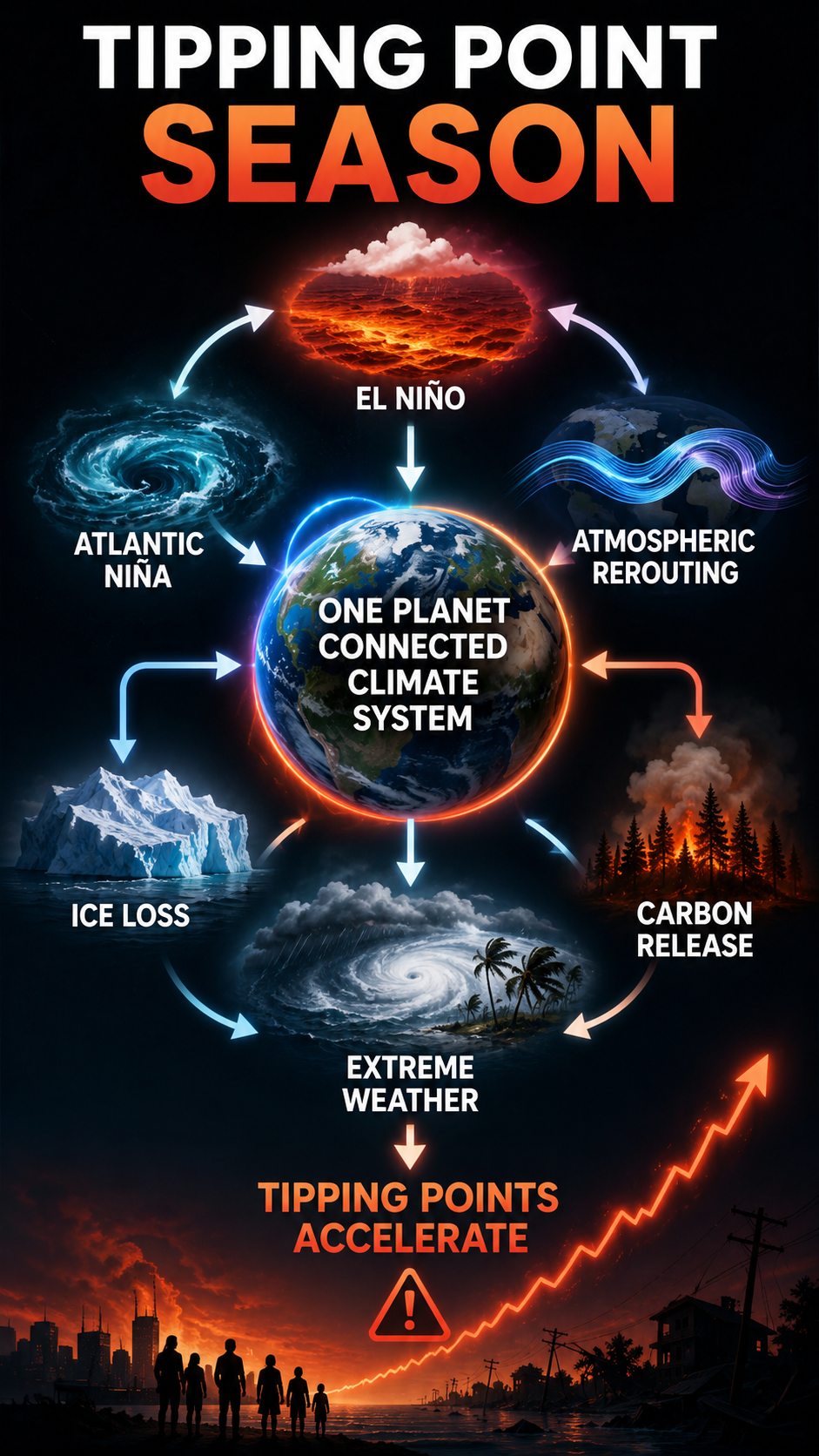
The first tipping point season was 2023–2024, when global temperatures exceeded +1.5°C for an extended period. During that season, nine tipping points became observable:
- Greenland Ice Sheet Collapse
- West Antarctic Ice Sheet Collapse
- Labrador–Irminger Seas/SPG Convection Collapse
- East Antarctic Subglacial Basins Collapse
- Arctic Winter Sea Ice Collapse
- East Antarctic Ice Sheet Collapse
- Amazon Rainforest Dieback
- Boreal Permafrost Collapse
- Atlantic Meridional Overturning Circulation (AMOC) Collapse
This phenomenon occurred simultaneously with El Niño. ENSO is not a cause of climate change; rather, it is a manifestation of the climate system’s accumulated energy. Most of that accumulated climate energy is stored in the oceans. Every several years, much of this heat is brought toward the surface in an oscillating pattern.
Over the last 30 years, El Niño events have continued to occur at their historical frequency of roughly every 2 to 7 years, but their intensity has dramatically increased. A recent August 2026 study by the University of Michigan revealed that El Niño events have become nearly 40% stronger over the last few decades compared with the pre-industrial era.
The last 30 years have borne witness to three of the most powerful “Super El Niño” events in recorded history, alongside an exceptionally strong event currently unfolding in 2026. The extreme heat released by this “supersized” El Niño is expected to temporarily push the entire planet above the 1.5°C global warming limit by late 2026 and into 2027.
The 1.5°C Tripwire
Much of the world is focused on 1.5°C. One reason the public has become so focused on this number is its simplicity. A 1.5°C (2.7°F) increase sounds like a straightforward, easily understood concept. It also doesn’t sound particularly frightening. After all, what’s the big deal about a couple of degrees of warming? Some people even portray it as potentially beneficial.
Scientists take a very different view.
As the introduction illustrates, the climate system is not a collection of isolated components responding independently to rising temperatures. It is a dynamic, interconnected system in which energy moves between the atmosphere, oceans, ice, land, ecosystems, and human systems. At the micro level, millions of individual feedbacks are operating throughout the Earth system. At the macro level, all of those interactions combine to form a single planetary climate system.
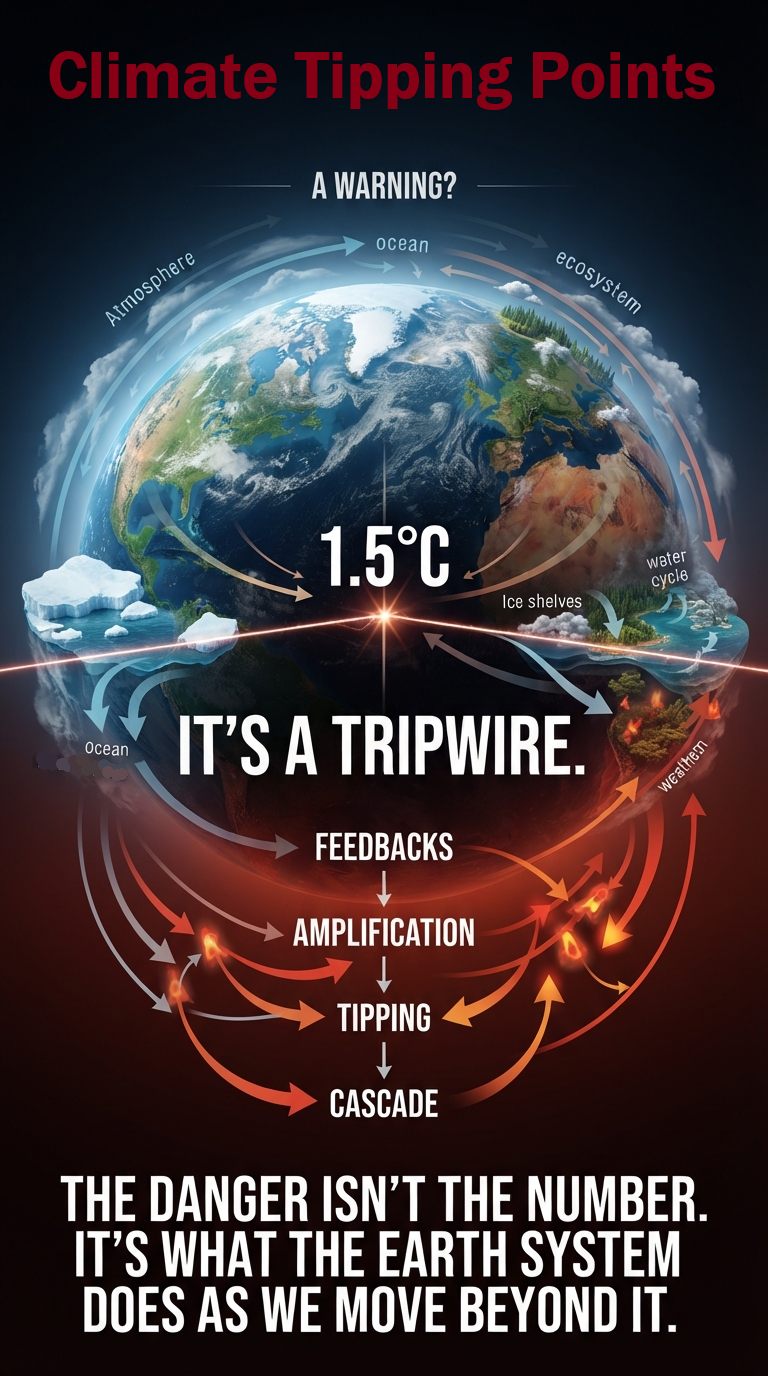
The critical question is therefore not simply how much the planet warms, but what happens as warming changes the system itself. Understanding how these feedbacks interact—and, more importantly, how they amplify one another—is at the bleeding edge of climate science. The climate system is not a simple thermostat in which each additional degree produces a proportionally larger but otherwise predictable effect. It is a complex, nonlinear system capable of crossing thresholds and shifting into fundamentally different states. That is why 1.5°C matters.
The 1.5°C threshold identified in the Paris Agreement—and the roughly 2°C level generally regarded as an even more dangerous boundary—is not important because the difference between 1.4°C and 1.5°C is somehow magical. These numbers matter because increasing global temperatures raise the probability of triggering major climate tipping points.
And, as the first tipping point season demonstrates, we are no longer dealing with tipping points simply as isolated possibilities. We are beginning to observe the coupling, interaction, and amplification of tipping points and feedbacks across the climate system. Once tipping points begin to activate, the question of whether warming ultimately reaches 2°C, 3°C, or even 4–7°C becomes much less relevant for two fundamental reasons.
First, tipping points can initiate self-reinforcing feedbacks that continue driving change even after the original forcing changes. Second, the impacts do not necessarily increase gradually with temperature. They can accelerate, compound, and cascade as interconnected systems begin to destabilize.
In other words, 1.5°C is not a destination. It is not merely a warning sign or an alarm. It is a tripwire.
A Planetary Feedback Network
This tipping point season is pushing the climate system even further, with traditionally non-connected tipping points and feedbacks beginning to couple with one another. One example is the coupling of a Pacific El Niño and an Atlantic Niña.
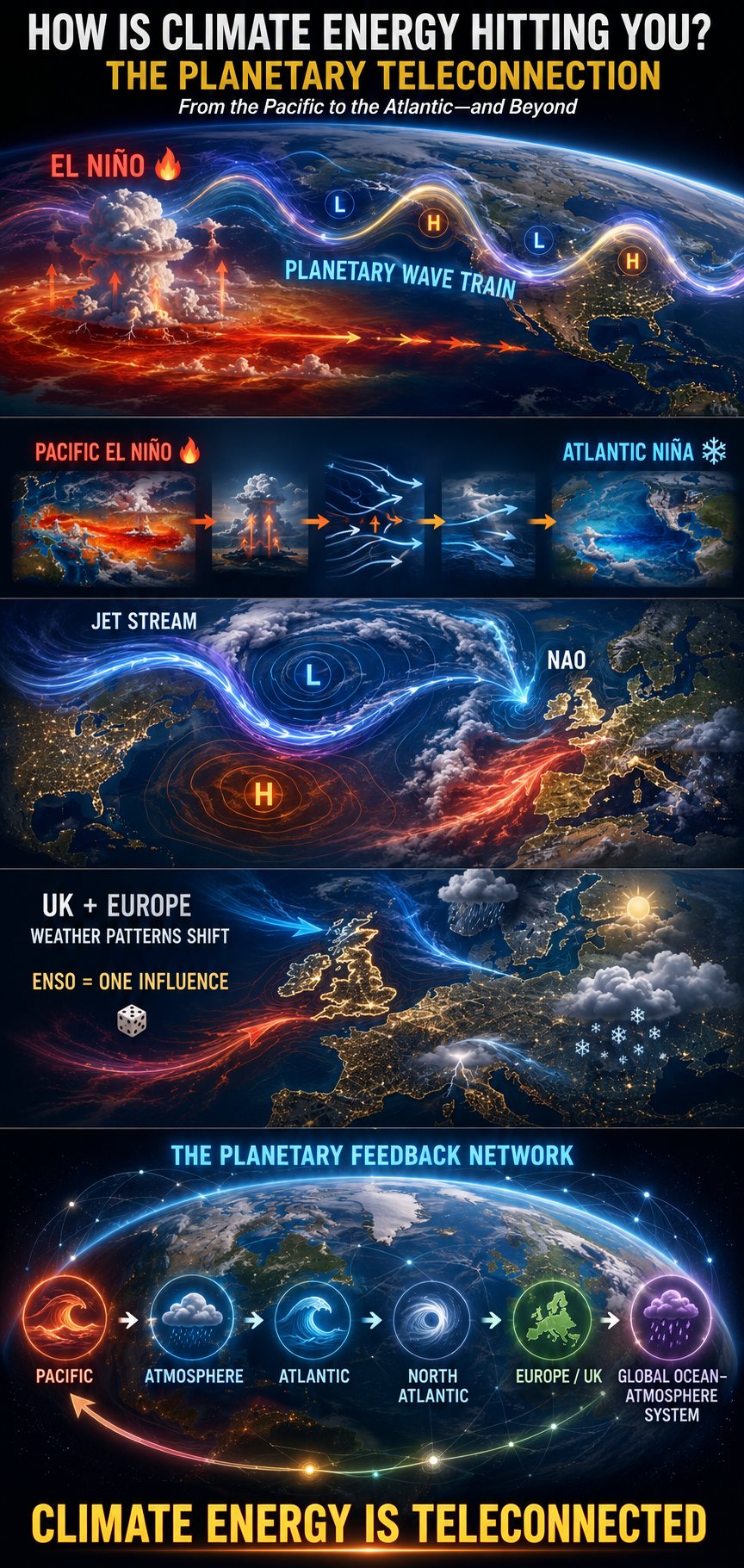
Usually, the Pacific and Atlantic pretty much “do their own thing.” But this year is different. The climate system has been supercharged with energy, and that energy is manifesting in some strange and surprisingly interconnected ways. The unusual co-occurrence of a Pacific El Niño and an Atlantic Niña illustrates how strongly connected Earth’s climate system is. Although the Pacific and Atlantic are separate ocean basins, the atmosphere links them through planetary-scale circulation patterns.
The deeper significance is the connection itself.
A thermal anomaly in the Pacific can reorganize tropical convection. That atmospheric reorganization can propagate through the global circulation system, altering pressure and winds over the Atlantic. Those winds can change ocean upwelling and sea-surface temperatures. The resulting ocean anomaly can then modify atmospheric moisture, convection, and storm development.
The signal can extend even farther through the North Atlantic jet stream and atmospheric wave patterns, influencing weather regimes across Europe and the United Kingdom.
This is not a single atmospheric current traveling around the planet. It is a coupled network of atmospheric and oceanic responses operating across different spatial and temporal scales.
What begins as: PACIFIC WARMING
became: ATMOSPHERIC REROUTING
then: ATLANTIC COOLING
and ultimately:
REGIONAL WEATHER + HYDROCLIMATIC CONSEQUENCES
The climate system is therefore not a collection of isolated ocean basins and weather systems. Energy moves through the connections. The atmosphere carries the signal. The oceans respond. Feedbacks propagate. One planet. One interconnected climate system.
This tipping point season makes observable, for the first time in history, the coupling, interaction, and amplification of feedbacks—and their collective pushing of tipping points into their second derivation.
The Tipping Points Simplified
🌎 TIPPING POINT SEASON
What if climate change isn’t simply about a planet getting warmer?
What if we are entering a period when multiple climate tipping points begin activating, interacting, and amplifying one another?
That is the argument behind the paper, “Tipping Point Season.”
The first tipping point season emerged in 2023–2024, when global temperatures exceeded +1.5°C for an extended period and nine major tipping points became observable.
Now, in 2026, the climate system is showing something even more important: connections.
A Pacific El Niño can influence atmospheric circulation. Atmospheric circulation can alter the Atlantic. Ocean changes can modify moisture, convection, and storms. Feedbacks propagate across the planet.
The climate system is not a collection of isolated parts.
It is one interconnected system.
And that changes how we should think about the 1.5°C threshold.
1.5°C is not a magical temperature at which everything suddenly changes.
It is a tripwire—a point beyond which the probability of triggering major tipping points increases, while feedbacks can begin accelerating, compounding, and cascading through the system.
The critical question is no longer simply:
“What happens as the planet gets warmer?”
It is:
“What happens as we cross the tripwires?”
🔥 Tipping Point Season explores what happens when climate feedbacks stop behaving like isolated processes and begin behaving like a coupled planetary network.
One planet. One interconnected climate system. And potentially, a season of tipping points.
🌎 PERMAFROST THAW SIMPLIFIED
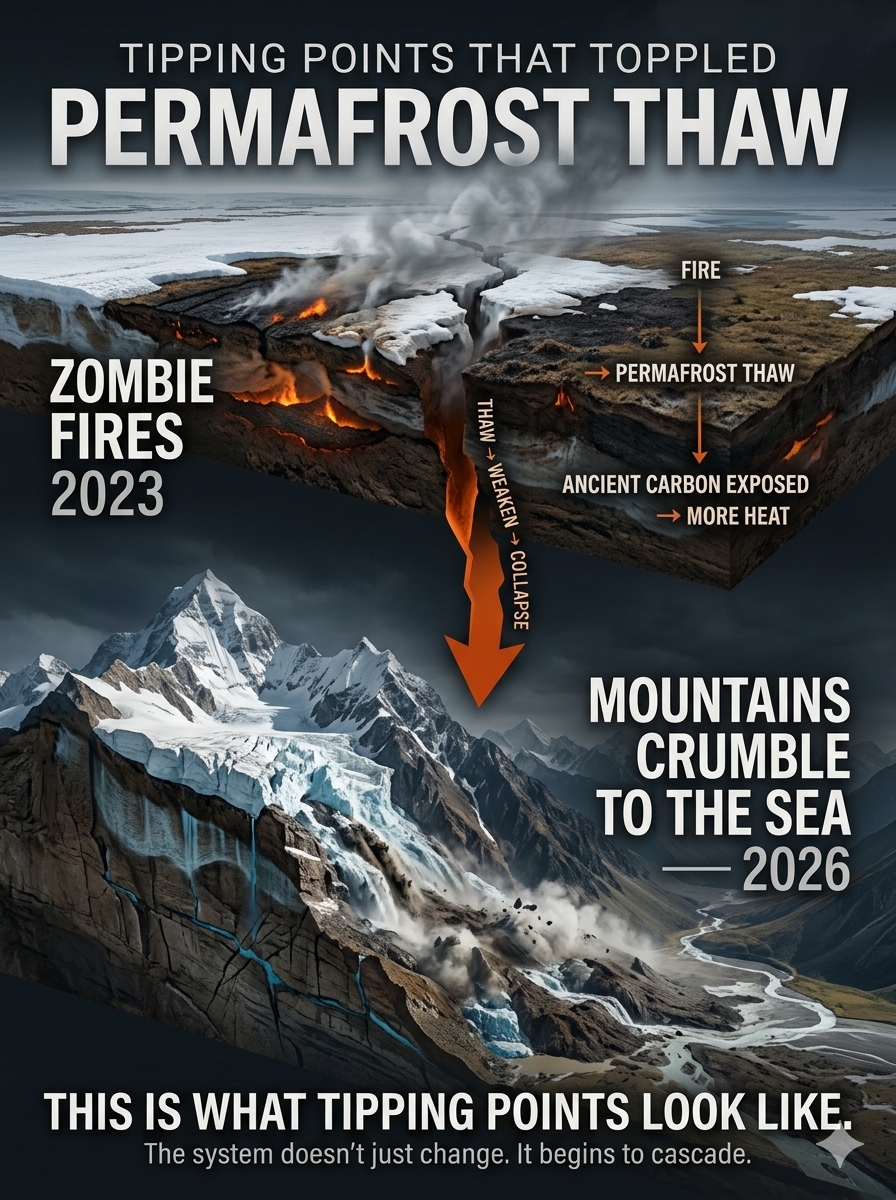
Now that we’re deep into Tipping Point Season, my first assignment was to identify the most observable tipping points emerging this season and compare them with what we were seeing last season.
Tonight’s publishing is Permafrost Thaw: The Sequel.
The first chapter was the 2023 warning signal: zombie fires—wildfires that persisted underground through winter and re-emerged as the frozen landscape thawed. 🔥
The sequel is 2026: mountains crumble to the sea. 🏔️🌊
This is the “Second Derivative of the Problem”—when permafrost thaw moves beyond a change in temperature and begins changing the physical stability of the landscape itself.
As frozen ground loses its structural strength, rock fractures, slopes destabilize, and glacier ice, rock, water, sediment, and permafrost can become part of the same cascading failure.
The graphic tells that story in two acts:
🔥 2023 — ZOMBIE FIRES STARTED
Permafrost and carbon-rich ground begin releasing stored heat and carbon. A serious positive feedback.
🏔️ 2026 — MOUNTAINS CRUMBLE TO THE SEA
Frozen ground loses its reinforcing function, contributing to slope instability and enormous cascading flows of ice, rock, water, and sediment. The loss of snow, ice, and other reflective surfaces also reduces albedo across large areas, creating another serious positive feedback.
The first warning was underground.
The second became impossible to miss.
This is what tipping points look like—not isolated events, but cascading failures where one destabilization can help trigger another, and each new failure feeds back into the system, accelerating and amplifying the next.
🏔️ MOUNTAIN GLACIERS SIMPLIFIED
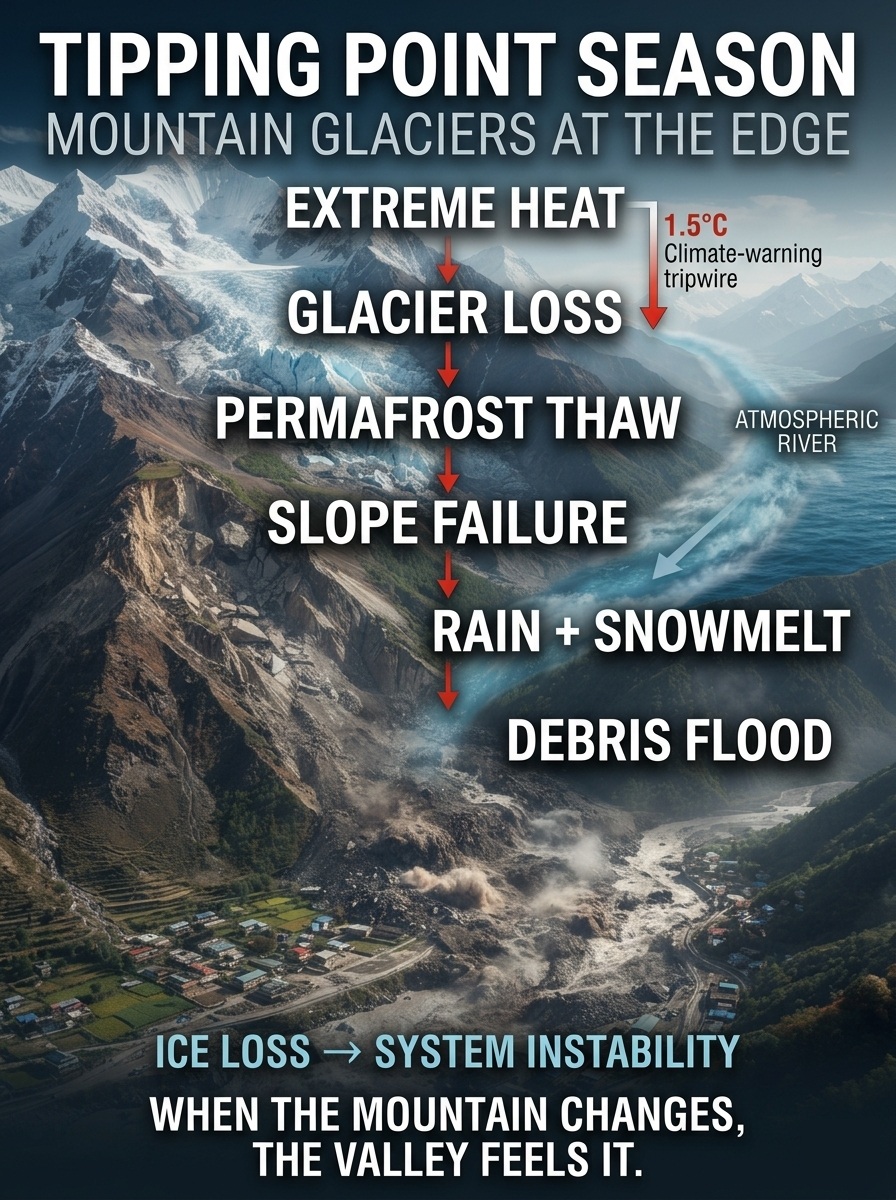
Mountain glaciers are disappearing faster.
But the bigger danger may be what happens to the mountains when the ice disappears.
Record global heat and the powerful 2023–2024 El Niño helped drive extraordinary glacier mass loss worldwide. Now, with another potentially powerful El Niño developing against an already overheated climate, the consequences extend far beyond shrinking glaciers.
Extreme heat melts glacier ice.
Permafrost thaws.
Mountain slopes weaken.
Rain replaces snow.
Atmospheric rivers deliver enormous amounts of water.
Landslides block rivers.
Temporary lakes form.
And those lakes can suddenly burst downstream.
The danger is no longer simply ICE LOSS.
It is SYSTEM INSTABILITY.
This is what happens when multiple climate-sensitive systems begin moving together—and feedbacks start turning one disturbance into another.
Tipping Point Season: Mountain Glaciers at the Edge
The mountain isn’t just losing ice.
The mountain is changing.
Mountain Glacier Retreat Full Report
🌎 GREENLAND MELTING SIMPLIFIED
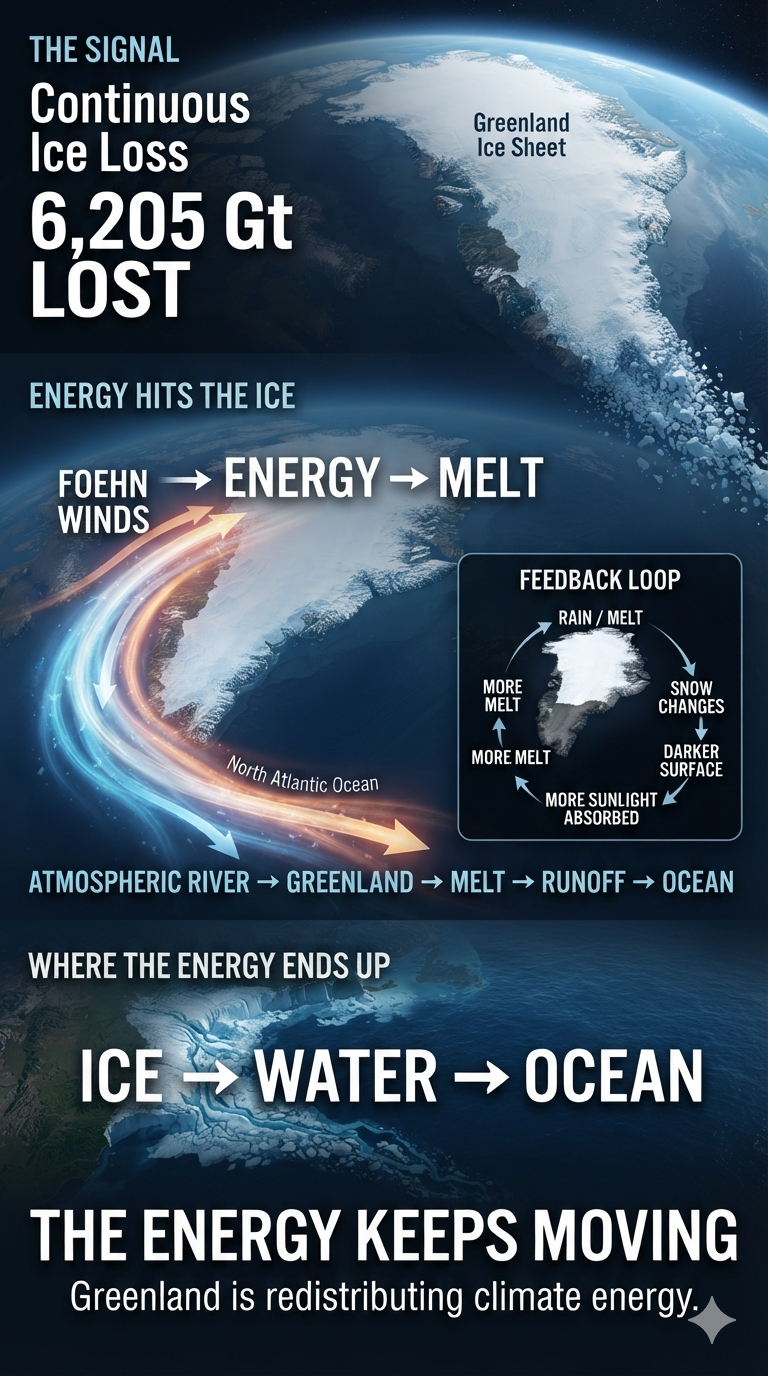
What does a tipping point actually look like?
It may look less like one dramatic event—and more like a system changing, feedback by feedback, until the changes begin reinforcing one another.
That is what makes Greenland so important.
Greenland has now experienced 30 consecutive years of ice loss.
From 1986/87 through 2025/26, approximately 6,205 gigatons of ice have disappeared—contributing about 17.4 millimeters to global sea-level rise.
But the most important story isn’t simply the amount of ice that has melted.
It is where the climate energy is going.
🔥 Warmer air carries more moisture.
🌧️ Atmospheric rivers transport that moisture and heat toward Greenland.
💨 Topography can transform those atmospheric rivers into powerful foehn winds.
🌡️ Rain and warm air increase melting.
❄️ Snow and ice are transformed.
☀️ Darker surfaces absorb more solar energy.
💧 More meltwater runs toward the ocean.
🌊 Freshwater enters the North Atlantic and can interact with ocean circulation.
One process connects to another.
And another.
And another.
This is the essence of Tipping Point Season.
Climate change isn’t simply a thermometer rising.
It is an interconnected planetary system processing enormous amounts of additional energy.
Greenland is one place where we can watch that energy being transformed into physical change.
The 6,205 gigatons of ice already lost are the accounting entry.
The atmospheric rivers, heat, rainfall, melting, runoff, circulation, and sea-level rise are the transactions.
And the feedbacks connect them.
🌎 One planet.
🔥 One interconnected climate system.
⚠️ And potentially, a season of tipping points.
Read “Greenland: Gigatons Gone” and see how climate energy moves through the system—and what it hits next:
Greenland Full Report
🌊 CORAL REEFS SIMPLIFIED: FIRST OVER THE TIPPING POINT
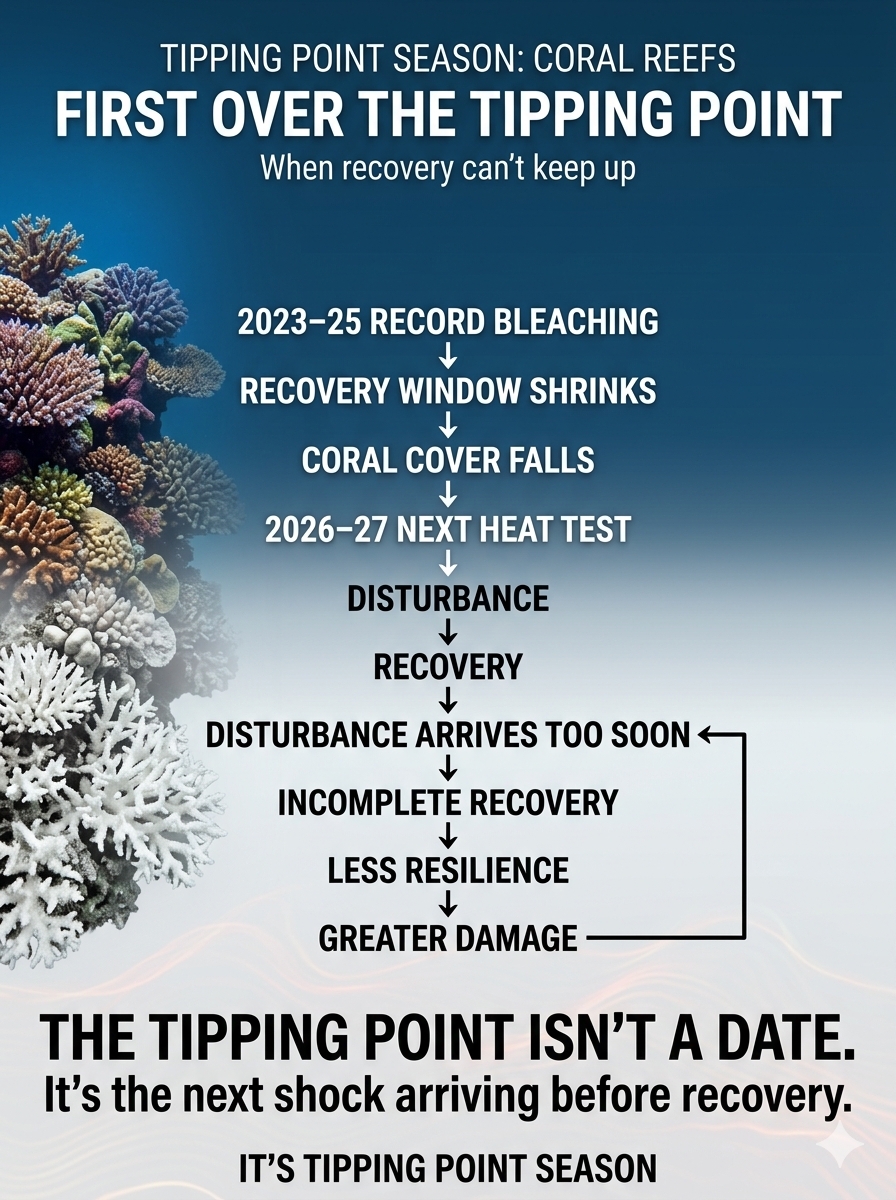
What if a climate tipping point isn't a single catastrophic moment?
What if it's a season of repeated failures—when an ecosystem is hit again before it has recovered from the last shock?
The world's coral reefs may be showing us what that looks like.
🔥 The 2023–2025 global coral bleaching event was the largest on record.
🌡️ Bleaching-level heat stress affected approximately 84.4% of the world's coral reef area.
🪸 Global hard-coral cover is now about 9.5% below its historical average.
⏳ Major bleaching events that once occurred roughly once a decade are now occurring about every 5–6 years.
And the critical problem isn't simply the heat.
It's the shrinking recovery window.
HEAT → BLEACHING → MORTALITY → LESS RESILIENCE → SLOWER RECOVERY → MORE DAMAGE FROM THE NEXT HEATWAVE
Another major El Niño is now developing.
The question is whether the next major heat event will arrive before damaged reefs have had enough time to recover.
Are we watching a tipping point happen not as one catastrophic event, but as a cascade of increasingly incomplete recoveries?
The tipping point isn't necessarily a date.
It may be the moment when recovery can no longer keep up.
🌊 CORAL REEFS: FIRST OVER THE TIPPING POINT
Read the paper and follow the emerging Tipping Point Season: Coral Reef Collapse
🌎 TIPPING POINT SEASON: THE AMAZON DIEBACK

The Amazon is more than a rainforest. It is part of Earth’s climate-regulating system—and one of the places where a regional disruption could become a global problem.
This tipping point season, watch the Amazon closely.
A major Amazon dieback would not remain an Amazon problem.
As forests lose resilience, carbon storage can decline, regional rainfall patterns can shift, and warming can intensify. Those changes could interact with other vulnerable parts of the Earth system—from permafrost thaw and ice-sheet collapse to AMOC slowdown.
That is the danger of tipping cascades:
One system destabilizes → amplifies warming and disruption → increases pressure on another → triggers further change.
The result could be a cascade that moves far beyond the Amazon.
🌳 Amazon dieback → carbon loss & rainfall disruption → additional warming → pressure on other tipping systems → global climate cascade
The critical question isn’t simply “Will the Amazon reach a tipping point?”
It is:
What happens when tipping points begin interacting with one another?
🔬 Tipping Point Season: The Amazon Dieback
A closer look at why the Amazon matters—and why what happens there may not stay there.
#TippingPoints #Amazon #AmazonRainforest #ClimateChange #ClimateScience #TippingCascades #Permafrost #IceSheets #AMOC #EarthSystem #ClimateRisk
🌎 AMOC SIMPLIFIED: ONE PLANETARY SYSTEM
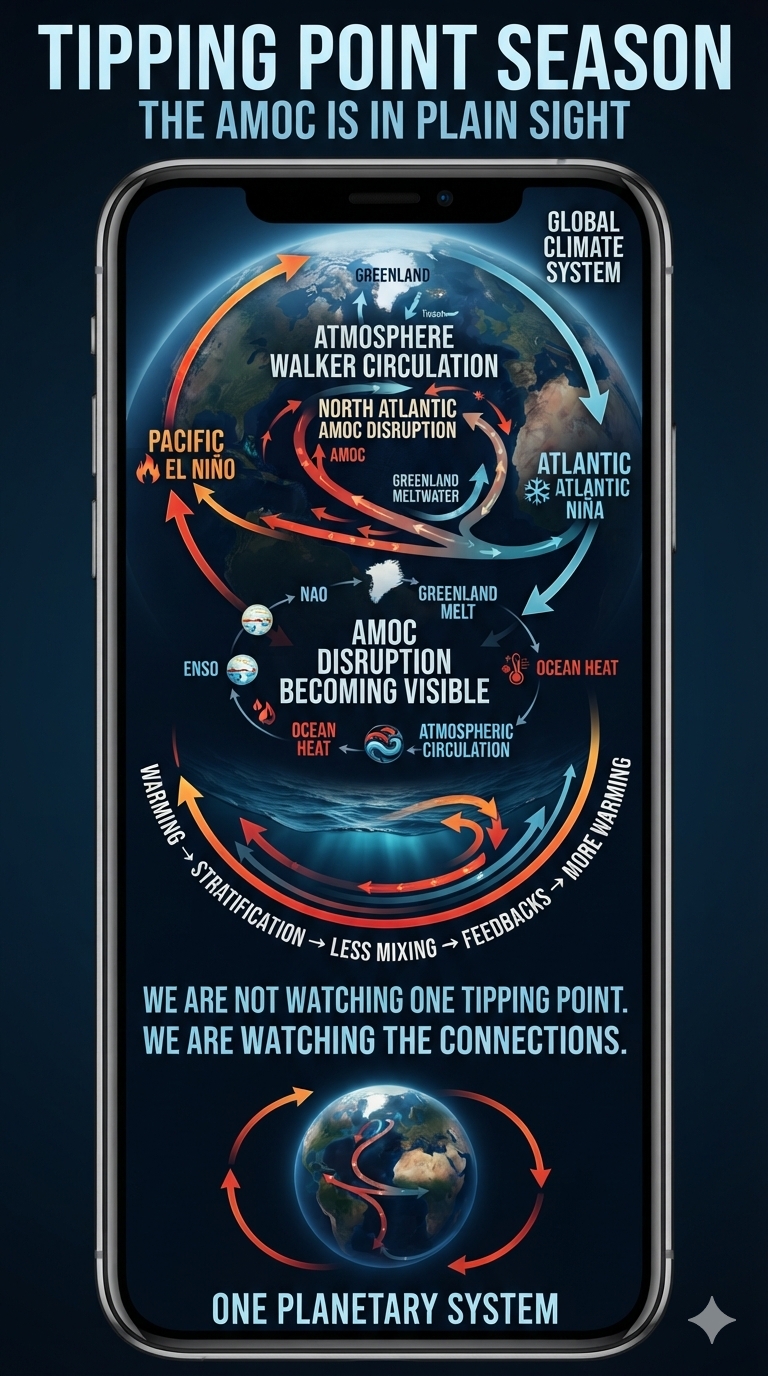
What if the most important sign of a climate tipping point isn’t the tipping point itself—but the way the rest of the planet begins to respond?
My new paper, “Tipping Point Season: See the AMOC Sea,” looks at the increasingly interconnected behavior of the Pacific, Atlantic, North Atlantic, and atmosphere.
The developing 2026–2027 climate configuration—Pacific El Niño alongside Atlantic Niña—offers a striking example of how climate energy can be rerouted across ocean basins through the atmosphere.
Pacific warming changes convection.
The atmosphere reroutes energy.
Atlantic winds change.
Upwelling increases.
The tropical Atlantic cools.
And the North Atlantic circulation is part of that same planetary system.
That matters because the AMOC is not an isolated climate component. Its disruption can interact with Greenland melt, ocean stratification, atmospheric circulation, ENSO, the NAO, and other feedback mechanisms.
This is what makes this Tipping Point Hunting Season different.
The AMOC disruption is becoming more noticeable—not necessarily because there is one dramatic moment of collapse, but because its fingerprints are increasingly visible in the behavior of the systems connected to it.
We may be moving from a climate system where tipping points can be studied individually toward one where the critical question is how they interact.
One ocean warms.
Another cools.
The atmosphere responds.
The circulation changes.
The feedbacks respond.
And the planet adjusts.
We are not hunting for one tipping point.
We are watching the connections between them.
🌎 ONE PLANETARY SYSTEM
🌎 HUNTING FOR POLAR ICE
Subtitle: Tipping Points Comingling
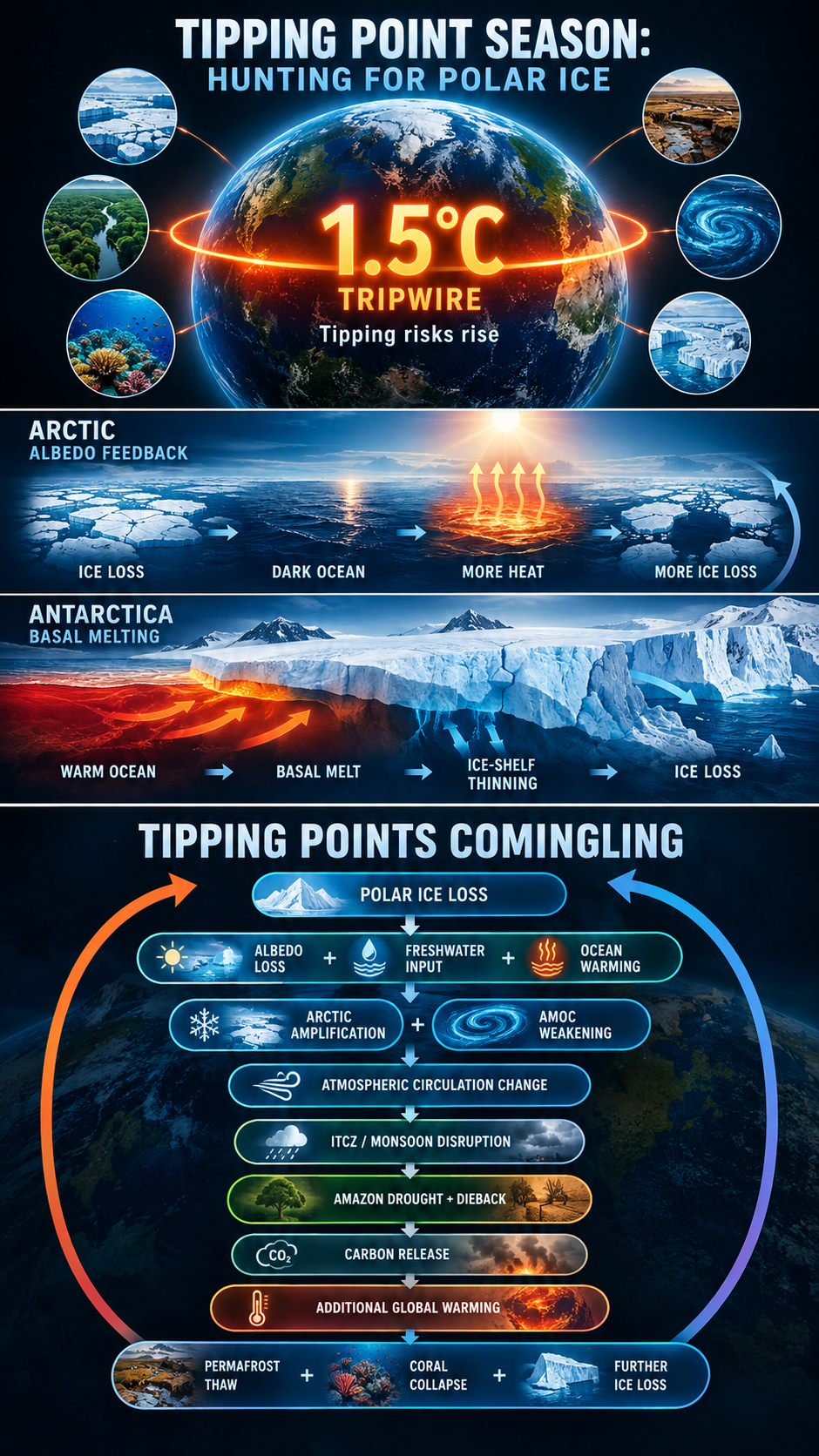
What happens when the planet crosses the 1.5°C tripwire and multiple climate systems are already under stress?
We’re beginning to find out.
The polar regions are sending some of the clearest signals. Arctic sea ice is shrinking and thinning, amplifying warming through the albedo feedback. In Antarctica, warmer ocean water is attacking vulnerable ice shelves from below through basal melting, weakening the buttresses that slow the flow of land-based ice into the ocean.
But the bigger concern isn’t any single tipping point.
It’s what happens when they start interacting.
Polar ice loss means more than melting ice. It means changes in albedo, freshwater input, ocean heat, atmospheric circulation, and eventually the systems that regulate rainfall and ecosystems around the planet.
Polar ice loss → albedo loss + freshwater input + ocean warming → Arctic amplification + AMOC weakening → atmospheric circulation change → ITCZ / monsoon disruption → Amazon drought + dieback → carbon release → additional global warming → permafrost thaw + coral collapse + further ice loss.
These aren’t isolated dominoes.
They are connected feedbacks.
The links exist. The feedbacks are physically real. And they already are interacting.
The question is no longer whether these feedbacks will interact, but how strongly they will amplify one another.
This is why I’m calling this Tipping Point Season.
We’re not simply watching the ice melt.
We’re hunting for evidence that the climate system is beginning to behave differently.
🌎 MATING SEASON:
Comingling Tipping Points and Proliferating Feedbacks
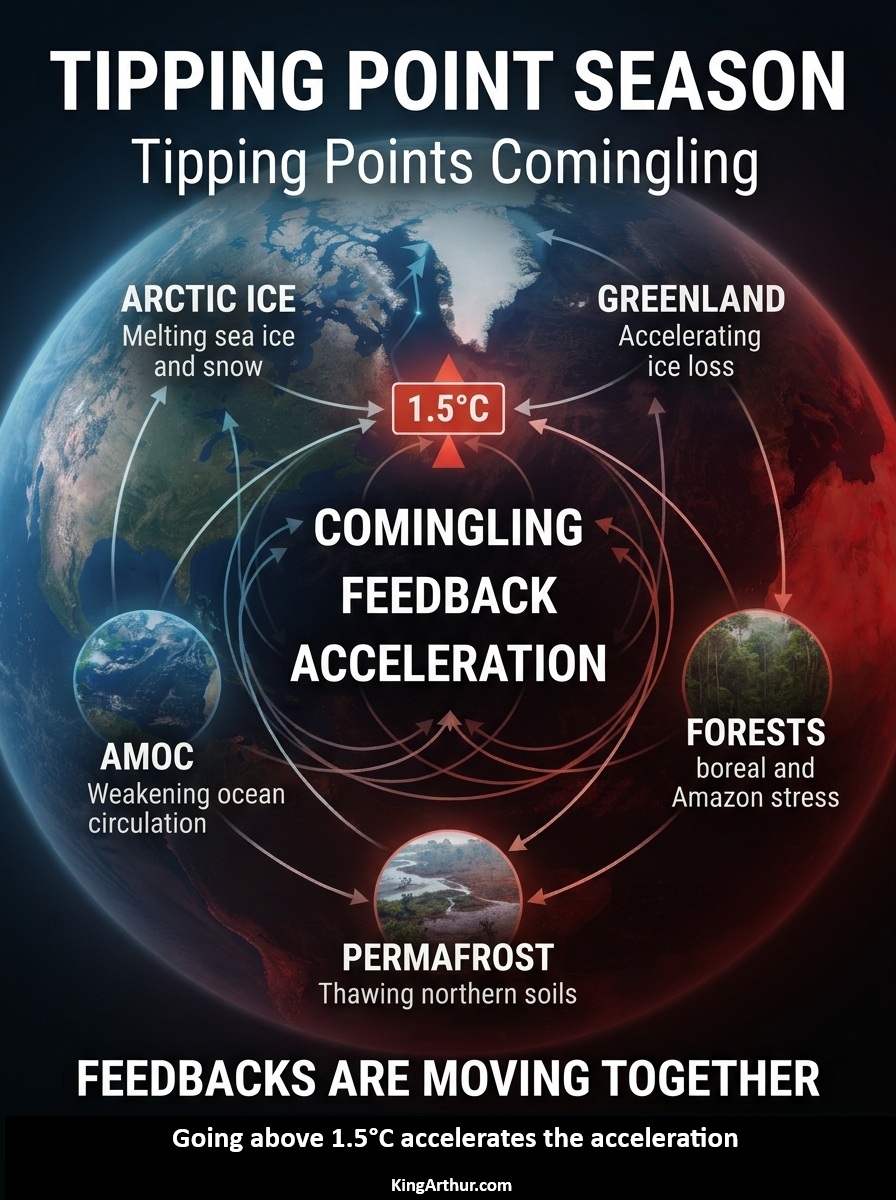
Tipping points are not necessarily isolated events waiting to happen one at a time.
Several have already begun moving together.
Ice loss changes albedo. Arctic warming alters atmospheric circulation. Greenland melt adds freshwater to the North Atlantic. Permafrost thaws and releases greenhouse gases. Forests are stressed by heat, drought, and fire. Ocean and atmospheric systems respond.
The important question is no longer simply: When will a tipping point occur?
It is: What happens when multiple tipping elements begin interacting with one another?
Tipping points come together. Feedbacks proliferate. Interactions strengthen. And acceleration emerges.
The climate system begins to change faster and in more complex ways than its individual pieces can be understood in isolation.
That is the idea behind the paper:
Tipping Point Season: Comingling Tipping Points and Proliferating Feedbacks
How Coupled Climate Feedbacks Are Accelerating Earth-System Change
The greatest danger may not be one tipping point suddenly toppling.
It may be several moving together.
🌡️ 1.5°C is not a magical switch.
It is a tripwire into a climate system where more interconnected components are being pushed toward critical states.
Comingling Tipping Points and Proliferating Feedbacks Full Report
Easy-to-Read Resources