Tipping Point Season:
Coral Reef Collapse
1Climatologist, Economist
2Physicist
September 2026
Coral Reefs: First Over the Tipping Point
Introduction: When a Tipping Point Becomes a Season
What does a climate tipping point actually look like?
It may not arrive as a single dramatic moment when an ecosystem suddenly disappears. It may instead emerge as a season of repeated failures—a period in which environmental shocks arrive faster than a system can recover from them.
A tipping system does not necessarily cross a threshold because of one extraordinary event. It can cross because the interval between disturbances becomes shorter than the system's recovery time. Each disturbance then begins from a weaker baseline, reducing resilience and increasing the damage caused by the next disturbance.
Coral reefs may be the clearest global example of this process now underway. The issue is no longer simply that oceans are becoming too warm for corals.
The deeper problem is that the ocean is becoming too warm, too often, for coral reefs to recover between heat events. That changes the mathematics of the system.
A reef that repeatedly bleaches and recovers is one system. A reef that bleaches again before it has recovered is another. As living coral cover declines, the physical structure of the reef deteriorates, recruitment becomes more difficult, ecological relationships are disrupted, and the capacity of the ecosystem to resist the next disturbance declines.
The disturbance is therefore no longer merely an external shock.
The damage begins to alter the system's response to the next shock.
The 2023–2025 Coral Reef Collapse
The massive global coral bleaching event that began in 2023 and extended through 2025 was not simply another bad year for coral reefs.
On April 15, 2024, NOAA confirmed that the world was experiencing its fourth global coral bleaching event on record—and only the second such event in the previous ten years. NOAA's subsequent assessment found that from January 2023 through September 2025, bleaching-level heat stress affected approximately 84.4% of the world's coral reef area, with mass bleaching documented across at least 83 countries and territories. NOAA characterized it as the largest global bleaching event yet recorded.
The significance is not merely the percentage of reefs exposed to extreme heat.
The significance is the systemic sequence.
Corals live within a relatively narrow thermal range. Extreme heat disrupts the symbiotic relationship between coral animals and the microscopic algae that provide much of their energy. The corals expel these symbiotic algae, producing the characteristic white appearance known as bleaching.
Bleaching itself does not necessarily mean immediate death. But it represents a severe physiological stress response. If elevated temperatures persist, corals can become energy-starved, more vulnerable to disease, and increasingly likely to die.
And recovery takes time.
That recovery time has become the critical variable.
The Recovery-Time Threshold
For decades, coral reefs experienced major disturbances separated by periods long enough for surviving corals to grow, reproduce, and rebuild reef structure.
That creates a basic resilience relationship:
Recovery time < interval between major disturbances = resilience can be maintained.
But when the relationship reverses:
Recovery time > interval between major disturbances = cumulative degradation.
This is the point at which a disturbance regime can become a tipping-point regime.
The reef does not need to experience an infinitely large temperature shock. It only needs to experience disturbances frequently enough that recovery becomes incomplete.
Each new heatwave then begins with less living coral, less structural complexity, fewer reproductive colonies, and a more degraded ecological network.
The system's starting point for the next disturbance has changed.
2026: The Recovery Window Is Closing
The latest global assessment from the Global Coral Reef Monitoring Network (GCRMN), released in August 2026, provides striking evidence that this process is already occurring.
The Status of Coral Reefs of the World: 2025 assessment combines more than 40 years of observations, including approximately 21.1 million observations from 87,299 surveys at 36,886 reef sites across more than 120 countries, territories and economies.
Its central finding is stark.
Global hard-coral cover averaged approximately 30.2% during the historical reference period of 1980–2009. During 2020–2024, the average had fallen to approximately 27.3%—a relative decline of about 9.5%. Global hard-coral cover was estimated at approximately 25.8% in 2024, and the decline between 2023 and 2024 alone was approximately 8.9%, the largest single-year decline in the assessment.
But the most important finding is not simply the amount of coral that has disappeared.
It is the shrinking interval available for recovery.
Major global bleaching events historically occurred roughly once a decade. Since 2010, the interval has contracted to approximately five or six years. Many corals require years to mature and reproduce, meaning that another major disturbance can arrive before a previously damaged reef has rebuilt its biological capacity.
The reef therefore enters the next heatwave carrying the ecological debt of the previous one.
The Staircase of Decline
This produces what can be described as a staircase of decline.
The pattern is not necessarily a smooth downward slope.
It can look more like:
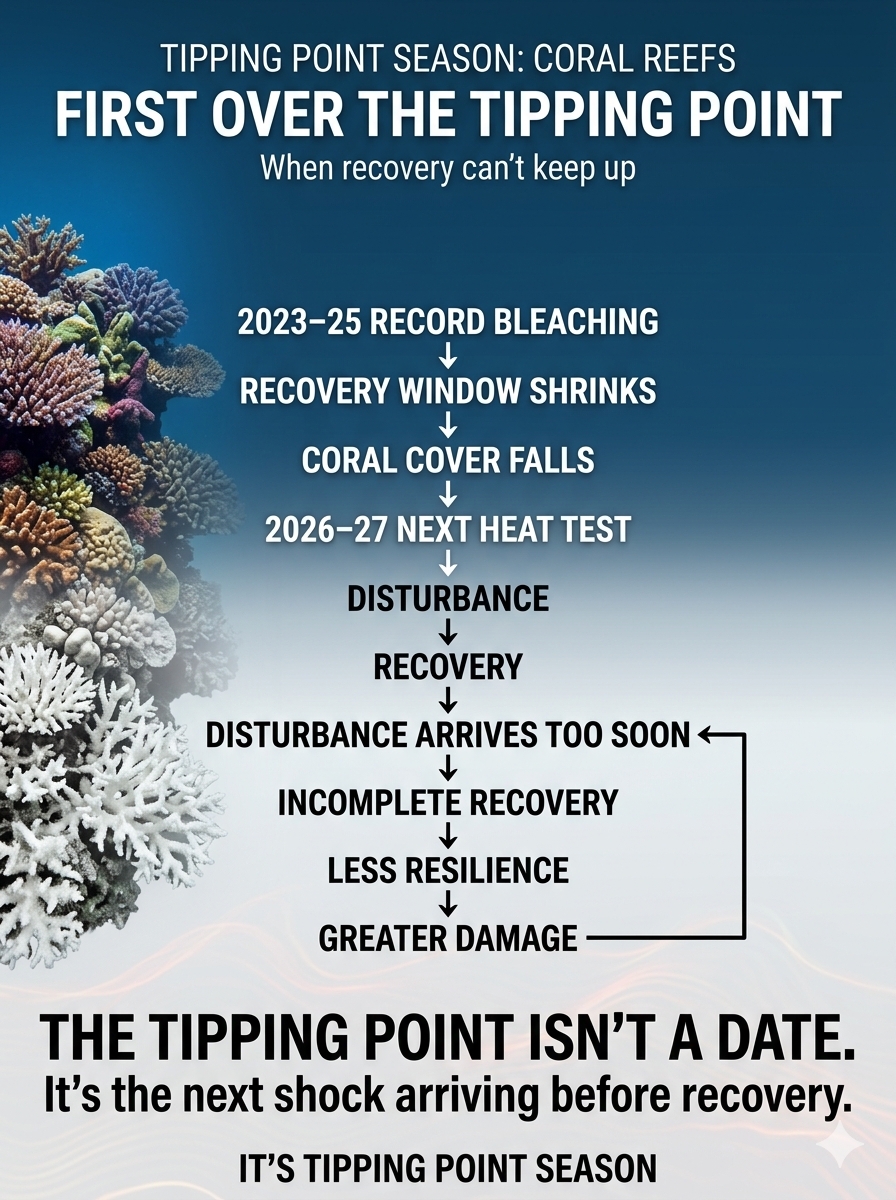
Heatwave → bleaching → partial recovery → next heatwave → additional mortality → partial recovery → next heatwave.
At first, the system appears resilient because some recovery occurs after every event.
But if recovery is incomplete, the baseline gradually falls.
The next event therefore begins from a lower level than the previous one.
Over time:
- living coral cover declines;
- coral colonies become smaller and less reproductively mature;
- reef architecture becomes less complex;
- fish habitat declines;
- carbonate production is reduced;
- recruitment becomes more difficult;
- algae can occupy space formerly occupied by corals;
- local water-quality and fishing pressures become more consequential;
- and the capacity of the reef to recover from the next disturbance diminishes.
This is a nonlinear process because the consequences of each disturbance increasingly depend upon the condition created by previous disturbances.
From Feedback to Amplification
This is where the coral story enters the broader Tipping Point Season framework.
A climate disturbance can initiate a feedback sequence:
Ocean warming → coral bleaching → coral mortality → loss of reef structure → reduced ecological resilience → slower recovery → greater vulnerability to the next heatwave.
At the same time, other pressures can compound the process.
Overfishing can alter food-web dynamics. Poor water quality can increase physiological stress. Coastal development can damage habitat and sediment water. Disease can become more consequential in already stressed populations.
These pressures do not have to be equally important everywhere. The critical point is that multiple stressors can interact with climate-driven heat stress.
A reef weakened by one pressure may be less capable of absorbing another.
The system can therefore move from a condition of resilience toward a condition of fragility.
The Fourth Global Bleaching Event Was Different
The four global bleaching events provide a revealing sequence.
The first occurred in 1998. The second occurred in 2010. The third occurred in 2016. The fourth began in 2023 and produced unprecedented global heat stress through 2025.
NOAA's final assessment found that the fourth event affected approximately 84.4% of global reef area with bleaching-level heat stress—far exceeding the previous record.
The events are therefore not simply four independent episodes.
They form a sequence.
And the intervals between them matter.
The first question is:
How severe was each disturbance?
The more important question for a tipping system is:
How much recovery occurred before the next disturbance arrived?
2026: The Next Season Begins
NOAA now reports that the fourth global bleaching event likely ended in 2025. But “ended” does not mean that the reef system returned to its previous state.
That distinction is essential.
A bleaching event can end while the ecological consequences continue.
Dead coral does not instantly become living coral again. Reef architecture does not immediately rebuild. Reproductive populations do not instantly recover. Ecological relationships do not reset to their previous configuration.
The system carries the disturbance forward.
And now the next disturbance regime is emerging.
NOAA's August 2026 ENSO assessment reports a strengthening El Niño, with a greater than 90% probability of a very strong event during the Northern Hemisphere fall and winter of 2026–27. NOAA notes that El Niño can increase ocean temperatures and raise the risk of renewed widespread coral bleaching.
This means the next major stress period does not begin with global reefs restored to their pre-2023 condition.
It begins with an already damaged system.
The 2026–2027 Test
This makes the coming period particularly important.
If another widespread marine heatwave produces substantial bleaching before many reefs have recovered, the event will function as more than another episode of coral stress.
It will test whether the system has entered a new dynamic regime.
The sequence becomes:
2023–2025: Record global heat stress
↓
2025–2026: Partial recovery and continuing ecological damage
↓
2026–2027: Renewed El Niño and increasing heat risk
↓
Repeated bleaching before full recovery
↓
Lower coral cover and reduced structural complexity
↓
Reduced resilience
↓
Greater vulnerability to the next disturbance
This is the architecture of a tipping-point cascade.
When Recovery Becomes the Threshold
The conventional way of discussing ecological tipping points emphasizes a critical value: a temperature, rainfall level, population density, or other measurable threshold beyond which a system abruptly changes state.
Coral reefs suggest another possibility.
The critical threshold may be temporal.
The decisive variable may be the relationship between:
the time required to recover
and
the time available before the next disturbance.
Once the recovery window becomes consistently shorter than the recovery requirement, the system can enter a self-reinforcing trajectory of degradation.
That is why the latest GCRMN findings are so important. The report does not merely document coral loss. It documents the erosion of the conditions necessary for recovery.
Past the Point of Restoration—or Transformation?
It is important to distinguish between coral survival and reef persistence in its historical form.
Some corals will survive. Some reefs will recover. Some regions may remain comparatively resilient. The GCRMN assessment itself shows substantial geographic differences, including regions where coral cover has increased.
Therefore, “coral reefs are gone” is not an accurate description of the global situation.
The more consequential possibility is that many reefs are being pushed toward a different ecological state.
A reef may retain coral while losing much of the species composition, three-dimensional structure, productivity, biodiversity, and ecological relationships that characterized the earlier system.
In that sense, the tipping point is not necessarily the disappearance of every coral.
It is the loss of the self-maintaining reef system.
Once the biological and physical structure has been sufficiently degraded, returning to the original state may require conditions that no longer exist.
Why Coral Reefs Matter Beyond Coral
Coral reefs are not isolated ecosystems.
They are infrastructure.
They provide habitat for marine species, support fisheries and tourism, contribute to coastal protection, and sustain cultural and economic systems for hundreds of millions of people.
When coral declines, these functions can decline as well.
The loss therefore propagates outward:
Coral loss → habitat loss → biodiversity loss → fisheries stress → economic disruption → coastal vulnerability.
This is another defining characteristic of a tipping-point system.
The initial disturbance occurs in one component, but the consequences propagate through connected systems.
Coral Reefs in the Tipping Point Season
Coral reefs represent one of the first global ecosystems in which the transition from isolated shocks to persistent cascade dynamics can be observed in real time.
The evidence is not a single number.
It is the convergence of multiple signals:
- record-breaking global bleaching;
- increasing marine heatwave frequency;
- shortening recovery intervals;
- declining global hard-coral cover;
- repeated mortality events;
- loss of reef structural complexity;
- interaction with local ecological stressors;
- and renewed heat stress arriving before global recovery is complete.
Individually, each signal can be interpreted as another environmental problem.
Together, they describe a changing system.
The Tipping Point Is Not a Date
This leads to an important conclusion.
The coral-reef tipping point should not necessarily be represented as a particular year on a calendar.
It is better understood as a transition in system behavior.
Before the transition, a reef experiences disturbance and returns toward its previous state.
During the transition, recovery becomes incomplete.
After the transition, each disturbance leaves the system farther from its previous state, while the remaining system becomes increasingly vulnerable to the next disturbance.
That is what a tipping point looks like when viewed dynamically.
Conclusion: The Season Has Changed
Coral reefs have not disappeared.
But the conditions under which they historically recovered are disappearing.
The fourth global coral bleaching event demonstrated the scale of the new climate regime. The latest global assessment demonstrates that coral cover has declined and that the recovery window between major disturbances is narrowing. NOAA's current ENSO outlook indicates that another period of elevated ocean heat risk is developing as the 2026–2027 season approaches.
This is the central insight of the Tipping Point Season framework:
A tipping point may become visible not when a system suddenly collapses, but when the system can no longer recover between shocks.
For coral reefs, that process is increasingly observable.
The danger is no longer simply that the next heatwave will bleach the reef.
The danger is that the next heatwave will arrive while the reef is still recovering from the last one.
Then another follows.
And another.
Each begins from a weaker baseline.
Each reduces resilience.
Each makes the next disturbance more consequential.
That is the beginning of a cascade.
And if the process continues long enough, the question changes from:
“When will the coral reef collapse?”
to:
“How much of the original reef system can still recover?”
That may be the most important tipping-point question of all.
Sources
- NOAA Coral Reef Watch — Global Coral Bleaching Event assessment, updated June 2, 2026.
- NOAA Coral Reef Watch — ENSO Conditions and Alerts, August 13, 2026.
- Global Coral Reef Monitoring Network — Status of Coral Reefs of the World: 2025, released August 31, 2026.
- Australian Institute of Marine Science — assessment of global coral reef trends.
Read the full report: This is Tipping Point Season
Easy-to-Read Resources