Tipping Point Season:
Permafrost Thaw
1Climatologist, Economist
2Physicist
September 2026
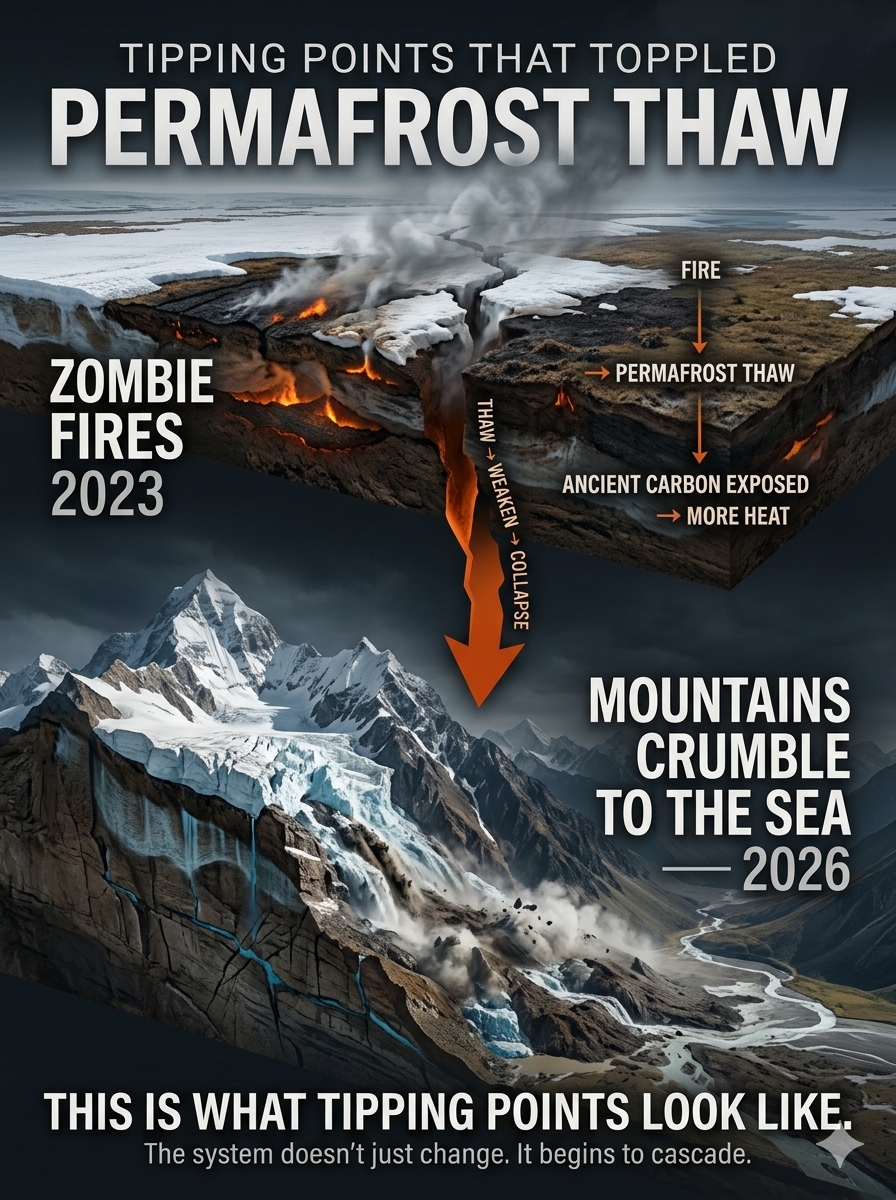
Warming → Thaw → Microbial Decomposition → Greenhouse-Gas Emissions → Additional Warming → Additional Thaw
Permafrost is not simply frozen dirt.
It is a massive reservoir of organic carbon accumulated over thousands of years. When frozen ground thaws, microbes gain access to previously locked organic material. They decompose it and release carbon dioxide and, under oxygen-poor conditions, methane.
That creates a feedback:
warming → thaw → microbial decomposition → greenhouse-gas emissions → additional warming → additional thaw.
But that is only one part of the process.
Permafrost is also physically coupled to vegetation, soil moisture, hydrology, fire, snow cover and ground ice.
Once those connections begin changing rapidly, the response can become nonlinear.
The “Compost Bomb” Effect
One of the most striking mechanisms is what can be called the “compost bomb” or self-heating effect.
When previously frozen organic matter thaws, microbial decomposition accelerates. Decomposition is an exothermic process: biological activity releases heat. That heat is not large enough to explain Arctic warming by itself, but locally it can become part of a reinforcing thermal environment.
That warming activates biological processes that themselves produce heat and greenhouse gases inside a system already undergoing thermal destabilization.
The frozen carbon reservoir is effectively being converted from a long-term carbon store into an active component of the carbon cycle.
Water Carries the Heat
Rain and changing hydrology provide another pathway.
Permafrost responds not only to air temperature but to the movement of heat through the ground.
Warm rain can penetrate the active layer and transport heat downward. Changes in snow, soil moisture, drainage and groundwater can alter how efficiently heat is stored and transferred through frozen ground.
The result is a system in which atmospheric warming, precipitation, hydrology and ground temperature interact.
This is particularly important because the response is not necessarily gradual.
Research on abrupt permafrost thaw has shown that collapsing ground, rapid erosion, landslides and thermokarst can expose large quantities of previously protected carbon much faster than gradual thaw models assume. Abrupt thaw may occur across less than 20% of the permafrost zone yet potentially affect roughly half of its stored permafrost carbon.
That is a tipping mechanism.
Not because every square mile of permafrost suddenly disappears, but because a relatively limited area of abrupt thaw can have a disproportionately large effect on the carbon cycle.
Thermokarst: When Frozen Ground Loses Its Structure
Permafrost is also a structural system. Ice binds soil and sediment together. When that ice melts, the ground can collapse.
The result is thermokarst—a landscape of subsidence, ponds, lakes, gullies, and collapsing terrain. Thermokarst forms when ice-rich permafrost thaws, causing the ground surface to collapse and creating uneven, pitted landscapes of depressions, hollows, and thermokarst lakes.
El Niño can trigger positive Pacific–North American teleconnection anomalies, driving unusually warm winter conditions across northwestern North America and parts of Siberia. These winter temperature spikes, combined with localized wildfire cycles, can accelerate active-layer thaw and thermokarst formation. The mechanism involves Northern Hemisphere winter atmospheric wave trains associated with the PNA pattern.
This can expose deeper layers of ancient carbon, including carbon-rich deposits such as Yedoma, to oxygen, microbes, water, and atmospheric processes.
The important distinction is between gradual thaw and abrupt thaw.
Gradual thaw progressively deepens the seasonally thawed active layer. Abrupt thaw can physically destroy the ground.
That difference matters enormously.
Once the ground collapses, hydrology changes. Lakes form or drain. Slopes destabilize. Sediment moves. Previously protected organic material becomes exposed.
The carbon cycle has effectively changed gears.
Fire Removes the Insulating Blanket
Then there is fire.
The extraordinary Canadian and Siberian wildfires of recent years are not merely consequences of Arctic warming. They can also become mechanisms that accelerate permafrost degradation.
The surface vegetation, moss and peat layer acts as an insulating blanket. Fire removes that blanket. The exposed soil can absorb substantially more solar energy, increasing ground temperatures and deepening the active layer.
The effect can persist for decades.
Research in Canadian permafrost peatlands has found that wildfire impacts on the soil thermal regime can persist for approximately 30 years, with burned areas experiencing warmer and deeper active layers and accelerated thermokarst development.
The relationship works in both directions.
Warming promotes fire.
Fire promotes permafrost thaw.
Thaw can promote soil drying and further fire.
Recent modeling research published in Nature Communications found that rapid permafrost thaw can produce abrupt changes in soil hydrology, surface warming and atmospheric dryness that intensify Arctic and sub-Arctic wildfires, particularly in western Siberia and Canada.
This is not a single feedback loop.
It is a network of feedback loops.
The Zombie-Fire Connection
The most disturbing manifestation is the phenomenon popularly called the “zombie fire.”
Peat and organic soils can continue smoldering beneath the surface after the visible flames disappear. These fires can survive through winter and re-emerge when conditions become favorable.
That means a previous year’s fire can effectively become the seed for the next year’s fire. The system acquires memory.
And that matters because climate tipping behavior often involves precisely this kind of persistence: the system does not return to its previous state when the original disturbance ends.
The fire changes the ground. The changed ground changes the next fire. The next fire changes the ground again.
Meanwhile, the carbon released by both combustion and thaw adds additional greenhouse gases to the atmosphere.
The 2023 Canadian fire season demonstrated the scale of this problem. A Nature study estimated approximately 647 million tonnes of carbon (647 TgC) were emitted by Canadian fires from May through September 2023—comparable to the annual fossil-fuel carbon emissions of a major industrial nation. The burned area was more than seven times the average annual area of the preceding four decades.
The climate system is therefore not merely warming the Arctic.
It is increasingly capable of removing the mechanisms that kept the Arctic frozen.
Then Came Nepal and Tibet
And this brings us to the next level of the argument.
On August 26, 2026, a massive collapse occurred in the Nepal–Tibet border region.
A glacier and associated rock mass collapsed from approximately 5,200 meters, sending ice, rock, sediment and water cascading more than 1,200 meters into the valley below. The resulting event produced a catastrophic flash flood through the Bhotekoshi and Trishuli river systems.
The scale was extraordinary.
By September 3, more than 1,200 people had been reported dead in Nepal, thousands remained missing, entire communities had been destroyed, and thousands of homes had been destroyed or rendered uninhabitable.
It might be premature to claim that the 2026 El Niño directly caused the Nepal–Tibet collapse. The scientific investigation is still developing. But that does not make the event irrelevant to tipping-point dynamics.
Quite the opposite.
It demonstrates what happens when multiple components of a cryospheric system become unstable simultaneously.
Glacier.
Rock.
Water.
Permafrost.
Slope stability.
River system.
Infrastructure.
One failure can trigger another.
That is the essence of a tipping cascade.
The Second Derivative of the Problem
The August 26, 2026 Nepal–Tibet event was something more than simply another climate disaster.
The first derivative is change. The second derivative is acceleration of change.
But there is another level beyond acceleration:
the coupling of changes.
A glacier loses mass. Permafrost warms. Ground ice melts. Water penetrates fractures. The frozen material that once helped bind rock and soil together loses strength. Slopes become unstable. Rock loses support. Glacial ice moves. A glacier, rock mass, or entire mountainside collapses. The collapse mobilizes ice, water, sediment and debris. The resulting torrent can destroy roads, bridges, vehicles, homes and entire sections of river valleys.
One destabilized component triggers another.
That is a tipping cascade.
And this is precisely why treating every tipping point as an isolated phenomenon misses the larger danger.
Permafrost Is the Glue
Following the catastrophic August 26, 2026 bedrock failure and glacier collapse along the Nepal–Tibet border near Langtang Lirung, geomorphologists have increasingly scrutinized the role of high-altitude permafrost in mountain stability.
In high-altitude alpine environments such as the Himalayas, permafrost is not merely frozen soil. It can function as a critical structural component of the mountain itself.
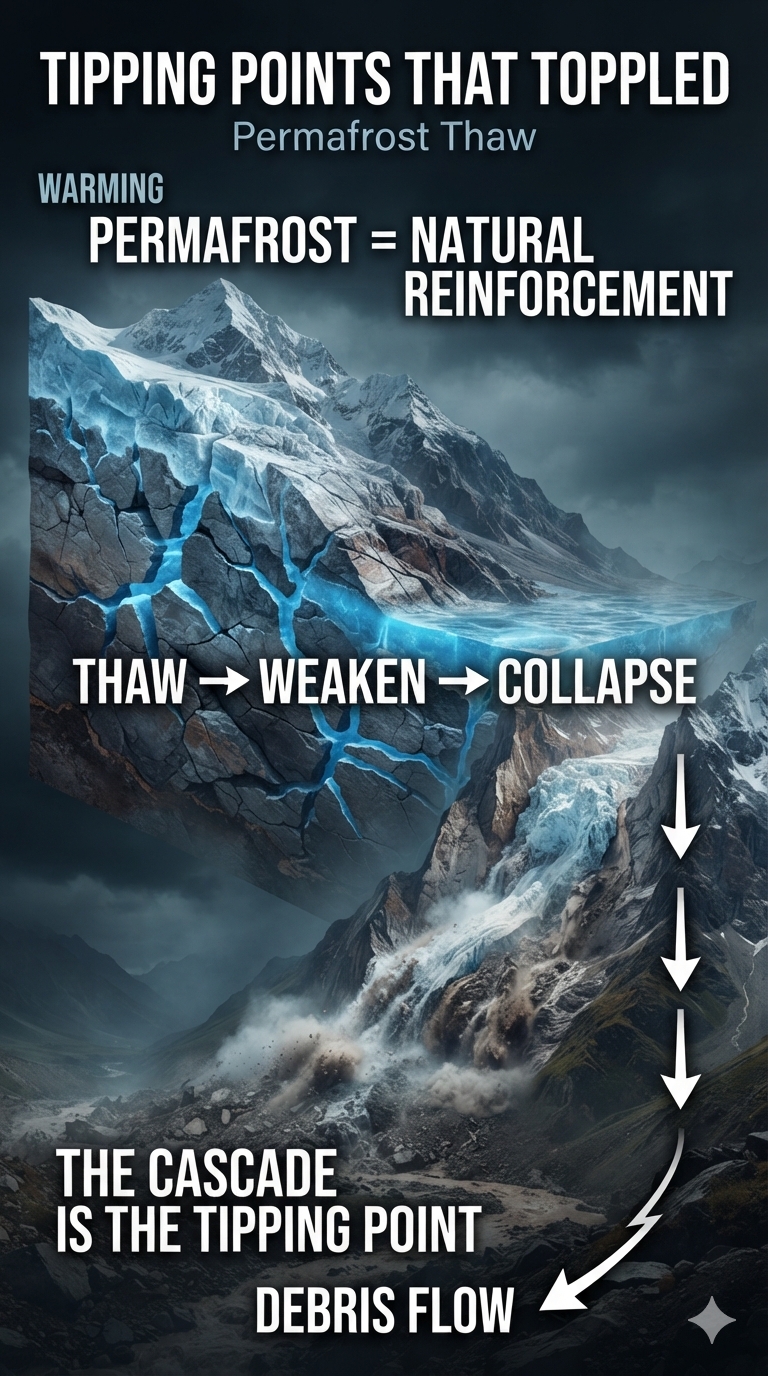
Ice within fractures, rock pores and sediment acts as a natural cement. Frozen ground can increase the mechanical strength of slopes and help stabilize otherwise extremely steep terrain. When that ground warms and the ice melts, the mechanical properties of the mountain change.
The mountain does not simply become warmer.
It becomes structurally weaker.
That distinction is fundamental.
For thousands of years, freezing temperatures helped lock together rock, sediment, ice and soil. Climate warming attacks that system from multiple directions simultaneously. Higher air temperatures warm the ground. Changing snow cover alters the insulation of the surface. Meltwater and rainfall can penetrate fractures. Repeated freeze–thaw cycles weaken rock. And as permafrost ice melts, the frozen bonds that previously helped hold the landscape together disappear.
The result can be progressive destabilization followed by abrupt failure.
This creates a particularly dangerous feedback:
warming → permafrost thaw → loss of structural strength → slope instability → collapse → debris and water mobilization → downstream destruction.
And the process does not necessarily stop at the first collapse. A collapsing glacier can destabilize rock. A rock avalanche can displace enormous quantities of water. Water can erode and destabilize additional slopes. Sediment can transform a river into a rapidly moving debris flow. The debris flow can destroy infrastructure and alter the river channel. A newly formed blockage can create a temporary lake that becomes another hazard when it fails.
In other words, the mountain itself can become a chain reaction.
The Permafrost Connection
This is where the Nepal–Tibet event becomes particularly important to the broader tipping-point argument.
Permafrost is one of the hidden components of the cryosphere. Unlike a retreating glacier, its destabilization is often invisible until the physical structure it supports begins to fail.
You may not see permafrost disappearing. You see what happens after it disappears. You see rockfalls. You see landslides. You see collapsing slopes. You see thermokarst. You see rivers suddenly carrying enormous quantities of sediment. And, in extreme cases, you see entire mountainsides transform from solid terrain into a rapidly moving mixture of rock, ice, water and soil.
That is why the Nepal–Tibet collapse can be viewed as a possible second-order manifestation of cryospheric destabilization.
The first-order effect is warming. The next effect is permafrost degradation. The next is loss of structural integrity. Then comes cascading physical failure. The climate signal has effectively been converted into mechanical energy.
Frozen ground becomes unstable ground.
Stable ground becomes a landslide.
A glacier becomes a flood.
A mountainside becomes a river of debris.
That is what makes tipping cascades so different from ordinary linear climate change. The danger is not simply that each component changes. The danger is that the components are connected. Permafrost can be the glue holding the system together.
Remove the glue, and the pieces do not merely move independently.
They can bring each other down.
This is the second derivative of the problem:
not merely that the climate is changing, and not merely that the rate of change is accelerating, but that increasingly unstable components are beginning to interact in ways that amplify one another.
And when those interactions become visible as collapsing mountains, cascading glaciers, flash floods and debris flows, the tipping point is no longer something we have to imagine.
You can watch it happen.
Climate Energy Becomes Fluidized
There is something visually profound about events like this. Climate energy is normally discussed in abstract units: joules, watts per square meter, degrees Celsius. But once enough energy accumulates in the Earth system, its consequences become physical.
Ice melts.
Rock fractures.
Slopes collapse.
Water accelerates.
Sediment becomes a moving fluid.
Rivers jump their banks.
Roads disappear.
Bridges are ripped from their foundations.
Cars, homes, trees and entire sections of mountains can become part of a single moving mass.
You can literally watch stored climate energy being converted into motion.
That is the part that makes these events so difficult to dismiss as theoretical.
From the Arctic to Pennsylvania
The connection is not confined to the Arctic.
When smoke from the Canadian wildfires descended into Pennsylvania in both 2023 and 2026, the feedback was no longer an abstract Arctic phenomenon. It became observable from the ground. People who had never seen the Arctic could see the consequences of an increasingly unstable northern climate hundreds or thousands of miles away.
The smoke was a visible atmospheric connection between a rapidly changing high-latitude system and everyday life in the northeastern United States.
That is another characteristic of cascading climate disruption:
distance stops protecting us.
The Dominoes Are Already Moving
This is ultimately “tipping points that toppled” means. A tipping point is often imagined as a single dramatic moment when a system suddenly crosses a line. Earth systems are rarely that simple. They are networks.
Coral reefs are connected to ocean temperature, marine heatwaves, disease, ocean chemistry and ecological recovery.
Permafrost is connected to air temperature, snow, vegetation, soil moisture, microbial activity, hydrology and fire.
Glaciers are connected to temperature, precipitation, meltwater, rock stability, permafrost and downstream hydrology.
These systems interact.
A destabilized system can therefore push another system toward instability.
That is the real danger.
The 2023–2025 coral bleaching catastrophe demonstrated how quickly a global ecosystem can be subjected to unprecedented simultaneous heat stress. The permafrost-fire relationship demonstrates how warming can activate feedbacks that reinforce the original warming. The 2026 Nepal–Tibet catastrophe demonstrates how instability within a cryospheric system can cascade through ice, rock, water and infrastructure.
And the 2026–2027 El Niño is now arriving on top of all of it.
NOAA’s current assessment gives this El Niño a greater than 90% probability of becoming very strong, with a substantial probability of reaching historic strength. We should therefore stop asking only:
“Has a tipping point been crossed?”
The more important question is:
“How many systems are already unstable enough that the next disturbance can push them into a new state?”
Because that is what tipping cascades look like. Not one domino. A row of them. And increasingly, we can watch them fall.
They are no longer merely theoretical. They are observable. They are physical. And they are happening now.
Read the full report: This is Tipping Point Season
Easy-to-Read Resources