The Humidity Paradox: Why a Warmer Atmosphere Is Getting Wetter—and Drier at the Same Time
Introduction
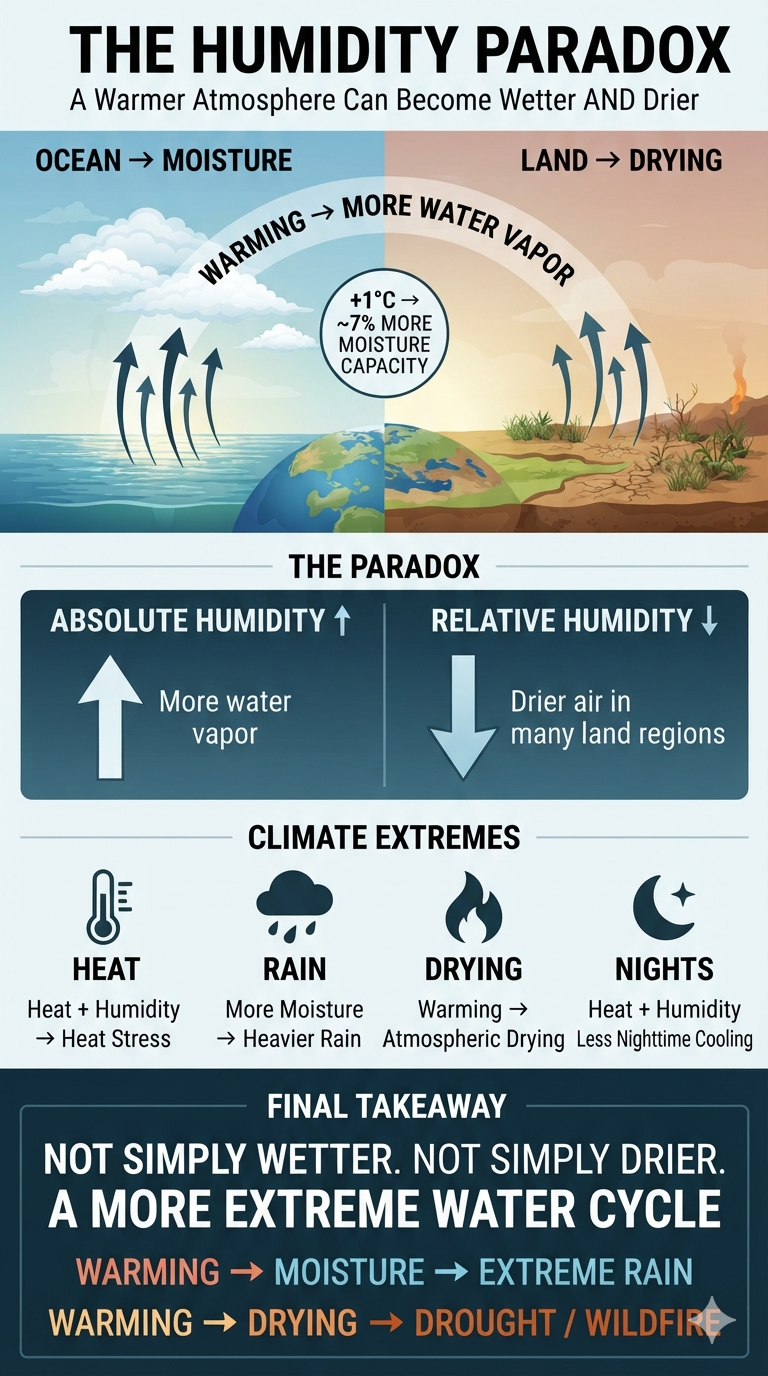
Absolute humidity—the total amount of water vapor in the air—is increasing globally as the climate warms. The fundamental physics is straightforward: according to the Clausius–Clapeyron relationship, warmer air can hold substantially more water vapor. For every 1°C (1.8°F) of warming, the atmosphere’s water-holding capacity increases by roughly 7%.
As human-caused greenhouse gas emissions raise global temperatures, evaporation from the oceans and land surface increases, adding more water vapor to the atmosphere. This creates an important distinction, however: the atmosphere can contain more water vapor even while relative humidity declines in many regions.
The Humidity Paradox
Absolute humidity measures how much water vapor is actually present in the air.
Relative humidity measures how close the air is to saturation relative to the maximum amount of moisture it could hold at that temperature.
Because warmer air has a rapidly increasing moisture capacity, these two measurements can move in different directions.
Over Much of the Ocean
Absolute humidity has increased substantially across much of the global ocean as the atmosphere warms. In some regions, ocean-surface and near-surface air temperatures have increased by more than 10°C relative to historical conditions for significant periods. Because warmer air can hold substantially more water vapor—roughly 7% more per 1°C of warming—the moisture-holding capacity of the atmosphere can become dramatically larger.
Over Much of the World’s Land
Relative humidity has declined across many continental regions. Land surfaces generally warm faster than the oceans, particularly in already-dry and semi-arid regions. As temperatures rise, the atmosphere’s capacity to hold water vapor can increase faster than the actual moisture supplied by evaporation. The result is a drying demand on the land: the atmosphere pulls moisture more aggressively from soils, vegetation, and other surface reservoirs—intensifying soil moisture loss, plant stress, drought conditions, and wildfire risk.
The result is a paradoxical combination: More floods AND more droughts.
Over Land and Dry Regions
Several regions show particularly pronounced drying trends:
- American West and Southwest: Rapid warming is increasing atmospheric moisture demand faster than water availability in many areas, intensifying drought and wildfire conditions.
- Interior South America: Parts of the Amazon Basin and surrounding interior regions are experiencing declining relative humidity as warming and land-use change affect moisture recycling.
- Mediterranean Basin and Southern Europe: Declining relative humidity contributes to stronger atmospheric drying, soil desiccation, and more severe heat and drought conditions.
- Southern Africa and Central Asia: Large continental interiors are increasingly exposed to atmospheric drying because warming is increasing moisture demand faster than local moisture supplies can compensate.
Over Oceans and Moisture-Rich Regions
Over much of the ocean, relative humidity is more stable because evaporation provides a continuing source of atmospheric moisture. In some regions, relative humidity can increase because of ocean warming, atmospheric circulation changes, and enhanced moisture transport.
The tropical oceans are especially important. Their vast warm-water surfaces provide enormous quantities of moisture to the atmosphere, helping maintain high humidity and supplying the water vapor that can fuel intense precipitation and tropical cyclones.
In the Arctic and other high-latitude regions, declining sea ice exposes more open ocean to the atmosphere. Increased evaporation from newly exposed water can raise local atmospheric moisture and influence clouds, precipitation, and regional energy balance.
Monsoonal regions can also experience large seasonal increases in humidity when atmospheric circulation transports moisture-rich maritime air over land, producing dangerous combinations of heat and humidity.
The Dangerous Consequences of Rising Atmospheric Moisture
1. Severe Heat Stress
Humidity directly affects the body’s ability to cool itself.
When air is already moisture-rich, sweat evaporates less efficiently. This reduces the body’s primary mechanism for dissipating heat and can sharply increase heat stress, particularly during prolonged periods of extreme heat.
The combination of high temperature + high humidity is therefore much more dangerous than temperature alone suggests.
2. More Extreme Rainfall
A warmer atmosphere can contain more water vapor. When moisture-rich air rises, cools, and condenses, that additional atmospheric moisture can contribute to substantially heavier precipitation.
This creates an important climate feedback:
Warming → More atmospheric moisture → Greater precipitation potential → More extreme rainfall → Greater flood risk
The same atmosphere that can become dangerously dry over land between storms can also produce much more intense rainfall when moisture is concentrated and lifted.
3. Hotter and More Humid Nights
High humidity can reduce nighttime evaporative cooling, particularly when temperatures remain elevated.
This matters because the human body needs nighttime cooling to recover from daytime heat exposure. When nights remain unusually warm and humid, physiological heat stress can accumulate over consecutive days.
The result is another dangerous combination:
Hotter days + warmer nights + higher humidity = greater cumulative heat stress.
One Atmosphere, Two Humidity Signals
The apparent contradiction between increasing absolute humidity and declining relative humidity disappears when the two measurements are understood as different properties of the atmosphere.
Absolute humidity asks: How much water vapor is actually there?
Relative humidity asks: How much water vapor is there compared with how much the warmer air could potentially hold?
Climate warming can therefore produce both simultaneously:
More atmospheric water vapor globally
while
relative humidity declines across many warming continental interiors.
This is one of the most important—and frequently misunderstood—features of climate-driven hydroclimatic change.
The atmosphere is becoming wetter in absolute terms while becoming more moisture-hungry in many land regions.
That combination can intensify the hydrologic extremes of a warming world:
More atmospheric moisture → More extreme precipitation
Warmer land → Lower relative humidity → Greater atmospheric drying demand
Higher humidity + higher temperatures → Greater heat stress
Hotter oceans → More evaporation → More atmospheric moisture
The result is not simply a “wetter” or “drier” planet.
It is a planet with a more energetic and increasingly polarized water cycle, where extreme moisture and extreme atmospheric drying can occur closer together in both space and time.
Extreme Impacts: Extreme Weather Events | Violent Rain | Deadly Humid Heat | Sea Level Rise | Insurance
Ecosystems & Feedbacks: Ecosystem Collapse & Extinction Risks | Soil–Insect Climate Feedback Collapse | Insect Collapse | Soil | Trees & Deforestation
Human Health & Society: Climate Change Business & Economics | DIY Climate Control | Climate & Human Health | Climate Tax | Limits of Human Adaptability | Climate-Driven Health Collapse | Food & Water Security | Civilization Collapse