When Climate Moves the Crust: The Earth Quakes
1Independent Climatologist, Economist, Membrane Domain, USA
2Independent Physicist, Membrane Domain, USA
Published: August 17, 2026
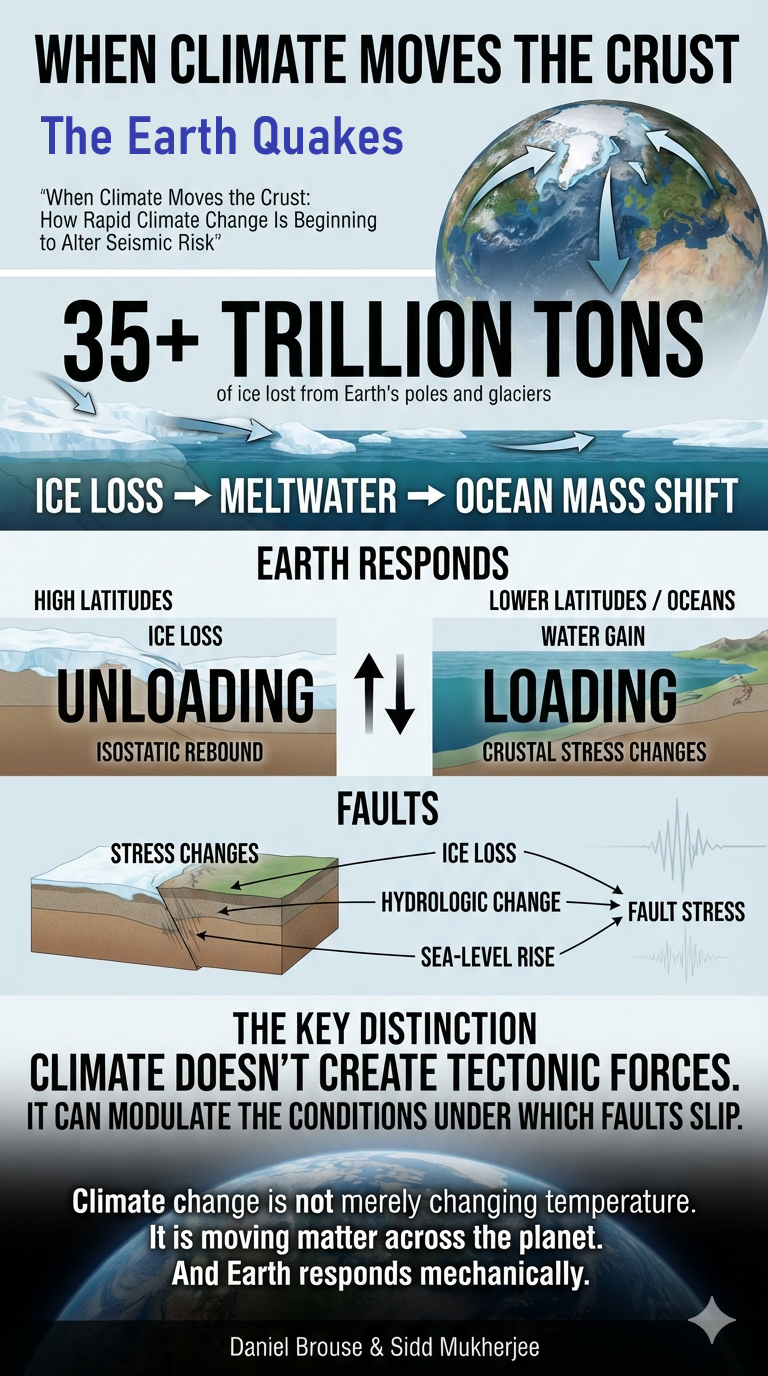
For decades, we have studied the relationship between earthquakes and climate change. Early in that work, there was little evidence that changes in global temperature were having any meaningful effect on tectonic activity. That conclusion was reasonable at the time. Climate change was expected to progress relatively slowly, over centuries or even millennia, and the resulting changes in surface mass and hydrological conditions were correspondingly gradual.
That assumption no longer describes the world we are entering.
The rate of climate change has accelerated dramatically, and many of the associated physical changes are now occurring on timescales measured in decades, years, and—in some cases—even months. This does not mean that global warming is heating the Earth’s crust enough to expand tectonic plates and cause earthquakes. That effect remains negligible.
The more important mechanism is mass redistribution.
Climate change is rapidly moving enormous quantities of water and ice around the planet. Ice sheets are losing mass, glaciers are retreating, permafrost is thawing, groundwater is being depleted or redistributed, reservoirs and lakes are experiencing increasingly extreme fluctuations, and sea level is rising. These changes alter the loads imposed on Earth’s crust and, in some locations, the pressure and stress conditions surrounding faults.
Earthquakes are ultimately controlled by stress. A fault can remain locked for centuries while tectonic forces slowly accumulate until the stress exceeds the fault’s resistance to slip. Climate-driven changes in surface loading do not create the tectonic forces responsible for most earthquakes, but they can modulate the timing, location, and frequency of seismic events by nudging already-stressed faults closer to—or farther from—the point of failure.
That distinction is critical.
Climate change does not need to cause tectonic earthquakes to become a meaningful factor in seismic risk. It only needs to change the conditions under which faults fail.
Glacial Unloading
One of the clearest mechanisms is the loss of glacial and ice-sheet mass.
For thousands of years, enormous glaciers and ice sheets have imposed immense loads on the Earth’s crust. When that mass is removed, the crust responds through a process known as isostatic rebound. The underlying crust rises as the weight above it decreases, changing the distribution of stress within the lithosphere.
In regions undergoing rapid deglaciation, this unloading can alter stress on existing faults and increase seismic activity. The effect is particularly important because the removal of ice can continue for decades or centuries after the initial climatic warming.
The key point is simple: when climate change removes trillions of tons of mass from the surface, the crust responds.
Permafrost Thaw and Meltwater
The destabilization of frozen ground introduces another mechanism.
As permafrost thaws and glaciers retreat, meltwater can penetrate fractured rock and mountain systems. Increased fluid pressure within faults can reduce the effective normal stress holding the fault surfaces together. In simplified terms, water can make it easier for an already stressed fault to slip.
This does not mean that every episode of melting will produce an earthquake. Rather, it creates another pathway through which rapid environmental change can influence the mechanical conditions surrounding faults.
Where faults are already near failure, relatively small changes in fluid pressure can matter.
Hydrostatic Load Shifts
Climate change is also producing increasingly extreme changes in the distribution of surface water.
Severe droughts remove enormous quantities of water from reservoirs, lakes, soils, and groundwater systems. Extreme precipitation and monsoon events can then return massive amounts of water over remarkably short periods.
That changing weight alters the stresses imposed on the crust.
Large reservoirs have long been recognized as capable of inducing or modulating seismicity, particularly where water infiltration increases pore pressure along faults. Climate-driven swings in precipitation, drought, groundwater storage, snowpack, and reservoir levels can produce similar loading and unloading effects, although the magnitude and significance vary greatly by location.
The important issue is not simply how much water exists. It is where that water is, how rapidly it moves, and how that movement changes the stress field.
Sea-Level Rise
Sea-level rise represents another large-scale redistribution of mass.
As land-based ice melts, water that was previously stored on continents is transferred into the oceans. At the same time, the increasing weight of seawater changes the loading conditions along continental margins and beneath coastal regions.
These effects are generally small compared with the enormous tectonic forces responsible for earthquakes. Nevertheless, in regions containing faults already close to failure, even relatively small changes in stress can influence the timing of seismic events.
The scientific question, therefore, is not whether sea-level rise is going to cause earthquakes worldwide. It is whether rapid changes in ocean loading can measurably influence seismicity in susceptible regions.
The Planet Is Moving Water at an Extraordinary Scale
Perhaps the most remarkable evidence that this redistribution of mass is physically significant comes from Earth’s rotation itself.
When ice sheets lose mass, that water does not disappear. It is transferred from land—particularly from the high latitudes—into the global ocean. Over time, ocean circulation and gravity redistribute that water across the planet, with a substantial portion ultimately moving toward lower latitudes.
The quantity of water involved is so enormous that the redistribution is measurable in the Earth’s rotation.
The “Figure Skater” Effect
Earth is not a perfect sphere. Its rotation causes it to bulge slightly around the equator, making the planet an oblate spheroid.
The basic physics is familiar from a figure skater spinning on ice. When mass moves farther from the axis of rotation, the moment of inertia increases and the rate of rotation decreases. When mass moves toward the axis, the opposite occurs.
The redistribution of water caused by melting ice therefore changes Earth’s moment of inertia and slightly alters the length of the day.
This is not theoretical speculation. Modern geodesy can detect these changes.
Earth has lost well over 35 trillion tons (gigatonnes) of ice from its polar ice sheets and glaciers over the past few decades, with the resulting meltwater being redistributed through the global ocean system, ultimately increasing ocean mass at lower latitudes. That represents an extraordinary transfer of mass from the high-latitude continents toward the oceans and, through gravitational and rotational processes, toward the equatorial regions.
The mechanical consequence is the counterpart to isostatic rebound. Where ice loss removes an enormous surface load and allows the crust to rebound upward, the accumulation of additional ocean water places an increasing load on the seafloor and coastal crust. In effect, while the high latitudes are experiencing unloading, lower latitudes are experiencing climate-driven loading.
The magnitude of this redistribution is difficult to comprehend: tens of trillions of tons of mass are being transferred across the planet within a geologically instantaneous interval.
Climate change is therefore not merely changing atmospheric temperature. It is physically moving enormous quantities of matter across Earth’s surface—and the solid Earth responds mechanically to that redistribution.
From Temperature Change to Mass Redistribution
This is where the relationship between climate change and seismicity becomes more interesting.
The traditional question was:
Is a warmer atmosphere heating the crust enough to cause earthquakes?
The answer is essentially no.
The more important question is:
Is rapid climate-driven redistribution of ice, water, and surface mass capable of altering the stress and pressure conditions acting on faults that are already tectonically stressed?
The answer is yes, in principle—and in some settings, observations already demonstrate that environmental loading can modulate seismicity.
The magnitude of the effect varies enormously from one region to another. Tectonic forces remain overwhelmingly dominant, and climate-related loading should not be portrayed as a replacement for conventional earthquake science.
But that is precisely why the issue deserves attention.
A fault does not have to be pushed from a state of complete stability to failure by climate change. It may only require a small additional perturbation when it is already near its failure threshold.
As climate change accelerates, the frequency and magnitude of these environmental perturbations are changing as well.
The climate system is becoming a faster-moving component of Earth’s physical system. The question is no longer whether climate can interact with the solid Earth. It is how much, where, and how rapidly those interactions can alter seismic risk.
Extreme Impacts: Extreme Weather Events | Violent Rain | Deadly Humid Heat | Sea Level Rise | Insurance
Ecosystems & Feedbacks: Ecosystem Collapse & Extinction Risks | Soil–Insect Climate Feedback Collapse | Insect Collapse | Soil | Trees & Deforestation
Human Health & Society: Climate Tax | Climate & Human Health | Limits of Human Adaptability | Climate-Driven Health Collapse | Food & Water Security | Civilization Collapse
Bottom line: The question is no longer how warm the planet becomes, but how life on Earth can endure when change outpaces our ability to adapt.
We cannot control the laws of physics, but we can control our pollution. The most effective action is to stop burning fossil fuels.