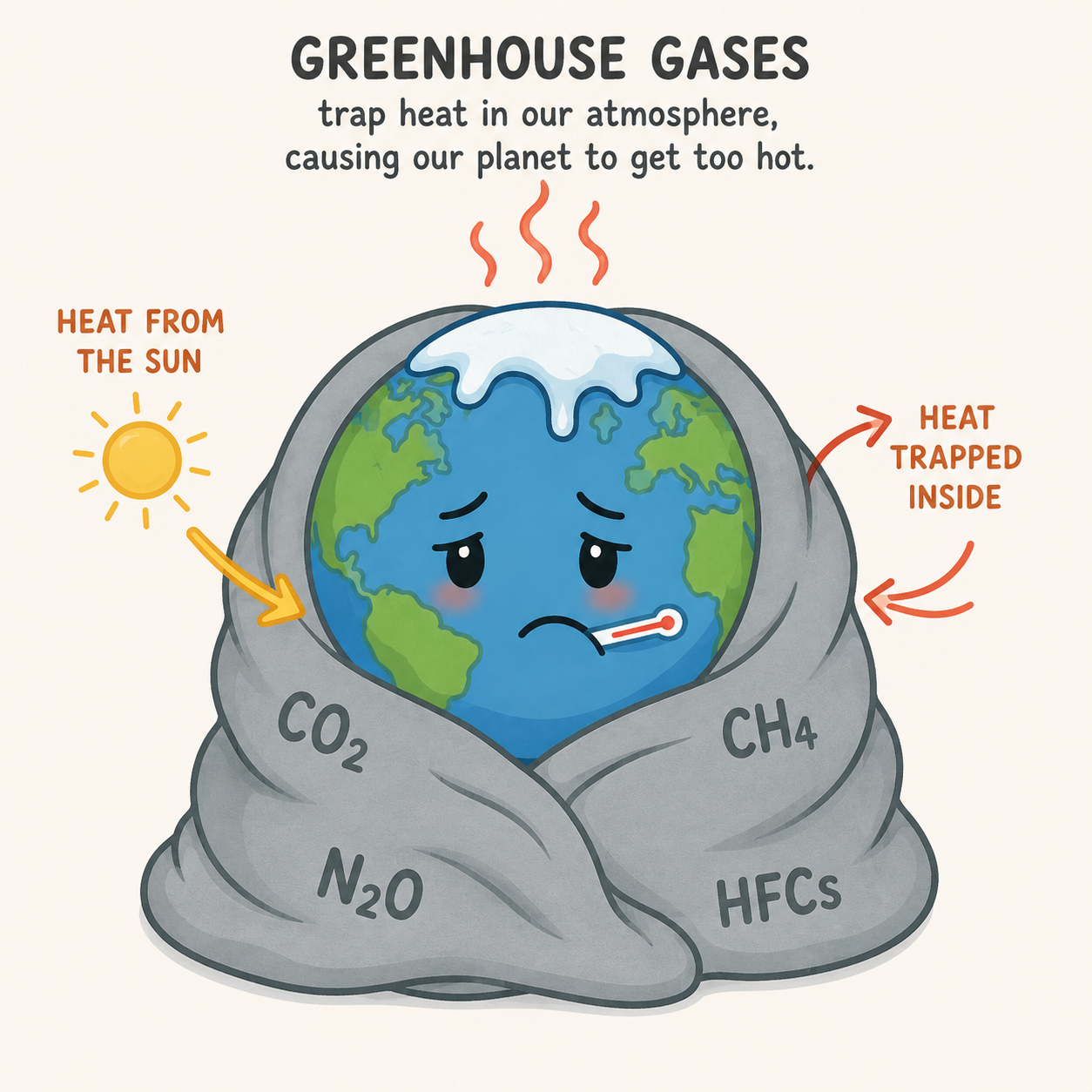
How Is the Climate Energy Hitting You?
Sudan’s Manmade Feedbacks
The Socio-Economic Multiplier
The climate hazard can intensify faster than society’s capacity to respond to it.
Hydroclimatic Whiplash and the Socio-Economic Feedback Loop
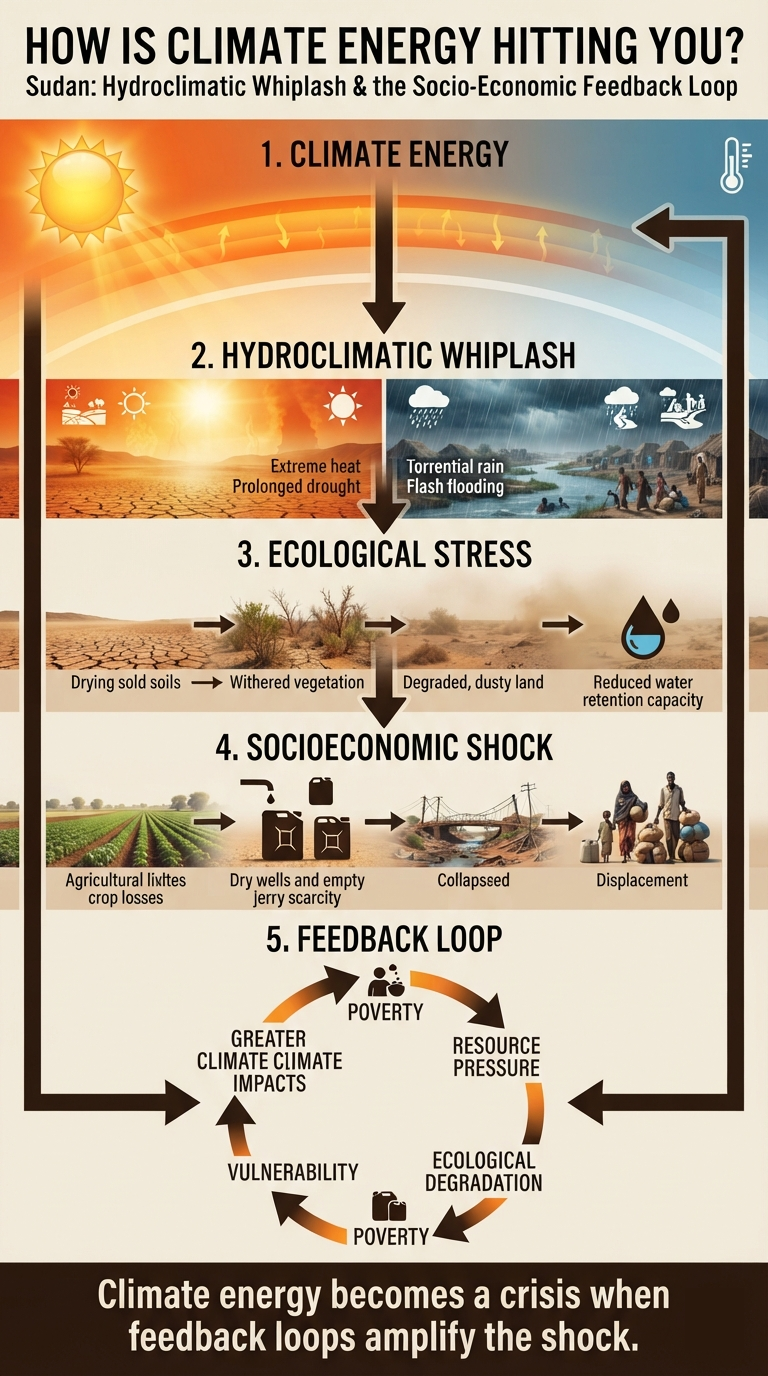
Sudan is experiencing more than a succession of extreme weather events. It is experiencing a coupled climate, ecological, and socioeconomic crisis in which each shock weakens the systems needed to absorb the next one.
Extreme heat increases water demand and accelerates soil and vegetation stress. Drought reduces agricultural productivity. Then intense rainfall arrives, producing flash floods that destroy crops, homes, roads, dams, and water infrastructure. Conflict magnifies the damage by degrading institutions, displacing populations, destroying infrastructure, and forcing people to rely more heavily on already-stressed natural resources.
The result is a reinforcing feedback loop:
Climate energy → hydroclimatic extremes → ecological degradation → economic losses → displacement and resource pressure → weakened infrastructure and institutions → greater vulnerability → larger impacts from the next climate extreme.
This is hydroclimatic whiplash interacting with socioeconomic vulnerability.
The Climate Shock Is Only the Beginning
A warmer climate does not simply produce more heat. Additional energy in the climate system can intensify the hydrological cycle, increasing atmospheric moisture demand while creating conditions for more intense precipitation when moisture is released.
Sudan is particularly vulnerable because millions of people depend directly or indirectly on rainfall, agriculture, groundwater, grazing lands, and fragile infrastructure.
A period of extreme heat and drying can therefore initiate a chain reaction. Heat increases evaporation and evapotranspiration. Soils lose moisture. Vegetation becomes stressed. Agricultural productivity declines. Water demand increases. Households and farmers draw more heavily on remaining water resources. Then, when intense rainfall arrives, degraded soils and damaged landscapes may have less capacity to absorb and retain water. Runoff increases. Flooding intensifies. Crops are destroyed. Infrastructure fails.
And the socioeconomic damage begins feeding back into the ecological system.
Hydroclimatic Whiplash
The most important feature is not simply that Sudan experiences droughts and floods.
It is the rapid alternation between them.
Prolonged heat and drying can be followed by intense, irregular rainfall. Communities already weakened by drought have fewer resources available to respond when flooding arrives.
This creates a compounding sequence:
Heat → drying → water scarcity → agricultural stress → poverty → reduced resilience → extreme rainfall → flooding → crop and infrastructure losses → displacement → increased resource pressure.
The same climate energy can therefore produce apparently opposite hazards—drought and flood, scarcity and excess—within the same broader system.
Ecological Degradation Becomes an Economic Feedback
Environmental degradation is not merely an ecological consequence of the crisis. It can become an amplifier of socioeconomic risk.
Vegetation provides natural protection against erosion, slows runoff, promotes infiltration, stores carbon, and helps moderate local temperatures.
When forests and other vegetation are removed, those ecological services decline.
In Khartoum, the loss of large areas of green cover has reduced natural buffering against heat and intense rainfall. Conflict and desperate resource extraction can accelerate this process as displaced and impoverished populations become increasingly dependent on local biomass for fuel and other necessities.
That creates another feedback:
Economic hardship → resource extraction → ecological degradation → greater climate vulnerability → larger economic losses → deeper hardship.
This is a classic reinforcing feedback loop.
The people most dependent on the natural environment are often the people least able to absorb its degradation.
Conflict Accelerates the Feedback
Sudan’s civil war dramatically increases the speed and severity of these feedbacks.
Conflict destroys roads, electrical systems, water infrastructure, health facilities, housing, agricultural assets, and government institutions. It also displaces people from established livelihoods and concentrates populations in places with limited resources.
The result is a reduction in adaptive capacity at precisely the moment climate volatility is increasing. A functioning society can respond to a flood by evacuating people, repairing roads, restoring electricity, treating contaminated water, rebuilding homes, and providing emergency food. A society experiencing war may be unable to do any of those things at sufficient scale. Consequently, the same physical climate event produces a much larger socioeconomic impact.
And that impact creates the conditions for the next crisis.
Water: The Central Feedback
Water connects nearly every component of Sudan’s crisis. Extreme heat increases atmospheric demand for moisture and raises human and agricultural water requirements. Drought reduces available water. Power failures can prevent wells and pumps from operating. Flooding can contaminate water supplies and damage water infrastructure. Displacement increases demand in receiving communities. Damaged infrastructure reduces distribution capacity. Unsafe water increases health risks. Illness reduces household productivity and increases economic stress. The system can therefore become self-reinforcing:
Heat → water demand → infrastructure stress → water scarcity → socioeconomic stress → reduced resilience → flood damage → contaminated water → health and economic losses.
Water is not simply another resource being affected by climate change. It is the connecting medium through which climate, ecology, infrastructure, health, agriculture, and economics interact.
Agriculture: Where Climate and Economy Collide
Agriculture is particularly sensitive to hydroclimatic whiplash.
Drought and extreme heat can reduce yields, deplete soil moisture, damage livestock, and consume seed reserves. Then intense rainfall can wash away soil, flood fields, destroy standing crops, and delay planting or harvesting.
A failed harvest has consequences beyond the farm. Food prices rise. Household purchasing power falls. Farmers lose income. Seed stocks decline. Livestock assets are depleted. Families sell productive assets to survive. Malnutrition increases. Migration and displacement accelerate. And the next growing season begins with fewer resources.
The feedback can therefore look like:
Climate shock → crop failure → income loss → asset depletion → reduced productive capacity → greater vulnerability to the next climate shock.
This is how a meteorological event becomes an economic event—and eventually a humanitarian event.
Displacement Creates New Ecological Pressure
Displacement adds another layer to the feedback system. People fleeing conflict or flooding must find food, water, shelter, fuel, and land. Large concentrations of displaced populations can place enormous pressure on surrounding forests, groundwater, agricultural land, and grazing areas. As resources become depleted, competition increases. Environmental degradation accelerates. Local livelihoods become less viable. More people become dependent on humanitarian assistance or migration.
The feedback therefore extends beyond individual households:
Extreme event → displacement → resource pressure → ecological degradation → livelihood loss → further displacement.
Climate vulnerability becomes socially transmissible.
The Collapse of Early Warning Capacity
Institutions are another component of the feedback loop. Effective meteorological services, flood monitoring, early-warning systems, emergency communications, and local governance can reduce the consequences of extreme weather. But conflict has severely weakened Sudan’s institutional capacity, including its ability to provide reliable meteorological information and early warnings.
That creates an important asymmetry:
The climate hazard can intensify faster than society’s capacity to respond to it.
When institutional capacity declines, the same amount of climate energy produces greater damage. Greater damage then further reduces institutional and economic capacity.
That is a reinforcing feedback.
The Socio-Economic Multiplier
The critical point is that climate change does not need to directly cause every component of Sudan’s crisis to substantially amplify it.
War is not caused by climate change. Poverty is not caused by climate change. Infrastructure destruction is not caused by climate change. But climate extremes can make each of these problems harder to manage.
Likewise, war, poverty, environmental degradation, and infrastructure failure do not cause climate change—but they can dramatically increase the damage produced by a given climate hazard.
This is why vulnerability matters. The physical climate signal enters a system that already contains feedbacks.
Those feedbacks determine how large the final impact becomes.
From Climate Energy to Human Consequences
Sudan provides a powerful example of how climate energy propagates through a coupled human-environment system.
The pathway is not simply:
Climate change → extreme weather → disaster.
It is closer to:
Climate energy
↓
Heat and hydroclimatic volatility
↓
Water and agricultural stress
↓
Ecological degradation
↓
Economic losses
↓
Displacement and resource pressure
↓
Infrastructure and institutional stress
↓
Reduced adaptive capacity
↓
Greater vulnerability
↓
Larger impacts from the next extreme event
↺
That final arrow is the most important part.
It turns a sequence of disasters into a feedback system.
Sudan as a Climate-Energy Feedback Experiment
Sudan demonstrates why climate risk cannot be understood through temperature records or individual disasters alone.
The important question is not simply:
How much hotter is it?
It is:
What does that additional energy do when it enters a stressed ecological and socioeconomic system?
In Sudan, it is interacting with water scarcity, extreme rainfall, agricultural vulnerability, environmental degradation, displacement, infrastructure failure, institutional collapse, and conflict.
Each component can reinforce the others.
The result is a system in which ecological degradation increases socioeconomic vulnerability, while socioeconomic stress accelerates ecological degradation.
Climate change supplies the additional energy.
Hydroclimatic whiplash supplies the shocks.
And the ecological and socioeconomic feedback loops determine how those shocks propagate through society.
That is how climate energy hits you.
Not as a single event.
As a cascade.
Taking the Temperature of Climate Change: How Is Climate Energy Hitting You?
Easy-to-Read Resources