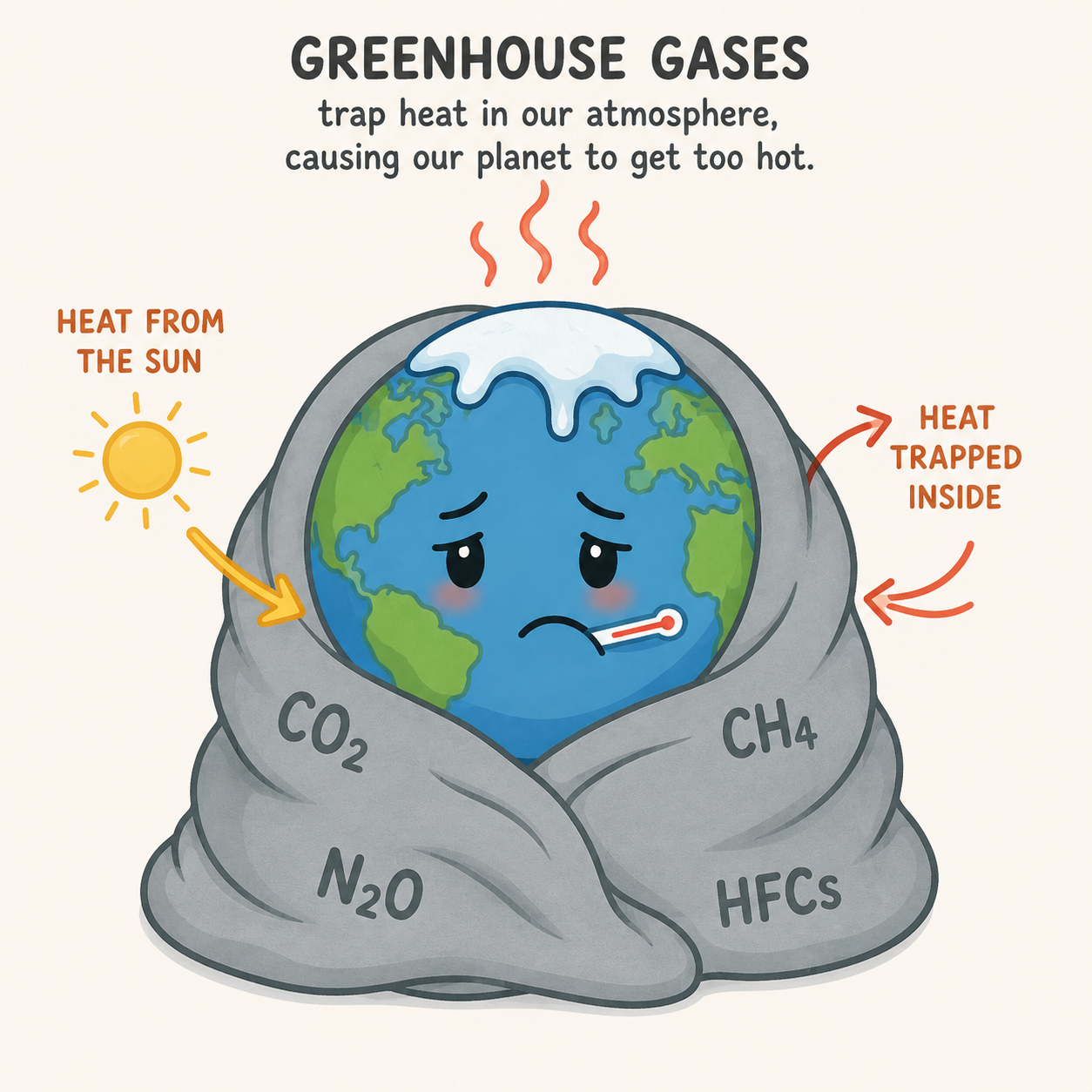
How Is the Climate Energy Hitting You?
The Grand Canyon
That is How Is Climate Energy Hitting You? In the Grand Canyon, on August 29, 2026, the answer was:
As a wall of water, rock, mud and debris moving through the canyon with enough energy to destroy almost everything in its path.
The Grand Canyon Flash Flood Tragedy
A devastating flash flood on August 29, 2026, tore through Grand Canyon National Park, leaving one person dead and approximately 15 people missing or unaccounted for. The disaster struck around 2:30 p.m. following intense rainfall on the Kaibab Plateau. Up to an inch of rain fell in just 20 to 30 minutes, sending an enormous surge of water cascading down the steep terrain into Bright Angel Canyon and the Phantom Ranch area.
The sudden deluge unleashed massive torrents that destroyed nearly every footbridge over Bright Angel Creek, forced the helicopter evacuation of more than 60 hikers and campers, and swept heavy boulders, trees, mud and metal debris into the Colorado River.
Emergency crews recovered the body of a 46-year-old man Sunday evening near Crystal Rapids.
This was not simply a lot of rain.
It was atmospheric water being converted into enormous amounts of kinetic energy in a matter of minutes.
And the conditions that made the landscape so vulnerable are increasingly being shaped by climate change.
Infrastructure and Park Impact
The flash flood caused severe and widespread damage to the inner canyon’s ecosystem and infrastructure.
Water Logistics: The flood ruptured the park’s critical water pipeline, forcing immediate water restrictions. Because the pipeline supplies essential water and fire-suppression capacity, overnight lodging within Grand Canyon National Park was suspended beginning August 31, 2026, while officials addressed the water emergency.
Transit Closures: The Colorado River was closed to river traffic because of hazardous floating debris and metal structures.
Trail Closures: The Black Bridge and Silver Bridge crossings of the Colorado River were closed, as was the North Kaibab Trail.
The destruction occurred extraordinarily quickly.
A few inches of atmospheric water falling over a few minutes became a moving wall of water, carrying enough energy to move massive rocks and debris, destroy bridges and fundamentally reshape portions of the canyon.
The Climate Connection
Monsoon storms are not new to the American Southwest. Flash floods have always occurred in the Grand Canyon. But saying that flash floods are natural does not mean climate change is irrelevant.
Climate change is altering the energy and moisture conditions under which these storms occur—and it is also altering the landscape through which that water moves.
As temperatures rise, the atmosphere can hold substantially more water vapor. The Clausius-Clapeyron relationship tells us that the atmosphere’s capacity to hold water vapor increases by approximately 7% for every 1°C of warming.
More atmospheric moisture means more potential precipitation energy available to intense storms. When that moisture is released rapidly through a powerful convective storm, enormous quantities of water can fall over a very small area in a very short period of time. That is exactly the kind of event that produces flash flooding in steep terrain.
But there is another part of the climate connection.
Wildfire Changes the Landscape
Climate change is also contributing to hotter, drier conditions and an increasingly dangerous wildfire environment across the American West. Wildfire strips vegetation from the landscape and can dramatically alter soil properties. Severe burns can leave soils far less capable of absorbing intense rainfall. Then the monsoon arrives.
Instead of rainfall being intercepted by vegetation and gradually infiltrating the ground, a much larger fraction can become rapid surface runoff.
The sequence becomes brutally efficient:
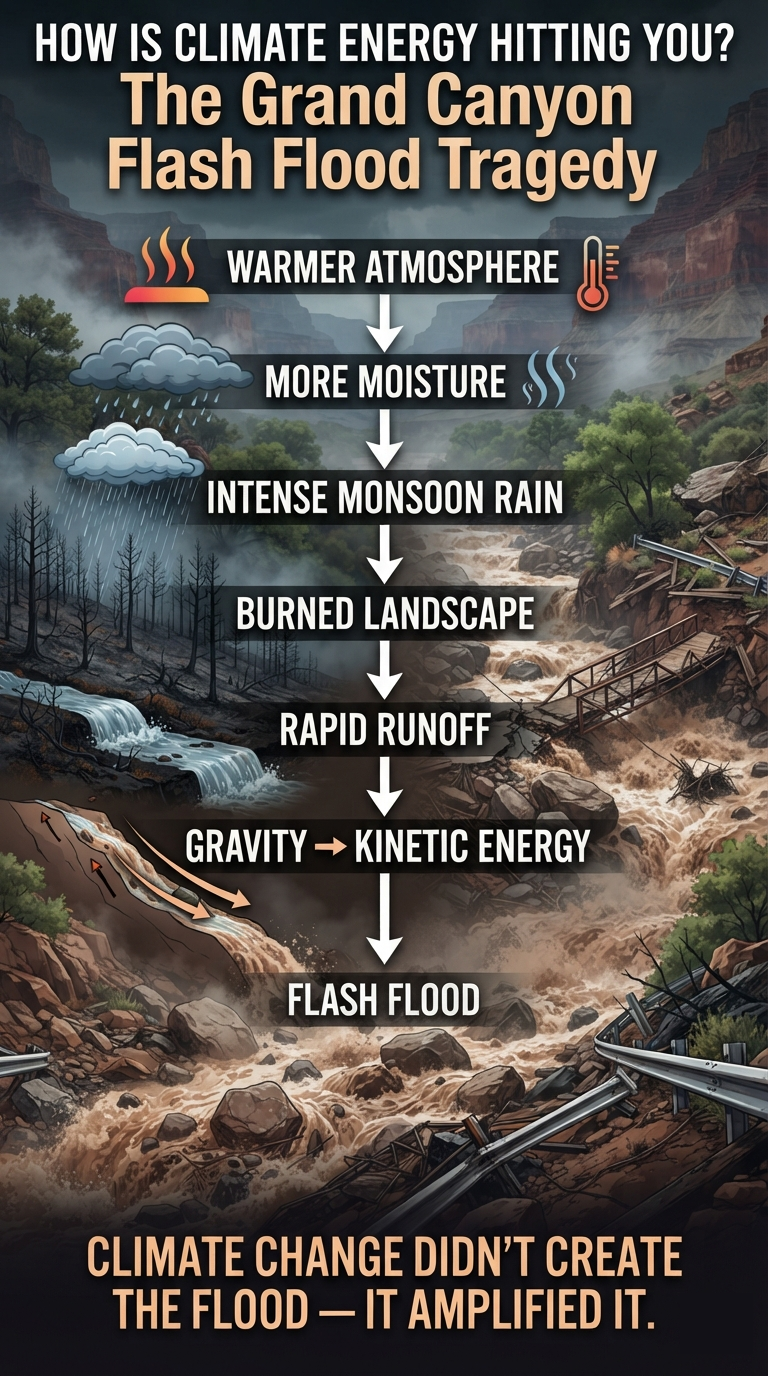
Heat → wildfire → vegetation loss → altered soils → intense rainfall → rapid runoff → flash flood → debris flow.
The National Park Service has specifically warned that areas affected by the Dragon Bravo Fire are particularly vulnerable to flash flooding and debris flows during monsoon storms.
This is where climate energy becomes visible.
When Climate Energy Becomes Kinetic Energy
The atmosphere supplies the water. The landscape supplies the gravitational potential. The canyon converts that potential energy into motion.
Rain falling on the Kaibab Plateau enters steep drainage channels. As the water rapidly descends toward Bright Angel Creek and the Colorado River, gravitational potential energy is converted into kinetic energy.
And the water begins carrying the landscape with it. Rocks. Boulders. Trees. Sediment. Mud. Ash. Metal. Infrastructure.
The result is a fluidized mass capable of enormous destructive force.
A rainfall event lasting only 20 or 30 minutes can therefore produce geological-scale consequences.
Atmospheric energy becomes hydrologic energy.
Hydrologic energy becomes gravitational energy.
Gravitational energy becomes kinetic energy.
Kinetic energy becomes destruction.
That is the physics of the event.
Climate Change Doesn’t Have to Create the Hazard
One of the most important points about climate attribution is that climate change does not have to invent a completely new type of weather event to make the event more dangerous. The Grand Canyon has always experienced monsoons. It has always experienced flash floods. It has always experienced erosion.
But climate change can change the background state of the system.
A warmer atmosphere can contain more moisture. Hotter and drier conditions can increase wildfire risk. Wildfires can remove vegetation and alter soils. A burned watershed can produce much faster runoff. And when extreme precipitation arrives, the same amount of rain—or potentially more rain—can produce a substantially different physical response.
The climate system is therefore not merely changing the weather.
It is changing the conditions under which weather interacts with the landscape.
Hydroclimatic Whiplash
This is one expression of hydroclimatic whiplash: rapid transitions between extreme drying and extreme wetting as increasing climate energy moves through the hydrological cycle.
First comes heat and drying. Then wildfire. Then atmospheric moisture. Then extreme precipitation. Then runoff. Then erosion and debris flows. The landscape can go from severely water-stressed to violently inundated in a matter of hours.
That is the whiplash.
And the Grand Canyon provides an almost perfect natural laboratory for watching the process unfold because steep terrain concentrates and accelerates the movement of water.
The Bigger Picture
The August 29 tragedy is therefore more than another isolated weather disaster. It is a powerful example of how climate energy can move through a coupled atmosphere-landscape system. The atmosphere held the moisture. The storm released it. The burned and altered landscape failed to absorb it. Gravity accelerated it. The canyon concentrated it.And the resulting kinetic energy moved rocks, debris and infrastructure toward the Colorado River.
One person died. Approximately 15 people remained missing or unaccounted for. More than 60 people had to be evacuated by helicopter. Bridges were destroyed. Trails were closed. The Colorado River was closed to river traffic. Critical water infrastructure was ruptured. And the landscape itself was reshaped.
This is what climate change looks like when you follow the energy.
It is not just a number on a temperature chart. It is not just a rising global average. It is not just another hotter summer.
Climate energy moves.
It moves through the atmosphere as heat and moisture.
It moves through storms as precipitation.
It moves through watersheds as runoff.
It moves downhill as gravitational energy.
And eventually, it becomes kinetic energy powerful enough to move boulders, destroy bridges and sweep human beings away.
The Grand Canyon has always been a place where the forces of geology are visible.
On August 29, 2026, those forces became brutally visible again.
Climate change didn’t create the Grand Canyon flash flood—it amplified the energy that drove it.
A warmer, more energetic climate can make the atmospheric and landscape conditions that produce such disasters more extreme.
And when that energy is released all at once, the question is no longer simply:
How much rain fell?
The more important question is:
How much energy did that rain unleash?
That is How Is Climate Energy Hitting You?
In the Grand Canyon, on August 29, 2026, the answer was:
As a wall of water, rock, mud and debris moving through the canyon with enough energy to destroy almost everything in its path.
Taking the Temperature of Climate Change: How Is Climate Energy Hitting You?
Easy-to-Read Resources