The Future Is Not Yet Written: Why Human Actions Still Matter in a World of Climate Tipping Points
Daniel Brouse¹ and Sidd Mukherjee²
June 2026
¹Independent Climate Researcher, Economist
²Physicist
How long do you think it takes to make six-million-year-old ice?
How hard will our generation make the struggle to thrive become a struggle merely to survive?
We determine the future today. Choose wisely.
Introduction
Unfortunately, we have already lost things that cannot be replaced or restored.
One of my favorite questions for people who dismiss the significance of climate change is simple:
How long do you think it takes to make six-million-year-old ice?
The answer, of course, is millions of years.
When ancient glaciers, ice sheets, ecosystems, coral reefs, forests, and species disappear, they do not return on timescales relevant to human civilization. Some losses are effectively permanent from the perspective of any society that will exist over the coming centuries or even millennia.
The reality is that many of the changes now unfolding across the Earth system cannot be reversed within a human lifetime. Yet this does not mean that the future is predetermined or that human actions no longer matter.
In fact, they matter enormously.
The Continued Role of Human Activities
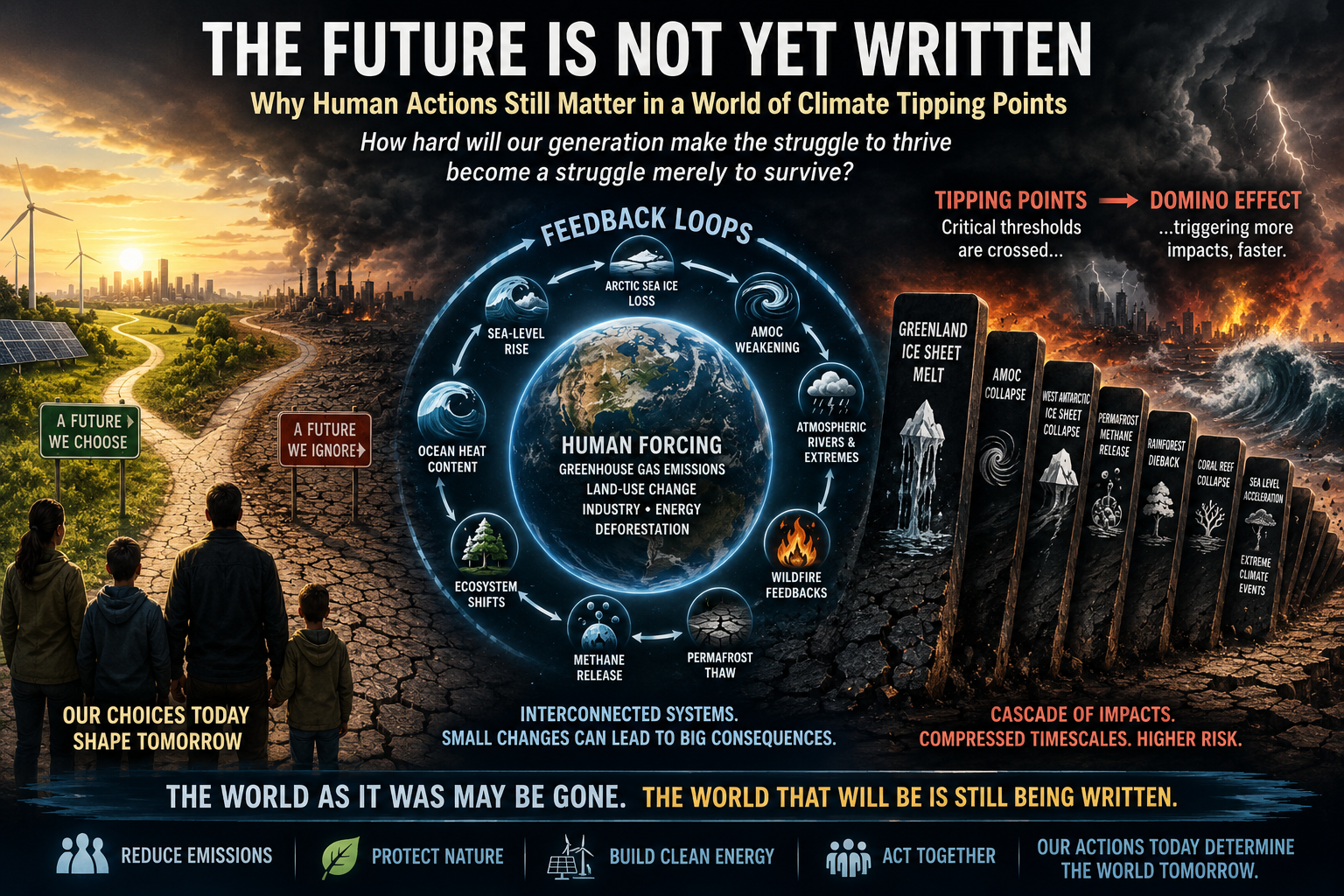
A growing body of evidence suggests that Earth's major climate systems are increasingly interconnected through a network of reinforcing feedback loops. Sea-level rise, polar amplification, ocean heat content, marine heatwaves, atmospheric rivers, Rossby-wave persistence, AMOC weakening, wildfire feedbacks, permafrost thaw, methane release, ecosystem shifts, and climatic whiplash all appear to be interacting in ways that increase complexity and reduce predictability.
Through our analysis of highly coupled nonlinear systems, we remain convinced that human forcing is still the primary driver and determinant of the ultimate outcome.
Many subsystems appear to be approaching—or perhaps have already crossed—important thresholds. The interactions among these systems make prediction increasingly difficult, and cascading responses are a legitimate concern. In a highly interconnected system, a seemingly modest perturbation can propagate through multiple pathways and produce consequences far larger than the original disturbance.
This possibility is precisely what makes climate change so dangerous.
Has the Climate System Become Autonomous?
An important question is whether humanity has already pushed the climate system beyond a point where it will continue to deteriorate regardless of future actions.
We are not yet convinced that this is the case.
The atmosphere, oceans, cryosphere, and biosphere are all responding to an energy imbalance that human activities continue to create. Greenhouse gas concentrations continue to rise. Fossil fuel combustion, land-use change, industrial processes, and ecosystem degradation continue to alter the balance of incoming and outgoing energy.
In this context, the strength, duration, and trajectory of human forcing still matter enormously.
While some tipping elements may already be in motion, there is little evidence that all future outcomes are now entirely independent of human influence. Rather, current observations suggest that human activities remain one of the most important variables governing how rapidly the climate system changes and how severe the consequences ultimately become.
Will the World Ever Be as It Was?
That does not appear possible.
The climate of the twentieth century is gone.
Many glaciers are retreating beyond recovery. Ancient ice is melting. Species are disappearing. Ecosystems are shifting. Ocean chemistry is changing. Sea levels will continue rising for centuries, and some changes already underway will persist for generations.
The question is no longer whether we can preserve the world exactly as it was.
We cannot.
The more important question is whether we can influence the world that follows.
Can We Influence How Bad It Gets?
The answer remains yes.
This is why continued focus on the acceleration of climate change is so important.
If human activities remain the dominant forcing mechanism, then reducing that forcing can still alter the trajectory of the system, even if we can no longer prevent many of the changes already set in motion.
The difference between a world that warms another degree and one that warms several more degrees is not an academic distinction.
It is the difference between:
- More manageable versus catastrophic sea-level rise.
- Regional crop disruptions versus widespread food insecurity.
- Occasional extreme heat versus chronic heat stress.
- Increased adaptation costs versus systemic economic disruption.
- Partial ecosystem loss versus widespread ecological collapse.
Small differences in average temperature translate into enormous differences in impacts because climate risks do not increase linearly. They compound through feedbacks, thresholds, and cascading interactions.
The Moral Question
Ultimately, climate change is not simply an environmental issue. It is a question of human welfare, opportunity, and survival.
The decisions made today will determine the quality of life experienced by many generations to come. They will influence access to food, water, shelter, health, security, and economic stability. They will shape the future of coastal communities, agricultural regions, and ecosystems around the world.
Perhaps the most important question is not whether climate change can be stopped entirely.
It is this:
How hard will our generation make the struggle to thrive become a struggle merely to survive?
The future may no longer be capable of becoming what it once could have been. But it is still capable of becoming far better—or far worse—depending on the choices humanity makes today.
The world as it was may be gone.
The world that will be is still being written.
We determine the future today. Choose wisely.
Feedback Loops → Tipping Points → Domino Effect
Feedback loops amplify climate change and can push interconnected Earth systems past critical tipping points. As tipping points are crossed, they can trigger additional feedback loops and destabilize other climate systems. This cascading "Domino Effect" compresses timescales, accelerates change, and increases the risk of rapid, nonlinear climate transformations.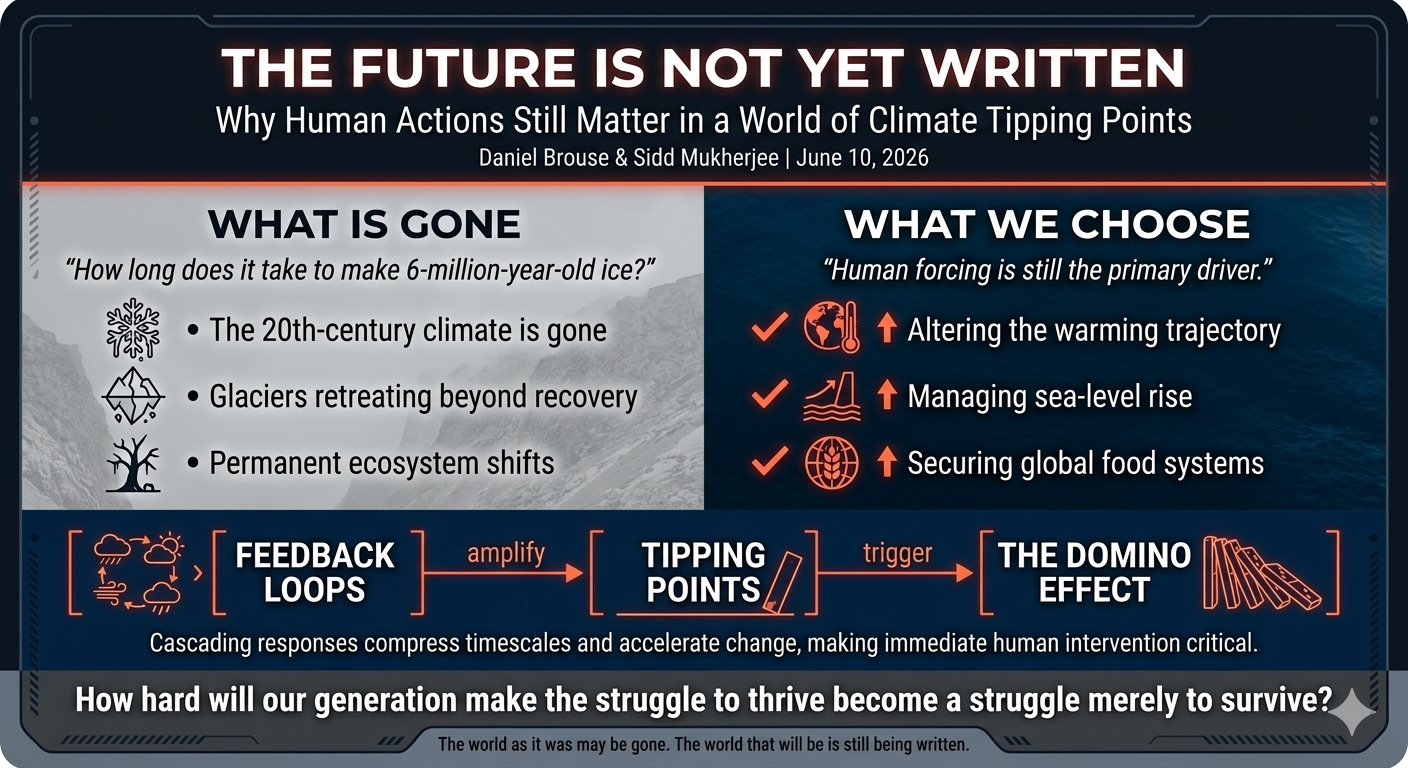
* Our probabilistic, ensemble-based climate model — which incorporates complex socio-economic and ecological feedback loops within a dynamic, nonlinear system — projects that global temperatures are becoming unsustainable this century. This far exceeds earlier estimates of a 4°C rise over the next thousand years, highlighting a dramatic acceleration in global warming. We are now entering a phase of compound, cascading collapse, where climate, ecological, and societal systems destabilize through interlinked, self-reinforcing feedback loops.