How Is the Climate Energy Hitting You?
Disruption in Penn’s Sylvania
Climate energy is reaching Pennsylvania’s forests not simply as higher temperatures, but as changes in timing, duration, intensity, and ecological relationships.
Phenology: The Study of Biological Lifecycle Events
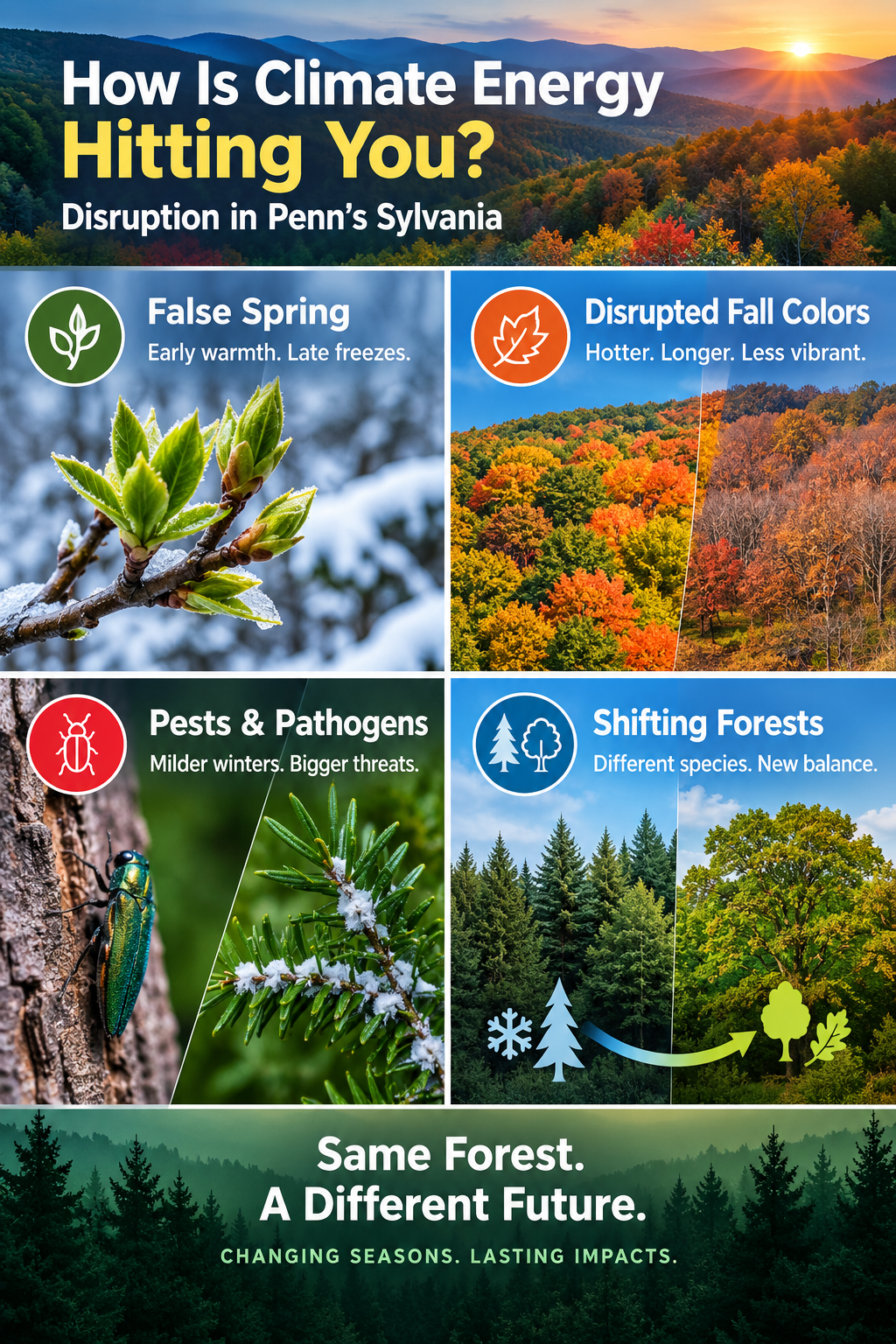
Pennsylvania’s forests are being disrupted by accelerating seasonal expansion—the lengthening of warm-season conditions into spring and autumn. The change is doing more than making individual days warmer. It is altering the timing of tree life cycles, increasing ecological vulnerabilities, and shifting which species can successfully survive and reproduce.
As summer-like conditions expand into early spring and late autumn, biological events known as phenology are increasingly occurring outside the historical weather conditions to which Pennsylvania’s forests evolved.
The result is a cascade of ecological disruptions.
1. The “False Spring” Trap
Warmer late winters and early springs can trigger tree activity prematurely.
The process:
Early warmth stimulates sap flow and causes trees to break dormancy and open their buds earlier than their historical timing.
The impact:
When freezing temperatures return, newly developed leaves, flowers, and fruit are vulnerable to frost damage. The result can be severe losses to both natural vegetation and agriculture.
Pennsylvania experienced a striking example during the spring 2026 freeze, when unusually early-season warmth was followed by sharp freezes. Some Pennsylvania orchards reported losses of 70% to 90% for certain fruit crops.
The problem is not simply that spring is warmer. It is that spring is becoming less predictable relative to the biological clocks of trees.
2. Disrupted Fall Foliage Cycles
The expansion of summer-like heat into September and October can delay or disrupt the transition to autumn.
The process:
Trees respond to shortening day length and cooler temperatures by reducing chlorophyll production. The resulting chemical changes produce the familiar autumn colors.
The impact:
When unusually warm conditions persist, particularly when combined with late-summer drought, trees can remain under prolonged heat and water stress.
Instead of a gradual transition from green to brilliant autumn colors, stressed foliage may turn brown, shrivel, or drop prematurely.
Pennsylvania’s famous fall foliage season can therefore become shorter, less synchronized, and more variable from year to year.
3. Pests and Pathogens Thrive
Shorter, milder winters combined with longer, warmer summers can create more favorable conditions for many forest pests.
The eastern hemlock (Tsuga canadensis)—Pennsylvania’s official state tree—is particularly vulnerable. The invasive hemlock woolly adelgid has devastated hemlock populations throughout the eastern United States. Warmer conditions can increase winter survival and permit the insect to expand into areas where historically colder conditions provided greater limitations.
The emerald ash borer presents another example. This invasive beetle has killed millions of ash trees across North America, including Pennsylvania’s native ash species. Longer warm seasons can accelerate insect development and increase the number of generations that can occur during a year.
Climate energy therefore interacts with existing biological threats: warming does not have to create a pest or pathogen to make the damage worse—it can make an existing threat more effective.
4. Shifting Forest Demographics
As Pennsylvania’s growing season lengthens and temperatures rise, the climatic conditions suitable for different tree species are shifting.
The result is not an overnight replacement of Pennsylvania forests. Instead, the competitive balance among species can gradually change as seedlings establish, mature trees experience increasing stress, and disturbances create opportunities for different species to expand.
In some locations, Pennsylvania’s forests may increasingly favor species associated with warmer regions, while cool-adapted species face greater stress.
| Cool-Loving Species Under Greater Stress | Heat-Tolerant or More Adaptable Species |
|---|---|
| Sugar maple | Red oak |
| American beech | White oak |
| Yellow birch | Chestnut oak |
| Eastern hemlock | Hickories |
| Other northern hardwoods | Some southern Appalachian species |
The transition will vary considerably by elevation, soil, moisture, latitude, and local microclimate. Forest composition is therefore likely to change unevenly across the Commonwealth rather than shifting uniformly from one species group to another.
The Larger Pattern
These changes are interconnected.
Earlier spring → premature growth → late-freeze vulnerability
Longer summer → heat and drought stress → weakened trees
Milder winter → greater pest survival → increased forest damage
Warmer autumn → delayed or disrupted dormancy → altered foliage cycles
Repeated stress → changing regeneration → shifting forest composition
Pennsylvania’s forests are adapted to seasonal variation. The emerging problem is that the seasons themselves are changing.
Climate energy is reaching Pennsylvania’s forests not simply as higher temperatures, but as changes in timing, duration, intensity, and ecological relationships.
The forest that future generations inherit may therefore look different from the forest Pennsylvania has known for centuries—not because one species suddenly disappears, but because the entire system is being gradually reorganized.
The seasons are moving. The forest is responding.
Accelerating Seasonal Expansion: Forever Summer
How Is Climate Energy Hitting You?
Tree Extinction Due to Human Induced Environmental Stress
Easy-to-Read Resources
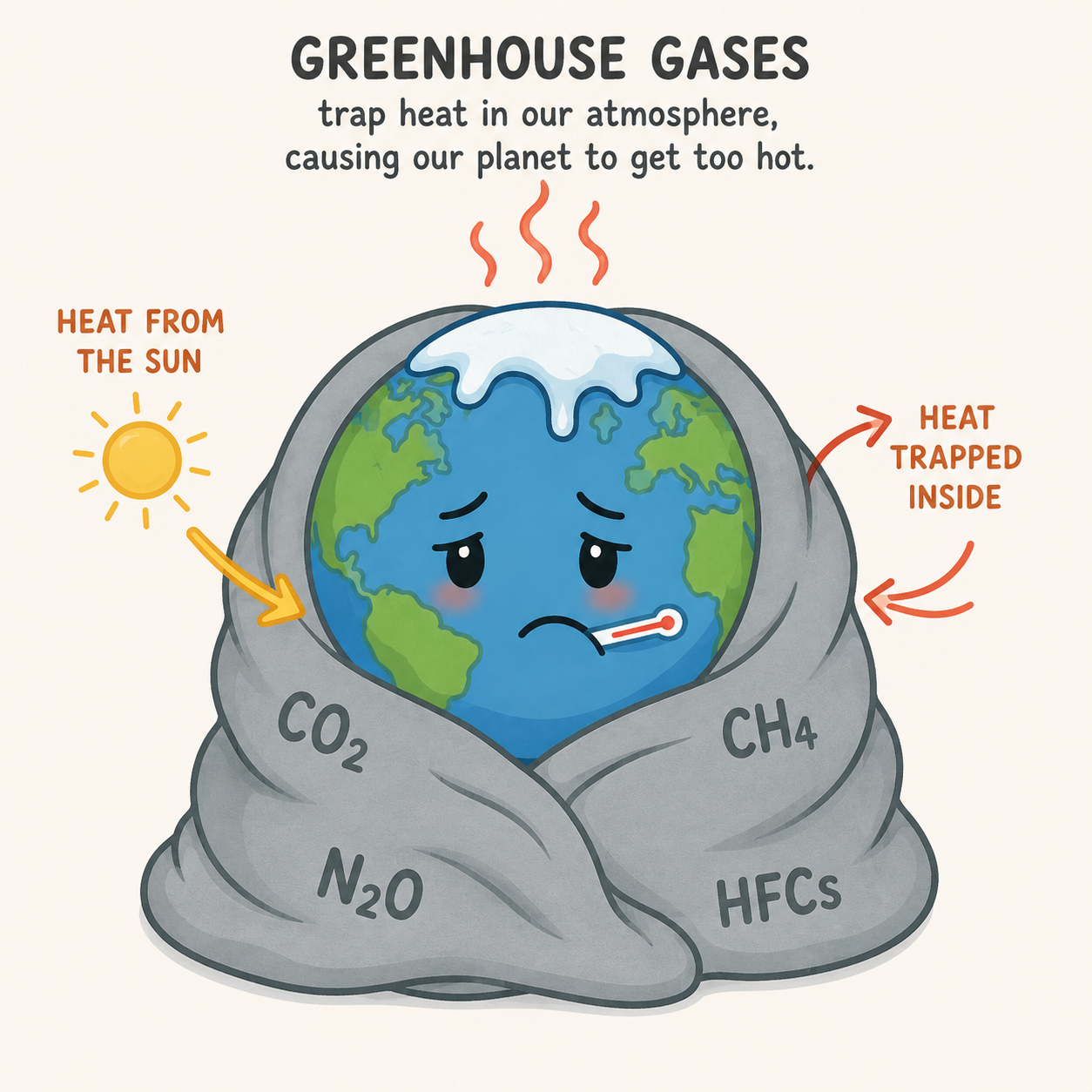
→ The Hitchhiker’s Guide to Climate Change
For the basics: Climate Change Simplified
Climate Change: What Can I Do?
Anthropogenic Global Warming 101
Feedback Loops →
Tipping Points →
Acceleration →
Domino Effect
Feedback loops amplify climate change and can push interconnected Earth systems past critical tipping points. As tipping points are crossed, they can trigger additional feedback loops and destabilize other climate systems. This cascading "Domino Effect" compresses timescales, accelerates change, and increases the risk of rapid, nonlinear climate transformations.