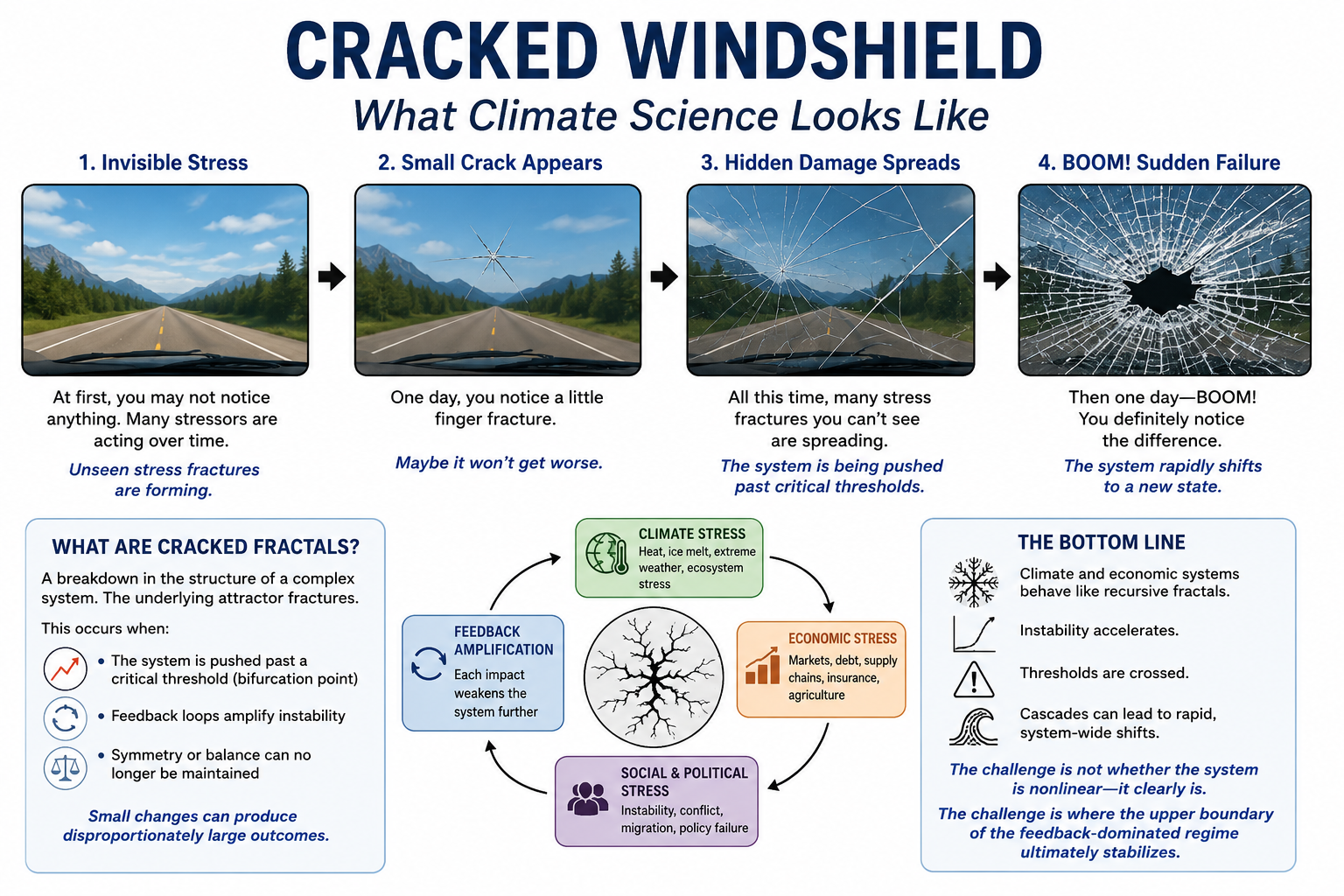
What does climate change look like?
In many ways, it resembles a cracked windshield.
At first, you may not notice anything at all. Time passes. The damage appears minor or even invisible. Then one day, a small fracture catches your eye — just a tiny finger crack stretching across the glass.
You think:
“Maybe it won’t get worse.”
But during all that time, unseen stress fractures have already been spreading beneath the surface. Temperature changes, vibration, pressure, and repeated impacts continue weakening the structure. The windshield may appear stable right up until the moment it suddenly fails.
Then one day:
BOOM.
The entire system changes.
Climate systems often behave the same way.
The graphic is a simplified representation of an extraordinarily complex system. Nevertheless, it provides a familiar visual analogy that helps make nonlinear climate dynamics easier to understand.
Up through the 1990s, we were largely in Frame 1 — invisible stress. The underlying pressures were building, but most of the damage remained hidden from view.
By the early 2000s, the first visible cracks began to emerge. Evidence of accelerating climate change, ecological degradation, and feedback amplification became increasingly difficult to ignore. Even then, many observers assumed the system might stabilize on its own and argued that the damage would remain limited.
Today, we are in the phase where hidden fractures are propagating throughout the system and becoming increasingly apparent. The accumulating damage can now be observed across multiple interconnected indicators, including rising temperatures, ocean heat content, ice-sheet instability, biodiversity loss, extreme weather, and economic disruption. It is becoming clear that the system is not simply going to repair itself.
The central question is no longer whether the cracks exist, but how rapidly the system moves toward the next phase — the point where cascading failures become unavoidable and the damage accelerates dramatically.
Because this is a nonlinear system dominated by interacting feedback loops, historical timelines provide only limited guidance. As stress accumulates, change can occur gradually for long periods and then suddenly accelerate, making future conditions arrive much faster than past trends alone would suggest.
A “cracked fractal” describes the breakdown of a complex system that once maintained a relatively stable internal structure.
Traditional fractals exhibit self-similarity — repeating patterns that remain bounded within a recognizable range of behavior. But under sufficient stress, the underlying attractor of the system begins to fracture. The system no longer returns to its previous equilibrium.
Instead, instability begins propagating through the network itself.
This breakdown often occurs when:
At that stage, small disturbances can produce disproportionately large outcomes.
In climate science, cracked fractals may manifest as:
The challenge is that coupled climate systems do not behave linearly. They increasingly exhibit characteristics similar to recursive fractal systems:
The question is no longer whether the climate system is nonlinear. That is already evident in the observational data.
The deeper uncertainty is where the upper boundary of the feedback-dominated system ultimately stabilizes — and whether critical subsystems fracture faster than humanity can adapt.
The same dynamics apply to economic systems.
Financial markets, supply chains, energy systems, insurance structures, and sovereign debt networks all depend upon relative stability and predictable feedback behavior. Under sufficient stress, these systems can also enter cracked-fractal regimes where volatility compounds recursively.
Examples include:
What appears stable on the surface may already contain invisible structural fractures spreading through the underlying system.
By the time the cracks become obvious, the destabilization process may already be well underway.
Complex systems rarely fail in isolation.
Climate stress amplifies economic stress. Economic stress weakens political stability. Political instability undermines coordinated mitigation and adaptation. Ecological degradation further weakens resilience.
The result is a coupled climate–economic–ecological system increasingly vulnerable to synchronized failure cascades.
Like a cracked windshield, the system may appear intact right up until the moment the fractures suddenly connect.
* Our probabilistic, ensemble-based climate model — which incorporates complex socio-economic and ecological feedback loops within a dynamic, nonlinear system — projects that global temperatures are becoming unsustainable this century. This far exceeds earlier estimates of a 4°C rise over the next thousand years, highlighting a dramatic acceleration in global warming. We are now entering a phase of compound, cascading collapse, where climate, ecological, and societal systems destabilize through interlinked, self-reinforcing feedback loops.
We examine how human activities — such as deforestation, fossil fuel combustion, mass consumption, industrial agriculture, and land development — interact with ecological processes like thermal energy redistribution, carbon cycling, hydrological flow, biodiversity loss, and the spread of disease vectors. These interactions do not follow linear cause-and-effect patterns. Instead, they form complex, self-reinforcing feedback loops that can trigger rapid, system-wide transformations — often abruptly and without warning. Grasping these dynamics is crucial for accurately assessing global risks and developing effective strategies for long-term survival.