Rossby Waves, Climatic Whiplash, and the Nonlinear Destabilization of Atmospheric Circulation
Abstract
Rapid Arctic amplification, accelerating Antarctic ice loss, and weakening ocean circulation are increasingly destabilizing Earth’s atmospheric circulation systems. One of the clearest manifestations of this destabilization is the amplification and persistence of Rossby waves — large-scale meanders in the jet stream that regulate heat transport, storm movement, and regional weather stability.
Historically, strong equator-to-pole temperature gradients maintained a relatively fast, organized jet stream and stable atmospheric circulation regime. However, as polar regions warm substantially faster than the global average, these gradients are weakening. The result is a slower, more amplified, and increasingly persistent jet stream characterized by stronger atmospheric blocking, prolonged weather extremes, and increasing climatic whiplash.
This paper examines the relationship between Rossby-wave amplification, Arctic amplification, Sudden Stratospheric Warming (SSW) events, and nonlinear atmospheric destabilization within the framework of the Nonlinear Acceleration Hypothesis. Evidence suggests that atmospheric persistence and circulation instability may now be compressing on nonlinear timescales, contributing to unprecedented heat domes, stalled flooding events, prolonged droughts, polar intrusions, and compound climate disasters.
1. Introduction
Historically, large temperature differences between the tropics and the polar regions helped maintain a fast-moving, organized jet stream in the upper atmosphere. These thermal gradients also supported the Atlantic Meridional Overturning Circulation (AMOC), one of the Earth’s most important oceanic heat redistribution systems.
Together, the jet stream and AMOC helped:
- redistribute planetary heat,
- reduce atmospheric stagnation,
- moderate regional climate variability,
- and maintain relatively stable seasonal patterns.
However, this equilibrium is increasingly destabilizing.
The Arctic is now warming approximately four times faster than the global average, while Antarctica is experiencing accelerating ice-sheet destabilization and record cryospheric loss. As these polar regions warm disproportionately, the equator-to-pole temperature gradient weakens.
This weakening fundamentally alters atmospheric dynamics.
2. Jet Stream Destabilization and Rossby-Wave Amplification
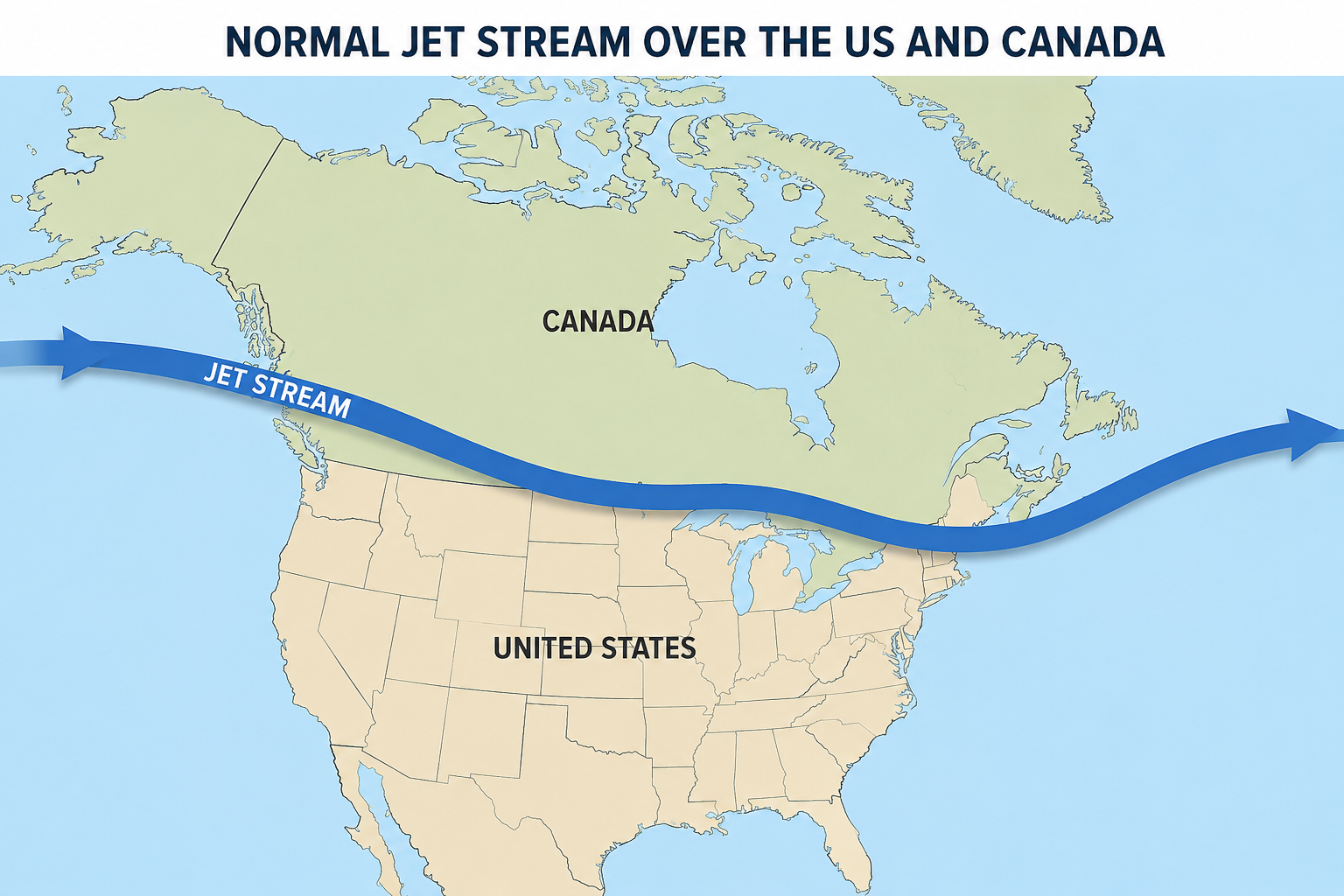
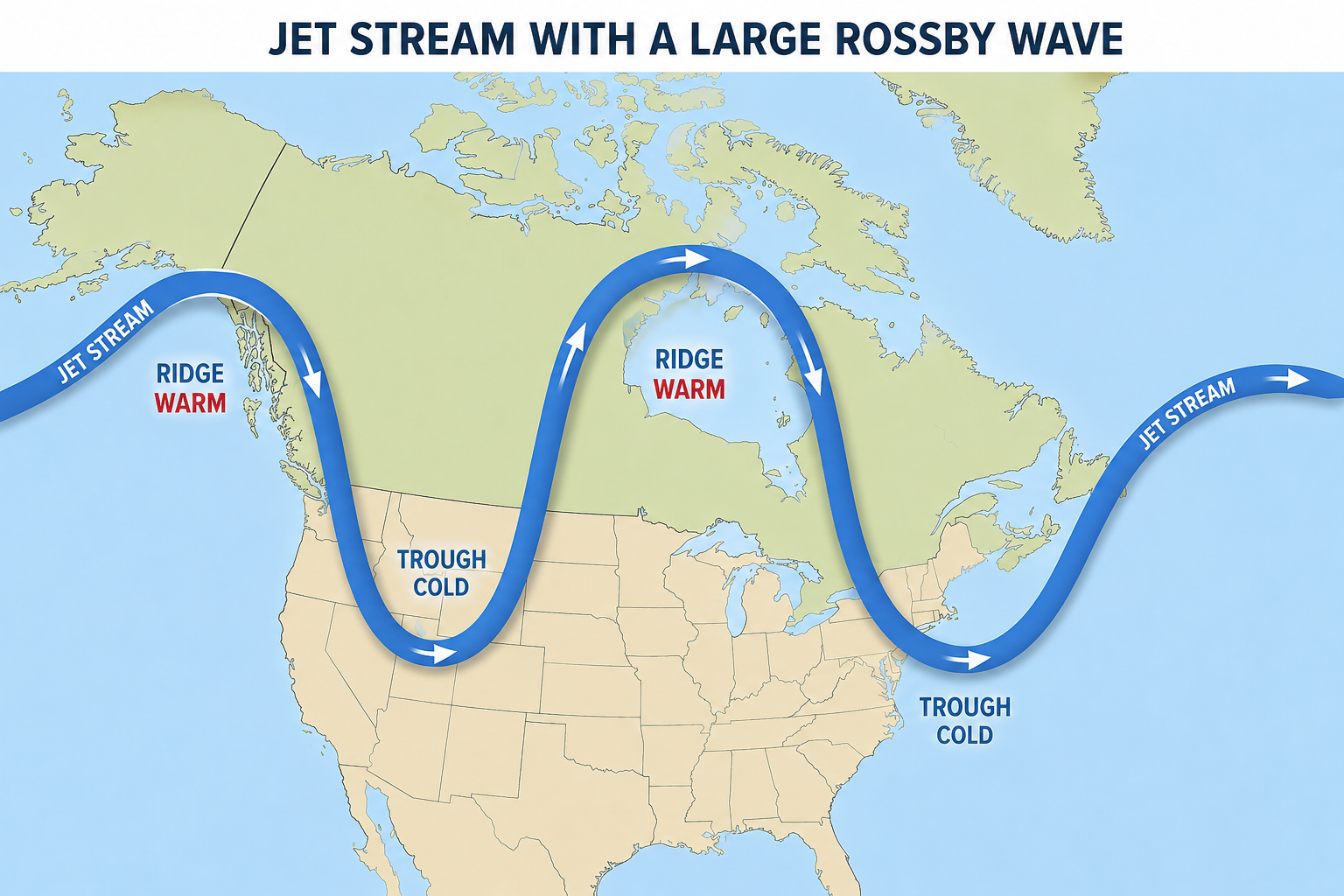
Under historically stable conditions, the jet stream generally flowed in a relatively progressive west-to-east pattern across the United States and southern Canada.
As thermal gradients weaken:
- zonal winds slow,
- the jet stream elongates,
- Rossby waves become more amplified,
- wave propagation slows,
- and atmospheric blocking becomes increasingly persistent.
The result is a circulation regime characterized by “stuck” weather patterns and amplified climatic extremes.
Observed Consequences Include:
- persistent heat domes,
- prolonged cold-air outbreaks,
- stalled storm systems,
- multi-day severe weather outbreaks,
- extreme rainfall persistence,
- prolonged droughts,
- and compound climate disasters.
Many of the most extreme recent weather events globally exhibit these characteristics.
Omega Block Ω
An omega block is essentially an extreme, highly amplified Rossby-wave pattern where the jet stream bends into the shape of the Greek letter Ω. These blocking patterns slow atmospheric circulation dramatically and can “lock” weather systems in place for days or even weeks.
That is a major factor behind persistent heat domes in the central U.S. Instead of weather systems moving progressively west-to-east as they historically did, the amplified wave stalls, allowing heat to continuously build beneath the ridge while storms and cooler air are diverted around it.
As these amplified Rossby waves meander around the hemisphere, similar blocking impacts can propagate into other regions at comparable latitudes — including the UK, Europe, and parts of Asia. That is why we increasingly see synchronized extremes globally: prolonged heatwaves in one region while other areas experience stalled flooding, cold intrusions, or drought.
Sudden Stratospheric Warming events, Arctic amplification, weakening thermal gradients, and Rossby-wave amplification are all interconnected components of the same broader atmospheric destabilization process.
3. Climatic Whiplash
One of the defining signatures of Rossby-wave amplification is climatic whiplash — rapid transitions between opposing weather extremes.
Examples include:
- severe drought followed by catastrophic flooding,
- unseasonable warmth followed by polar intrusions,
- prolonged stagnation followed by explosive cyclogenesis,
- and abrupt oscillations between heatwaves and cold outbreaks.
These transitions reflect increasing instability within atmospheric circulation systems rather than isolated weather anomalies.
The atmosphere increasingly appears to be shifting from:
a fast-moving progressive flow regime
toward:
a slower, more amplified, and more persistent nonlinear circulation regime.
4. Sudden Stratospheric Warming Events
Sudden Stratospheric Warming (SSW) events represent another major component of atmospheric destabilization.
During SSW events:
- polar stratospheric temperatures can increase by as much as 50°C within only a few days,
- the polar vortex weakens or destabilizes,
- and Arctic air masses can plunge far southward while anomalous warmth penetrates polar regions.
These disruptions increase atmospheric volatility and are increasingly associated with:
- severe winter storms,
- tornado outbreaks,
- bomb cyclones,
- prolonged southern cold spells,
- historic flooding,
- and early-season heat extremes.
As atmospheric circulation destabilizes, SSW behavior itself may become increasingly nonlinear and persistent.
5. The Nonlinear Acceleration Hypothesis
Rossby waves have always existed. The critical issue is not the mere existence of Rossby waves, but rather the observed shift toward:
- larger amplitudes,
- slower propagation,
- longer persistence,
- and stronger atmospheric blocking.
Within the framework of the Nonlinear Acceleration Hypothesis, atmospheric destabilization follows nonlinear dynamics:
Small increases in forcing can therefore generate disproportionately large responses once critical thresholds are crossed.
Interacting feedback systems include:
- Arctic amplification,
- weakening thermal gradients,
- sea-ice decline,
- ocean circulation instability,
- latent heat amplification,
- land-atmosphere coupling,
- drought feedbacks,
- and altered planetary-wave resonance.
The result is increasingly unstable atmospheric behavior.
6. Compression of Atmospheric Doubling Times
Evidence suggests that atmospheric persistence and Rossby-wave amplification may now be compressing on increasingly short timescales.
Estimated effective doubling intervals for persistence and intensity metrics have evolved approximately as follows:
| Period | Approximate Doubling Time |
|---|---|
| 1990s | ~40 years |
| 2000s | ~20 years |
| 2010s | ~10 years |
| Early 2020s | ~5 years |
| Mid-2020s | ~2–3 years |
Using:Td(t)=k(t)ln(2)
where:
- Td(t) = doubling time,
- k(t) = time-dependent growth constant,
- ln(2) = natural logarithm of 2,
the implied atmospheric instability growth constant rises nonlinearly as doubling intervals compress.
7. Approximate Decadal Amplification
If effective atmospheric doubling intervals approach approximately 2–3 years:
Over One Decade:
2(10/2.5)=24=16
This implies a potential:
~16-fold increase in persistence or intensity metrics per decade.
Using a 2-year interval:2(10/2)=25=32
Using a 1.5-year interval:2(10/1.5)≈26.67≈102
These calculations illustrate why nonlinear atmospheric destabilization can appear gradual for decades before suddenly producing:
- unprecedented heat domes,
- stalled megafloods,
- prolonged droughts,
- polar intrusions,
- and compound climate catastrophes
within compressed timescales.
Estimated Rossby Wave Trend Evolution
8. Atmospheric Blocking and Extreme Weather Persistence
The most significant climate signal may not simply be “more storms” or “more Rossby waves.”
Rather, it is the increasing persistence of atmospheric patterns.
Persistent blocking systems dramatically increase:
- heatwave duration,
- rainfall accumulation,
- drought intensity,
- wildfire risk,
- agricultural disruption,
- and infrastructure stress.
The atmosphere is increasingly exhibiting quasi-stationary circulation patterns capable of locking regions into prolonged extremes.
This persistence amplifies societal, ecological, and economic vulnerability.
9. Conclusion
The destabilization of atmospheric circulation represents one of the clearest emerging manifestations of nonlinear climate acceleration.
Rossby-wave amplification, atmospheric blocking, Arctic amplification, and Sudden Stratospheric Warming events are increasingly interacting within a destabilizing Earth system characterized by:
- weakening thermal gradients,
- slower circulation,
- amplified persistence,
- and accelerating climatic whiplash.
The central issue is no longer whether atmospheric instability is increasing, but rather:
how rapidly nonlinear feedback systems may continue compressing climatic timescales.
The emerging evidence suggests that Earth’s atmospheric circulation is transitioning away from historically stable progressive flow patterns toward a slower, more amplified, and increasingly nonlinear regime capable of generating unprecedented compound climate extremes.
* Our probabilistic, ensemble-based climate model — which incorporates complex socio-economic and ecological feedback loops within a dynamic, nonlinear system — projects that global temperatures are becoming unsustainable this century. This far exceeds earlier estimates of a 4°C rise over the next thousand years, highlighting a dramatic acceleration in global warming. We are now entering a phase of compound, cascading collapse, where climate, ecological, and societal systems destabilize through interlinked, self-reinforcing feedback loops.
We examine how human activities — such as deforestation, fossil fuel combustion, mass consumption, industrial agriculture, and land development — interact with ecological processes like thermal energy redistribution, carbon cycling, hydrological flow, biodiversity loss, and the spread of disease vectors. These interactions do not follow linear cause-and-effect patterns. Instead, they form complex, self-reinforcing feedback loops that can trigger rapid, system-wide transformations — often abruptly and without warning. Grasping these dynamics is crucial for accurately assessing global risks and developing effective strategies for long-term survival.